Breaking the Event Loop Bottleneck: Handling CPU-Intensive Tasks in Node.js
- February 16, 2026
- 5 min read

SEO and AI Search Specialist
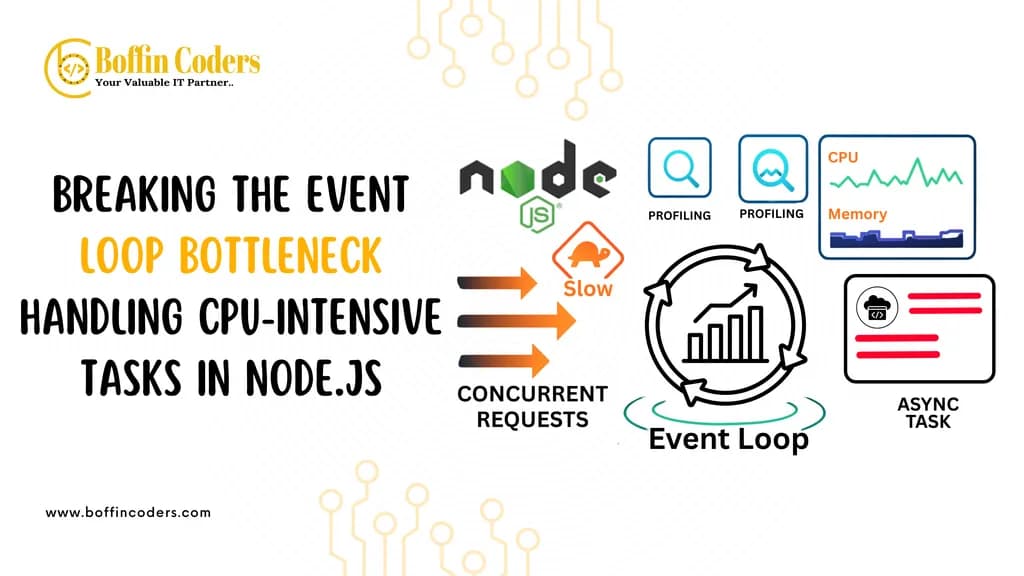
If you are new to Node.js, you’ve probably heard this sentence many times:
“Node.js is single-threaded but very fast.”
This sounds confusing at first. How can something be single-threaded and still handle thousands of users? And why do people warn you so strongly about CPU‑intensive tasks like image processing?
In this blog, we’ll explain everything step by step, using real-life examples, simple mental models, and clear code explanations so you understand not just what to do, but why it works behind the scenes.
A Real-Life Example: The Single Cashier Problem
Imagine a small coffee shop with:
- One cashier
- A long line of customers
Each customer places an order quickly: - “One coffee” - “One tea” - “One sandwich”
The cashier takes the order and immediately asks the barista to prepare it. While the drink is being made, the cashier moves on to the next customer.
This is how Node.js works with I/O tasks (database calls, API requests, file reads).
Now imagine one customer says:“I want you to roast the beans, grind them, and brew the coffee yourself - right now.”
The cashier stops everything and starts doing this long task.
What happens? - The line stops moving - Other customers wait - Everyone gets frustrated.
This is exactly what happens when CPU‑intensive code blocks the Node.js event loop.
What Is the Event Loop (In Simple Terms)?
The event loop is like that cashier.
- It can do one thing at a time.
- It quickly switches between small tasks.
- It works best when tasks finish fast.
Node.js is excellent when tasks: - Are asynchronous - Spend time waiting (I/O) - Don’t keep the CPU busy for long.
But when JavaScript runs a long calculation, the event loop cannot switch to anything else.
What Does “Blocking” Really Mean?
Blocking does not mean your app crashes.
It means: -
- Requests wait longer.
- APIs feel slow.
- The app looks frozen.
Simple blocking example:
1function heavyTask() {
2  let sum = 0;
3  for (let i = 0; i < 1e8; i++) {
4    sum += i;
5  }
6  return sum;
7}
8console.log('Start');
9heavyTask();
10console.log('End');
What’s happening behind the scenes?
- `heavyTask()` starts running
- JavaScript enters the loop
- The event loop is **busy until the loop finishes**
- No other code can run during this time
If this code runs inside an API request, all other users must wait.
Why Image Processing Is a Common Problem
Image processing often involves: - Resizing pixels - Changing formats - Compressing data
These operations: - Use a lot of CPU - Run for many milliseconds (or seconds) - Are usually written as loops.
If done on the main thread, they behave like the cashier doing all the work alone.
First Fix: Breaking Work into Smaller Pieces
Before introducing threads, Node.js allows us to pause our work briefly and let other tasks run.
This is called yielding to the event loop.
Example: Chunking work
1function processInChunks(items) {
2  let index = 0;
3
4  function runChunk() {
5    const start = Date.now();
6
7    while (index < items.length && Date.now() - start < 10) {
8      items[index]();
9      index++;
10    }
11
12    if (index < items.length) {
13      setImmediate(runChunk);
14    }
15  }
16
17  runChunk();
18}
What’s happening behind the scenes?
- We do a **small amount of work**
- We stop after ~10ms
- `setImmediate` tells Node.js:
“Run this again, but let others go first”
This keeps the app responsive.
Why this is not enough
- The work still runs on one thread.
- Total CPU time is unchanged
- Heavy tasks still slow the system
Real Solution: Worker Threads
Worker Threads allow Node.js to hire another cashier.
- Main thread → handles users
- Worker thread → does heavy work
Both work at the same time.
Worker Threads: Simple Mental Model
Think of worker threads as:
“A separate Node.js instance running in parallel”They:
- Have their own event loop
- Run JavaScript independently
- Communicate via messages
Basic Worker Thread Example
1//main.js
2const { Worker } = require('worker_threads');
3
4function runWorker(number) {
5  return new Promise((resolve, reject) => {
6    const worker = new Worker('./worker.js', {
7      workerData: number
8    });
9
10    worker.on('message', resolve);
11    worker.on('error', reject);
12  });
13}
14
15(async () => {
16  console.log('Main thread is free');
17  const result = await runWorker(1e8);
18  console.log('Result:', result);
19})();1//worker.js
2const { workerData, parentPort } = require('worker_threads');
3
4let sum = 0;
5for (let i = 0; i < workerData; i++) {
6 sum += i;
7}
8
9parentPort.postMessage(sum);parentPort.postMessage(sum);
Step-by-step explanation
- Main thread creates a worker
- Heavy loop runs inside the worker
- Main thread stays responsive
- Worker sends result back
The cashier never stops serving customers.
Why This Solves the Problem
- CPU-heavy work no longer blocks the event loop
- APIs stay responsive
- Node.js behaves predictably under load
Common Beginner Mistakes
- Running heavy loops inside API routes
- Assuming `async/await` makes code non-blocking
- Using workers for very small tasks
Remember:
`async` does not mean multi-threadedKey Takeaways
- Node.js has one main thread
- CPU-heavy work blocks everything
- Chunking helps but doesn’t parallelize
- Worker threads run heavy tasks safel
Final Thoughts
Node.js is not weak at CPU work - it just expects you to respect the event loop.
Once you understand this mental model, performance issues stop being mysterious and start becoming architectural decisions.
To refresh your understanding of the Node.js event loop, refer to the Node.js docs - Event Loop, Timers & process.nextTick for a detailed technical explanation.
Keep reading
Santosh Kumari
SEO and AI Search Specialist
Santosh Kumari works on technical SEO and AI search visibility, from site fixes to the structured data and page formats that AI answers quote. Santosh Kumari writes about practical changes that help search engines and AI understand a page.
Need this built?
Hire dedicated Node.js developers in India
US$18-35 an hour, or from US$3,000 a month for a dedicated developer. Shortlisted profiles within two working days; a developer you choose starts within one to two weeks. They work in your tools, under your management.
How hiring Node.js developers in India worksNeed this built?
We build websites and apps for businesses, and work behind digital agencies as their development team. Tell us where things stand on a 20-minute call.