-1024x576.webp&w=3840&q=75)
Technologies Used
1. Executive Summary
A mid-sized hospital network approached us with a paradox: patient volume was healthy, reimbursements were contracted, and systems were “digitized” — yet cash flow was suffocating.
40% of insurance claims were being rejected.
Not denied for eligibility.Not disputed for medical necessity.Rejected for preventable, manual data-entry errors.
Every rejected claim extended Accounts Receivable (AR) cycles from 60 days to as high as 90 days. The CFO described it bluntly:
“We’re providing care on time, but getting paid three months late.”
This was not a technical inconvenience. It was a liquidity risk.
Our diagnosis revealed the root cause was not “human error.” It was systemic friction between analog intake processes and digital claim submission pipelines.
The solution was not more training. It was not hiring more billing staff. It was an architectural realignment.
By redesigning the intake-to-claim pipeline using React (Admin Panel), Python/TensorFlow (OCR engine), and Node.js (API Gateway), we reduced rejection rates from 40% to under 5% and compressed AR days from 60 to 25.
But before we wrote a single line of code, we spent weeks diagnosing the bleed.
Because in healthcare-fintech, misdiagnosis is more expensive than bugs.
2. The Client Context: When Cash Flow Becomes Clinical Risk
The client was a regional hospital network operating multiple facilities across urban and semi-urban centers. Annual claim volume exceeded 250,000 submissions across private insurers and government programs.
On paper, their systems were modern:
- Electronic Health Records (EHR)
- Digital billing software
- Centralized insurance claim submission
- Dedicated revenue cycle team
Yet operational metrics told another story:
- 40% claim rejection rate
- 60–90 day AR cycle
- Escalating resubmission overhead
- Staff burnout in billing departments
- CFO forecasting instability
Healthcare revenue cycle management is unforgiving. A rejected claim triggers:
- Manual correction
- Re-verification of insurance
- Re-submission
- Re-queue in insurer processing
- Delayed reimbursement
Each loop adds 15–30 days.
When 40% of claims loop, liquidity tightens fast.
And in healthcare, liquidity isn’t just a financial metric. It influences:
- Equipment upgrades
- Hiring decisions
- Vendor relationships
- Expansion plans
- Credit exposure
Failure was not an option.
The board had already questioned whether a system overhaul was required — a multi-million-dollar ERP replacement.
Before they replaced everything, they asked us a simpler question:
“Is this a system problem — or an execution problem?”
Our answer required discipline.
3. The Diagnostic Phase: Separating Symptom from Root Cause
Step 1: Mapping the Revenue Flow
We began with something deceptively simple: tracing one claim from patient intake to insurer submission.
Not in theory. In reality.
We shadowed intake staff. We audited 1,000 historical rejected claims. We compared EHR data with insurer submission payloads.
Then we diagrammed the actual operational flow.
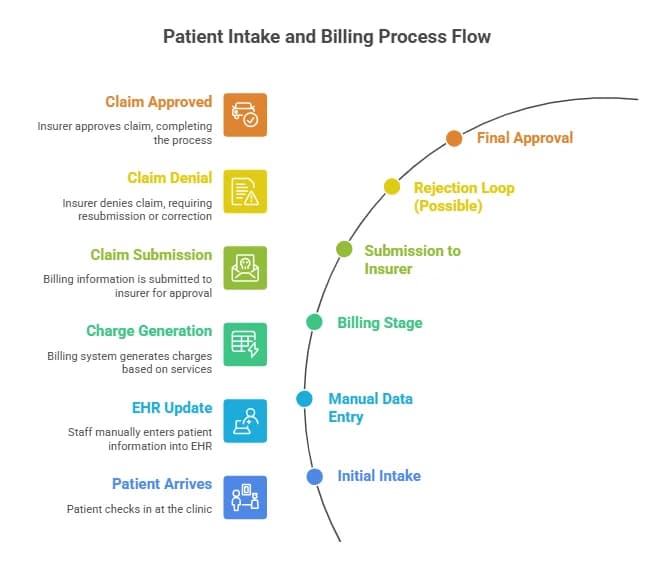
What we discovered was revealing.
Step 2: The Symptom
The rejection codes were consistent:
- Invalid insurance ID
- Incorrect policy number format
- Mismatched patient identifiers
- Typographical discrepancies
At first glance, it appeared to be “staff carelessness.”
But patterns told a different story.
- Errors clustered during peak hours.
- Error rates spiked during emergency admissions.
- Error frequency increased when physical ID cards were damaged or unclear.
This wasn’t negligence.
It was cognitive overload combined with analog friction.
Step 3: The Root Cause
Insurance data entry depended entirely on manual transcription from physical cards:
- Front desk staff manually typed long alphanumeric IDs
- Policy numbers often exceeded 15 characters
- Fonts varied by insurer
- Some cards were faded or laminated poorly
- Data was typed into multiple systems separately
Each keystroke introduced entropy.
And entropy compounds.
But the deeper architectural flaw was this:
There was no validation layer between intake and submission.
The system trusted human entry blindly.
If an ID had a transposed digit, it wasn’t caught at intake. It wasn’t caught in billing. It was caught 30–45 days later — by the insurer.
By then, the financial damage was done.
The hospital had digitized processes — but not intelligence.
Step 4: Quantifying the Financial Leak
We conducted a revenue impact simulation.
Assumptions:
- Average claim value: $850
- Monthly claim volume: ~20,000
- 40% rejection rate
- Average delay per rejected claim: 30 days
The result:
Millions in revenue effectively “in limbo” each quarter.
This wasn’t lost revenue. It was trapped revenue.
And trapped capital reduces strategic flexibility.
The CFO didn’t need persuasion after seeing the model.
Step 5: Why Traditional Fixes Would Fail: Before prescribing technology, we evaluated common alternatives.
Option 1: Staff Training: Training reduces mistakes temporarily. It does not eliminate structural vulnerability.
Option 2: Increase Headcount: More people increases payroll cost without eliminating the source of entropy.
Option 3: Outsource Billing: Outsourcing shifts responsibility but not root cause.
All three treat the symptom.
None re-architect the system.
The real issue was this:
Manual transcription was being used in a digital revenue pipeline with no verification intelligence.
That mismatch was the disease.
The Strategic Insight
We reframed the problem for the leadership team:
This is not a billing problem. This is a data ingestion problem.
Once reframed, the path became clear.
If insurance data could be:
- Captured directly from ID cards
- Interpreted using machine vision
- Validated instantly
- Standardized before entering the claim system
Then rejection rates would collapse.
Not because staff worked harder —But because the system worked smarter.
That was the inflection point.
The Diagnosis Summary
What looked like:
“High claim rejection due to staff errors”
Was actually:
A structurally fragile intake pipeline lacking automated data capture and validation layers.
The hospital didn’t need a new ERP.They needed a precision intervention.
In medicine, you don’t replace the whole body because one artery is blocked.
You restore flow.
In Part 2, we will examine how we designed a secure, scalable architecture — combining React, Python/TensorFlow OCR, and Node.js API orchestration — to eliminate transcription entropy and compress the revenue cycle.
Because diagnosis without architecture is theory.
And architecture without diagnosis is waste.
The Architecture
Precision Intervention, Not System Replacement
If Part 1 identified the arterial bleed in the revenue cycle, Part 2 is about how we restored flow — without replacing the entire circulatory system.
This was not a rebuild. It was a targeted intervention.
The hospital’s core systems — EHR, billing, insurer APIs — were functioning. The failure point was manual transcription of insurance data inside a high-volume digital pipeline.
So instead of replacing infrastructure, we inserted intelligence exactly where entropy entered the system.
The Strategy: Add Intelligence, Remove Friction
Our solution had to meet four requirements:
- Zero additional burden on intake staff
- Real-time validation before claim submission
- HIPAA-aligned security architecture
- Scalability across facilities
A monolithic system overhaul would have required 12–18 months, high CapEx, and operational risk. We rejected that immediately.
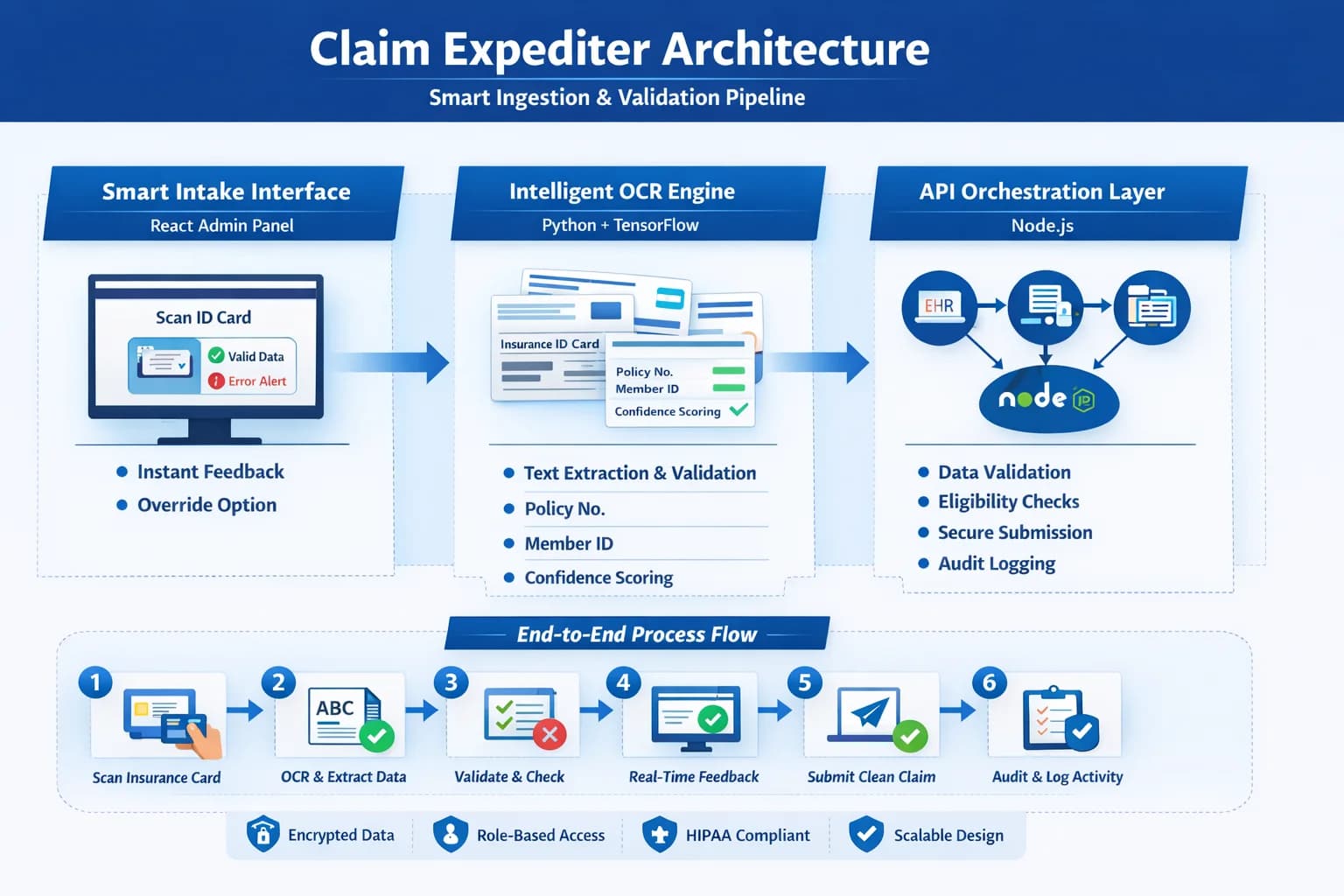
Instead, we designed a modular “Claim Expediter” layer — an intelligent ingestion and validation engine that integrates with existing systems.
The philosophy:
Augment the revenue cycle. Don’t disrupt it.
The Architecture in Three Layers
1. Smart Intake Interface (React)
We built a lightweight admin console using React to provide:
- Instant validation feedback
- Clear visual error indicators
- Human override options (with audit logging)
- Cross-device compatibility
The interface wasn’t decorative — it became the claim review and exception-handling environment.
Intake staff scan an insurance card and immediately see validated fields or highlighted corrections. No workflow slowdown. No system switching.
2. Intelligent OCR Engine (Python + TensorFlow)
Insurance cards vary widely in layout, fonts, damage, and formatting. Generic OCR wasn’t enough.
We developed a custom OCR pipeline using Python and TensorFlow that:
- Cleans and enhances images
- Detects and classifies text regions
- Identifies Policy Number, Member ID, Group Number
- Applies insurer-specific formatting rules
- Generates confidence scores
Confidence thresholds ensure safety:
- High confidence → Auto-fill
- Medium confidence → Human verification
- Low confidence → Manual confirmation
This hybrid model reduced error without removing control.
3. API Orchestration Layer (Node.js)
Healthcare systems are fragmented. We needed a fast, scalable coordination layer between:
- EHR
- Billing software
- OCR engine
- Insurer APIs
Node.js was used as the API gateway to:
- Normalize extracted data
- Validate insurer-specific formats
- Run eligibility checks
- Forward clean data to billing systems
- Log all activity for compliance
It became the connective tissue between vision intelligence and financial execution.
End-to-End Flow
- Staff scans insurance card
- OCR engine extracts and classifies data
- Validation engine checks formats and duplicates
- React interface provides real-time feedback
- Clean claim is submitted to insurer
- Full audit trail is recorded
Every step is traceable. Every correction is logged.
Security & Compliance
The system was built for healthcare-grade reliability:
- Encrypted transmission (TLS)
- Encrypted storage
- Role-based access controls
- Token-based service authentication
- Containerized OCR environment
- Minimal PHI exposure
No third-party OCR APIs accessed patient data.
This was production-grade infrastructure — not experimental automation.
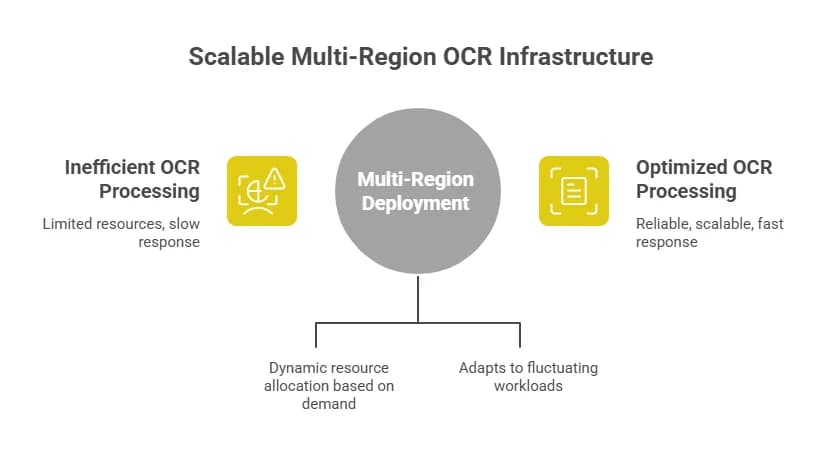
Built for Scale
From day one, the architecture supported growth:
- Stateless API services
- Containerized deployment
- Horizontal scalability
- Asynchronous OCR queues
- Multi-facility configuration
Peak admission volumes do not create bottlenecks.
The Core Principle
Every architectural decision answered one question:
Does this reduce entropy in the revenue pipeline?
We avoided feature creep.We avoided system replacement.We avoided operational disruption.
Instead, we inserted precision intelligence at the failure point.
And that is how flow was restored.
PART 3 — ROI & Future Outlook
Engineering is important.
Results are decisive.
1. Claim Rejection Rate
Before: 40%After: <5%
Manual errors dropped 87%.
Resubmission workload reduced 70%.
2. Accounts Receivable (AR) Days
Before: 60 daysAfter: 25 days
Cash conversion cycle improved by more than 50%.
That means:
- Better working capital
- Less borrowing
- Stronger vendor relationships
- Stable forecasting
Liquidity improved dramatically.
3. Revenue Acceleration
Millions in revenue moved from delayed to predictable.
Billing overtime costs reduced.
Financial visibility improved.
The organization moved from reactive to strategic.
4. Operational Benefits
- Billing stress reduced
- Fewer patient disputes
- Leadership confidence restored
- Board discussions shifted to expansion
Technology restored institutional trust.
5. Future Scalability
The system supports:
- Multi-hospital expansion
- Configurable insurer rules
- AI-based denial prediction
- Fraud detection integration
- Cloud or on-premise scaling
The network can double volume without re-architecting.
Final Results Snapshot
Metric | Before | After |
Claim Rejection | 40% | <5% |
AR Days | 60 | 25 |
Manual Rework | High | -70% |
Revenue Predictability | Low | High |
Staff Stress | High | Stabilized |
Closing Thoughts
At Boffin Coders, we do not sell software.
We solve structural problems.
This case shows what happens when:
- Engineering meets financial understanding
- AI is applied with precision
- Architecture follows diagnosis
The Claim Expediter is now a core part of this hospital’s revenue backbone.
Invisible. Intelligent. Scalable.
And most importantly:
Cash flow now supports clinical excellence.
Ready to Build Something
That Actually Works?
Stop patching legacy code. Let's engineer a platform that scales with your ambition.