Generative Engine Optimization (GEO): How to Rank Your Brand in AI Overviews and LLM Responses
- May 21, 2026
- 5 min read

SEO and AI Search Specialist
-1024x576.webp&w=3840&q=75)
For years, SEO meant one thing: rank higher on Google. You built backlinks, optimized headers, improved page speed, and watched your traffic grow. The system was clear, the strategies were known, and success was measurable.
But things have changed.
Today, your customers are not just searching - they’re asking. They’re starting conversations with AI tools like ChatGPT, Perplexity, Gemini, and Google’s AI Overviews. And in those conversations, your brand either appears… or it doesn’t exist.
This is where generative engine optimization comes in.
The Big Shift: From Search to Conversations
Earlier, users would search on Google and browse through multiple links before making a decision. Now, they ask a question and get a single, summarized answer from an AI.
That answer is powerful. It influences decisions instantly.
So instead of competing for clicks, brands are now competing to be mentioned in AI-generated responses.
This shift is redefining digital visibility.
What is Generative Engine Optimization (GEO)?
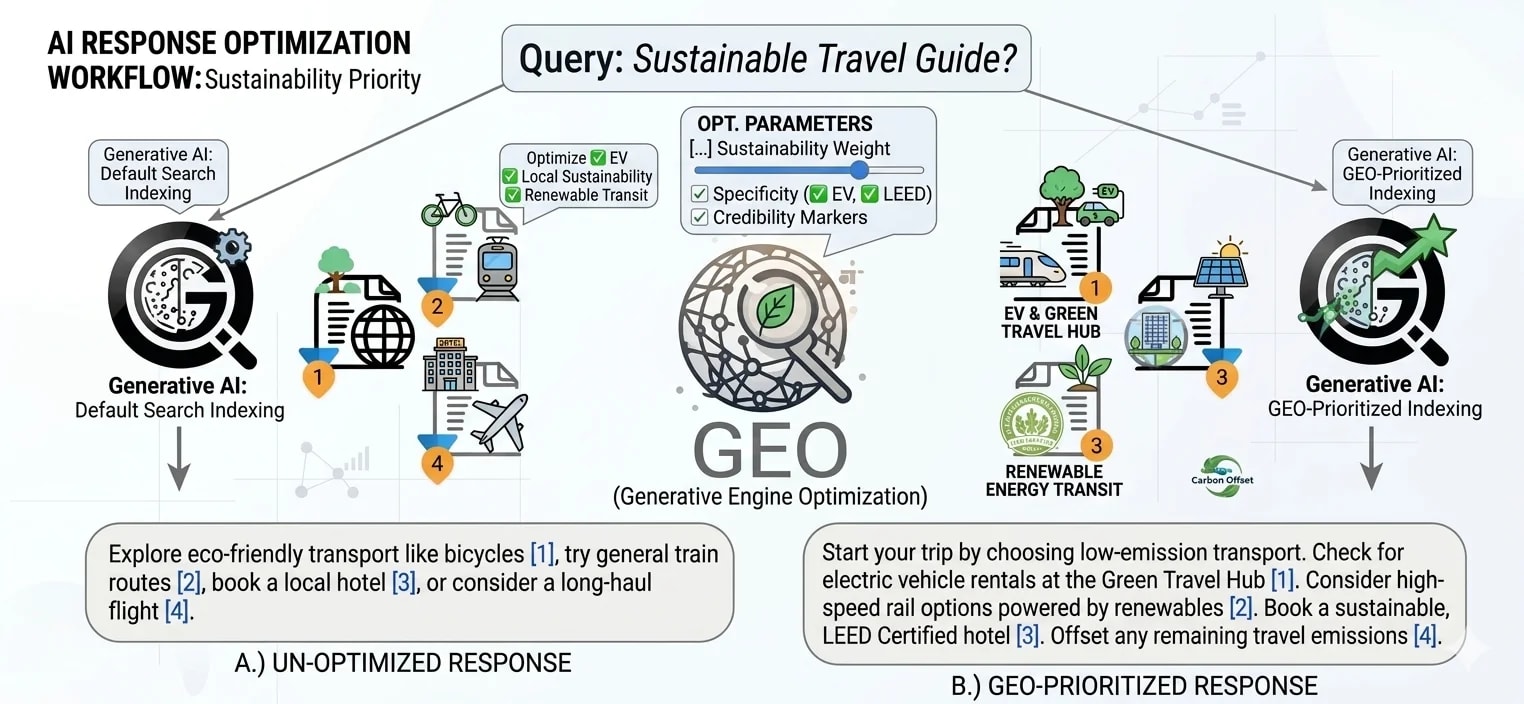
Generative engine optimization (GEO) means improving your content and online presence so that it shows up in answers created by AI tools like ChatGPT, Google, Perplexity, and Claude.
Instead of only trying to rank higher on search engines (like SEO), GEO focuses on making your brand part of the actual answer that AI gives to users.
This type of search is called agentic search. It means AI doesn’t just show links - it collects information, understands it, and gives a complete answer. Sometimes, it can even take actions for the user, like helping them choose or buy a product (this is called agentic commerce).
For example, if someone asks an AI tool, “What is the best digital marketing strategy for a small business?”, the AI will not just list links. It will collect information from different websites, blogs, and expert sources, then combine everything into one clear answer. It might explain strategies like social media marketing, SEO, and paid ads, highlight what works best for small businesses, and even give step-by-step suggestions. In this process, only a few trusted sources are used - so if your content is well-optimized, your brand can be included in that final answer.
Source: Inspired by industry trends and AI search optimization strategies, including Generative Engine Optimization (GEO), AI Overviews, and Large Language Model (LLM) search behavior, with insights referenced from SEMrush.
Why GEO is Important for Modern Businesses
Search behavior is changing fast. People now prefer quick, direct answers instead of clicking multiple links - and AI tools are providing exactly that.
Here’s why GEO matters:
1. AI is the New Starting Point: Many users now begin their search with AI tools. If your brand isn’t included in those answers, you lose visibility.
2. Less Website Traffic from Search: AI gives complete answers, so users don’t always visit websites. This means ranking on Google alone is not enough anymore.
3. Authority Matters More Than Ever: AI shows content from trusted and well-structured sources. GEO helps your brand build that trust and authority.
Core Pillars of GEO (Technical Breakdown)
To truly succeed in generative engine optimization, you need more than basic content improvements. You need a system that aligns with how AI models understand, retrieve, and generate information.
Let’s break down each pillar in depth.
1. Entity-Level Optimization
AI models interpret brands as entities, not just websites.
To improve visibility:
- Maintain consistent brand information across platforms
- Use structured data (Schema markup)
- Build entity associations (industry, services, expertise)
This helps AI connect your brand with specific topics.
2. LLM Search Optimization
LLM search optimization focuses on how large language models process and retrieve information.
Key tactics:
- Write in natural, conversational language
- Use semantic clarity (clear meaning, no ambiguity)
- Avoid keyword stuffing - focus on intent
Your content should answer questions like a human expert.
3. Retrieval-Friendly Content Architecture
AI systems often rely on retrieval mechanisms.
To optimize:
- Use clear headings (H1, H2, H3)
- Keep paragraphs short
- Include bullet points and summaries
- Add FAQ sections
This improves content chunking and retrieval accuracy.
4. Authority & Citation Signals
AI prefers content that is:
- Frequently referenced
- Consistent across platforms
- Supported by credible sources
Build authority through:
- Thought leadership content
- Case studies
- Data-backed insights
5. Multi-Source Presence
AI models aggregate data from:
- Websites
- Blogs
- Social platforms
- Third-party mentions
Your brand must exist consistently across all these touchpoints.
GEO vs SEO: Strategic Difference:
SEO | GEO |
Ranking in search engines | Appearing in AI responses |
Google, Bing | Google AI Overviews and AI Mode, ChatGPT, Perplexity |
Keywords, backlinks | Context, authority, structured content |
Web page rankings | AI-generated mentions and citations |
Click-based | Answer-based |
Website traffic | AI visibility & influence |
Your domain only | Multi- platform presence |
How to Optimize Your Brand for LLM Search
LLM search optimization is a critical part of GEO. Here’s how you can approach it:
1. Write for Questions, Not Just Keywords: Instead of focusing only on keywords, think about what users are asking.
Example:
- “What is generative engine optimization?”
- “How can small businesses rank in AI search?”
Answer these questions directly in your content.
2. Use Conversational Language: AI models are trained on conversational data. Your content should feel natural and easy to understand.
Avoid complex jargon unless necessary.
3. Create FAQ Sections: FAQs are highly effective for GEO because they match how users interact with AI.
Include questions like:
- What is GEO?
- Why is GEO important?
- How does GEO differ from SEO?
4. Optimize for Featured Snippets: Content that performs well in featured snippets often gets picked up by AI systems.
Focus on:
- Short, clear answers
- Structured formatting
- Direct explanations
Future of GEO and AI Search:
The future of search is clearly moving toward AI-driven experiences. As LLMs continue to evolve, businesses that adapt early will benefit the most.
We can expect:
- More AI-generated answers
- Less reliance on traditional search results
- Greater importance of brand authority
Generative engine optimization will become as essential as SEO is today.
Final Thoughts:
Generative engine optimization is not just a trend - it’s the next evolution of digital visibility.
To succeed in this new landscape, businesses must:
- Focus on high-quality, structured content
- Invest in LLM search optimization
- Build strong topical authority
- Work with experts when needed
Whether you’re a startup or an established company, adapting to GEO now will position your brand for long-term success.
If you’re ready to take the next step, exploring professional GEO optimization services in India can give your business the edge it needs in the AI-driven future.
Ready to make your brand AI-visible?
Start optimizing today and become part of the answers your customers are already searching for - with Boffin Coders as your trusted partner in Generative Engine Optimization.
Keep reading
Santosh Kumari
SEO and AI Search Specialist
Santosh Kumari works on technical SEO and AI search visibility, from site fixes to the structured data and page formats that AI answers quote. Santosh Kumari writes about practical changes that help search engines and AI understand a page.
Sell SEO to your clients without hiring an SEO team
Boffin Coders is the search team behind agencies: technical SEO, local SEO and answer-engine optimisation, delivered under your brand. You see the work before you pay.
Need this built?
We build websites and apps for businesses, and work behind digital agencies as their development team. Tell us where things stand on a 20-minute call.