How AEO and GEO Are Reshaping SEO in 2026: The Future of Search
- March 13, 2026
- 5 min read

SEO and AI Search Specialist
The world of search is changing faster than ever. For many years, businesses focused mainly on traditional SEO to rank their websites on search engines. The goal was simple: appear on the first page of search results and get clicks.
But in 2026, the way people search online has evolved. Today, users are asking questions through AI-powered search tools, voice assistants, and smart search engines. Instead of browsing through many links, users now expect quick and direct answers.
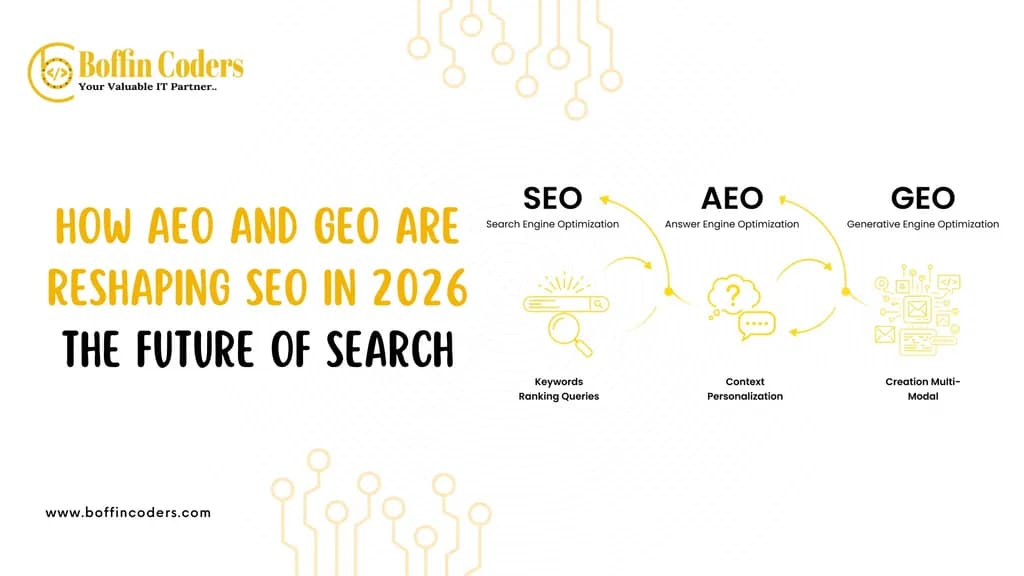
Because of this shift, two new strategies are becoming very important: AEO (Answer Engine Optimization) and GEO (Generative Engine Optimization). These approaches are transforming how websites appear in search results and how businesses attract online traffic.
Let’s explore how AEO and GEO are shaping the future of search.
The Changing Nature of Search
In the past, search engines worked mainly by matching keywords with webpages. If your website had the right keywords, good backlinks, and strong technical SEO, you had a better chance of ranking higher.
Today, search engines are becoming much smarter. They now use artificial intelligence to understand user intent and provide better answers. Instead of just showing links, many search platforms now provide summarized answers, featured snippets, and AI-generated responses.
This means users can often get the information they need without clicking multiple websites.
For businesses and website owners, this change creates a new challenge. It is no longer enough to simply rank high in search results. Your content must now be clear, helpful, and structured so that AI systems can easily understand and present it as an answer.
This is where AEO and GEO come into the picture.
What Is Answer Engine Optimization (AEO)?
Answer Engine Optimization (AEO) focuses on optimizing content so that search engines and AI assistants can quickly find and display answers from your website.
When users search for information today, they often ask questions like:
- “What is digital marketing?”
- “How does SEO work?”
- “What are the benefits of cloud computing?”
Search engines try to provide quick and accurate answers to these types of questions. Websites that present information clearly and directly have a higher chance of being selected as the source for these answers.
How AEO Works
AEO helps search engines understand your content by making it easy to scan and interpret. Instead of long blocks of text, content should be structured in a way that allows search engines to extract useful information quickly.
Key AEO practices include:
- Writing clear answers to common questions
- Using headings and subheadings
- Adding FAQ sections
- Using bullet points and short paragraphs
- Implementing structured data and schema markup
When done correctly, AEO can help your website appear in featured snippets, voice search results, and AI-generated answers.
What Is Generative Engine Optimization (GEO)?
Generative Engine Optimization (GEO) is a newer concept that focuses on optimizing content for AI systems that generate answers using multiple sources.
Generative AI search tools do not simply show a list of links. Instead, they analyze information from different websites and generate a complete response for the user.
These AI systems choose sources based on several factors, such as:
- Content accuracy
- Website authority
- Depth of information
- Trustworthiness
If your content provides valuable insights and reliable information, AI tools are more likely to reference or learn from your website when generating responses.
How GEO Influences Search
GEO focuses on creating content that is:
- Informative and detailed
- Well-structured
- Easy for AI systems to understand
- Written with expertise and credibility
The goal of GEO is to ensure that your website becomes a trusted information source for AI-driven search engines.
Why AEO and GEO Are Important in 2026
The rise of AI-powered search is changing how users discover information online. Because of this shift, businesses must adapt their SEO strategies.
Here are some reasons why AEO and GEO are becoming essential.
- AI-Powered Search Is Growing: More people are using AI search tools to find quick answers instead of browsing multiple websites.
- Voice Search Is Increasing: Voice assistants and smart devices are making conversational search more common.
- Users Want Faster Answers: People expect immediate solutions to their questions without spending time navigating through many pages.
- Search Engines Are Becoming Answer Engines: Search platforms are focusing more on delivering direct answers instead of just links.
All these changes mean that websites must optimize their content not only for search engines but also for AI-driven answer systems.
How Businesses Can Adapt Their SEO Strategy
To stay competitive in modern search environments, businesses should combine traditional SEO with AEO and GEO strategies.
- Focus on Helpful Content: Create content that solves real problems and answers the questions users are asking.
- Write Clearly and Simply: Simple and easy-to-understand explanations work better for both readers and AI systems.
- Structure Your Content Properly: Use headings, bullet points, and short sections so information can be easily scanned.
- Build Authority and Trust: Publish reliable information and demonstrate expertise in your industry.Following Google’s Search Essentials can also help businesses build a strong foundation for search visibility. These guidelines cover key technical requirements, spam policies, and best practices that help search engines discover, understand, and index website content.
- Optimize for Conversational Search: More users are searching using natural language queries, especially through voice search and AI tools.
The Future of Search
Search is moving toward a future that is AI-driven, conversational, and answer-focused. Instead of showing endless lists of links, search engines will continue improving their ability to deliver accurate and instant answers.
Websites that adapt to these changes by focusing on AEO and GEO strategies will have a better chance of staying visible in search results.
Businesses that rely only on traditional SEO methods may struggle to keep up with the evolving search landscape.
Final Thoughts
SEO is not disappearing - it is evolving.
In 2026 and beyond, success in search will depend on how well your content answers real questions, provides valuable information, and helps users quickly find what they need.
By combining traditional SEO with AEO and GEO strategies, businesses can stay visible in both search engines and AI-powered platforms.
At Boffin Coders, we believe the future of search belongs to businesses that focus on helpful content, strong authority, and AI-friendly optimization. Companies that adapt to these new search trends will be better positioned to grow their online presence.
The future of search belongs to websites that focus on clarity, usefulness, and trust.
Keep reading
Santosh Kumari
SEO and AI Search Specialist
Santosh Kumari works on technical SEO and AI search visibility, from site fixes to the structured data and page formats that AI answers quote. Santosh Kumari writes about practical changes that help search engines and AI understand a page.
Sell SEO to your clients without hiring an SEO team
Boffin Coders is the search team behind agencies: technical SEO, local SEO and answer-engine optimisation, delivered under your brand. You see the work before you pay.
Need this built?
We build websites and apps for businesses, and work behind digital agencies as their development team. Tell us where things stand on a 20-minute call.