GEO vs SEO: what is the difference, and do you need both?
- October 16, 2026
- 12 min read

SEO and AI Search Lead
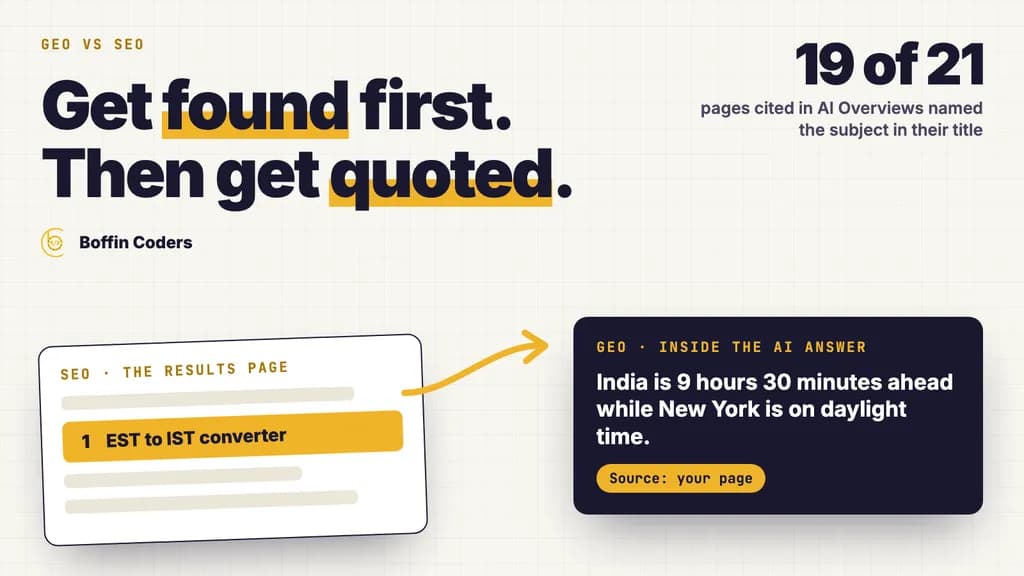
GEO vs SEO comes down to where you appear. SEO gets your page into the list of search results. GEO gets your page quoted or named inside the answer an AI engine writes, in Google's AI Overviews, ChatGPT, Gemini or Perplexity. You need both, in that order: when an AI engine cites a source, it found that source by searching, and GEO is the extra work that makes a page it finds easy to quote.
About 2,900 people a month in the United States and 590 in the UK search "geo vs seo", in the keyword data we pulled in October 2026. The question underneath is usually whether one replaces the other: "Has GEO replaced SEO?" and "Is SEO dead now with AI?" sit in Google's "People also ask" box for this search. So we checked instead of guessing: five questions, four AI answer engines, and a record of every source each answer cited. The results are below, with the method, so you can run the same check on your own site.
What is GEO?
GEO, short for generative engine optimisation, is the work of making a page easy for an AI engine to find, trust and quote when it writes an answer. The name comes from a 2023 research paper, presented at the KDD conference in 2024, whose authors reported that changes to a page could raise its visibility in generated answers by up to 40%. In practice, GEO is good SEO plus three habits: answers that stand alone, facts that agree everywhere, and a presence on the sites the engines already read.
You will also see it spelled generative engine optimization, the American spelling. It is the same thing.
The search "what is GEO" gets about 5,400 searches a month in the United States and 1,600 in the UK, and not everyone means the same thing by it. In marketing, GEO can also mean geographic targeting: showing ads or pages to people by location. That is a separate job. In this post GEO always means generative engine optimisation.
Is AI SEO called GEO?
Yes. GEO, AEO and AI SEO are three names for largely the same work. Answer engine optimisation (AEO) is the older name, from the years of featured snippets and voice assistants, when the goal was a direct answer lifted from your page. GEO covers the newer engines that write one answer from several sources. "AI SEO", "LLM SEO" and "GEO SEO" are names agencies use for the same tasks. The tasks barely differ, so use the name your client uses and describe the work, not the acronym.
What is the difference between GEO and SEO?
The difference between GEO and SEO is what you compete for. SEO competes for a position in a list of links, and the reader chooses which one to click. GEO competes for a line inside an answer the engine has already written, and the engine chooses which sources to cite. SEO is judged page by page. GEO is judged passage by passage, so one clear paragraph or table can be cited even when the page around it ranks lower.
Side by side
Same page, two different contests
| SEO | GEO | |
|---|---|---|
| The goal | Your page ranks in the list of results | Your page is cited, or your name appears, inside an AI answer |
| Shows in | Google and Bing results pages | Google's AI Overviews and AI Mode, ChatGPT, Gemini, Perplexity, Copilot |
| Chosen by | The reader picks a result to click | The engine picks which sources to cite |
| What wins | A page | A passage or a table that makes sense on its own |
| Earned by | A crawlable, fast, indexed page that answers the query, and links from other sites | All of that, plus the answer in the first two sentences, the same facts everywhere, and mentions on sites the engines read |
| Metric | Rankings, impressions and clicks | Citations and mentions per question and per engine, checked monthly |
The goal
- SEO
- Your page ranks in the list of results
- GEO
- Your page is cited, or your name appears, inside an AI answer
Shows in
- SEO
- Google and Bing results pages
- GEO
- Google's AI Overviews and AI Mode, ChatGPT, Gemini, Perplexity, Copilot
Chosen by
- SEO
- The reader picks a result to click
- GEO
- The engine picks which sources to cite
What wins
- SEO
- A page
- GEO
- A passage or a table that makes sense on its own
Earned by
- SEO
- A crawlable, fast, indexed page that answers the query, and links from other sites
- GEO
- All of that, plus the answer in the first two sentences, the same facts everywhere, and mentions on sites the engines read
Metric
- SEO
- Rankings, impressions and clicks
- GEO
- Citations and mentions per question and per engine, checked monthly
Where you appear, and what you measure
SEO puts you on the results page of Google or Bing, as a title and a short description. GEO puts you inside Google's AI Overviews and AI Mode, ChatGPT search, Gemini, Perplexity and Copilot, usually as a small link or a source card beside a sentence. The reader may never visit your page. They may still read your sentence, and your name.
SEO is measured in rankings, impressions and clicks. GEO is measured in citations and mentions, question by question and engine by engine. Google counts visits from AI Overviews and AI Mode inside the "Web" search type in Search Console, so you cannot separate them there. That is why GEO needs its own check, described later in this post.
Has GEO replaced SEO?
No. GEO has not replaced SEO, because AI engines still search an index before they cite anything. Google states that a page must be indexed and eligible to show with a snippet to appear as a supporting link in AI Overviews or AI Mode, and that there are no extra requirements beyond that. A page that search cannot find is a page an AI answer cannot cite.
The same question comes up as "is SEO dead now with AI?", and our check points the same way. Of the 21 sources Google's AI Overviews cited across our five questions, 11 came from sites that also held a first-page result for the same question. Google also says its AI features use "query fan-out": they run several related searches across subtopics before writing the answer. Each of those searches is an SEO contest of its own.
So GEO adds to SEO. What changes is what a good result looks like. A page that ranks but hides its answer under a long introduction gives the engine nothing short to quote.
How do AI answers choose which sources to cite?
AI answers choose sources in four steps. The engine decides whether it needs to search at all, turns the question into one or more searches, reads the pages those searches return, and cites the passages that answer most directly. To see each step in practice, Boffin Coders put five questions to four engines on 7 October 2026 and recorded every source.
How a source gets picked
Four steps, and search decides the third
- 01
The engine
Decide whether to search
A stable fact may be answered from memory. In our check, ChatGPT and Gemini searched for two of five questions: the two that depended on the date.
- 02
Query fan-out
Fan out into narrower searches
ChatGPT turned a question about a New York to India call into "New York India time difference October 2026 daylight saving time IST".
- 03
The search index
Read what the index returns
For Google, a page must be indexed and eligible for a snippet. 11 of 21 AI Overview citations in our check came from sites already on page one.
- 04
The answer
Cite the passage that answers
The answer is written from passages that state the point plainly, with a link or source card beside each claim.
Stable facts are answered from memory
ChatGPT and Gemini each searched the web for only two of our five questions. "What does CST stand for in time zones?", "How many time zones are there in the world?" and "What is the time difference between EST and IST?" were answered from what the model already knew, with no source cited. For a fact that does not change, there may be no citation to win in a chat app. Google's AI Overviews still cited sources for all five.
Questions that depend on today's date trigger a search
The two questions that made ChatGPT and Gemini search were the two whose answer depends on the date: when Israel changes its clocks, and the best time for a call between New York and India. ChatGPT's own search for the second was "New York India time difference October 2026 daylight saving time IST". It added the month, the year and the daylight-saving rule. That is fan-out in practice: the engine searches for a narrower question than the one you asked, and the page that answers the narrower question is the one it cites.
The engines return to the same few sources
Across the five AI Overviews, Google cited 21 sources. Thirteen came from just four time-zone and converter sites. Three came from forums (Reddit and Quora), three from articles on other sites, one from a news site and one from a YouTube video. In ChatGPT, the search for the call question returned ten results, all from one site, and the answer cited two of them. Engines go back to sites they already rely on for a subject, which is the oldest lesson in SEO, applied in a new place.
Our check, 7 October 2026
The chat apps searched only when the date mattered
| Question | AI Overview | AI Mode | ChatGPT | Gemini |
|---|---|---|---|---|
| What is the time difference between EST and IST? | 4 cited | No links | From memory | From memory |
| When does Israel change its clocks? | 3 cited | 4 cited | Searched, 3 cited | Searched, 5 cited |
| What does CST stand for in time zones? | 4 cited | 2 cited | From memory | From memory |
| How many time zones are there in the world? | 4 cited | 2 cited | From memory | From memory |
| What is the best time to schedule a call between New York and India? | 6 cited | 4 cited | Searched, 2 cited | Searched, 8 cited |
What is the time difference between EST and IST?
- AI Overview
- 4 cited
- AI Mode
- No links
- ChatGPT
- From memory
- Gemini
- From memory
When does Israel change its clocks?
- AI Overview
- 3 cited
- AI Mode
- 4 cited
- ChatGPT
- Searched, 3 cited
- Gemini
- Searched, 5 cited
What does CST stand for in time zones?
- AI Overview
- 4 cited
- AI Mode
- 2 cited
- ChatGPT
- From memory
- Gemini
- From memory
How many time zones are there in the world?
- AI Overview
- 4 cited
- AI Mode
- 2 cited
- ChatGPT
- From memory
- Gemini
- From memory
What is the best time to schedule a call between New York and India?
- AI Overview
- 6 cited
- AI Mode
- 4 cited
- ChatGPT
- Searched, 2 cited
- Gemini
- Searched, 8 cited
How do you check whether AI answers cite your site?
To check whether AI answers cite your site, list the questions your pages answer, put each one to every engine your buyers use, and record which sources each answer cites. Repeat the same questions every month, because answers change between runs. Boffin Coders ran this check on timezones.in, a time-zone reference site it owns and built, with five questions its pages answer in full.
The method, step by step
- Pick questions a specific page answers, phrased the way people ask them. Ours matched four kinds of page on timezones.in: a converter between two time zones, a daylight-saving page for one country, a guide to time-zone abbreviations and a list of UTC offsets.
- Run each question in every engine, from the same country and in the same language. We used a commercial search-data API that sends a question to Google (for the AI Overview and AI Mode), ChatGPT and Gemini and returns each answer with its sources: United States, English, one run per question per engine. The 20 calls cost US$0.07.
- Record three things per answer: whether the engine searched, which sources it cited, and the searches it ran. For ChatGPT the API also returns the searches it ran before answering, and they are the most useful line in the whole check.
- Read the cited pages next to your own. How quickly does each answer the question? Does the cited passage make sense on its own? Does it answer the narrower question from the fan-out?
- Rerun monthly with the same questions and keep a dated log. One run is a snapshot, not a ranking.
What the cited pages had in common
Two patterns stood out. First, 19 of the 21 pages cited in AI Overviews named the exact subject of the question in their title: the pair of time zones, the country, the abbreviation. The two exceptions were a general video and a meeting-planner tool. Second, all four pages cited for the EST and IST question dealt with daylight saving, which the question never mentioned. Three gave both differences in the passage Google showed: 9 hours 30 minutes while New York is on daylight time, and 10 hours 30 minutes when it is not. The fourth named daylight saving in its title. The full answer depends on it, so the cited answers included it.
What the citations had in common
Found by search, named for the question
5 of 5
questions with an AI Overview
Google wrote an AI answer with cited sources for every question.
11 of 21
citations from sites on page one
Sites that also ranked for the same question in the ordinary results.
19 of 21
cited pages named the subject
In the title: the pair of time zones, the country or the abbreviation.
13 of 21
citations from four specialist sites
Time-zone and converter sites. Forums, articles, news and video made up the rest.
How do you optimise a page for GEO?
You optimise a page for GEO by making each section answer one question on its own, in plain text that a crawler can read without running scripts. Start with pages that already rank, because those are the pages the engines find. The changes below are the ones Boffin Coders makes on its own pages and on client sites, and none of them needs special markup or an AI text file.
Answer the question in the first two sentences
Make each section heading a question your buyer asks, and answer it in the first two sentences under it. Engines quote passages, not pages, and a passage that only makes sense after the paragraph above it is hard to quote. Detail, examples and caveats come after the answer, not before it.
Where readers compare options, give them a table. A table holds the whole comparison in one block that an engine can lift and a reader can scan. Every "X vs Y" page needs one, which is why this post has one near the top.
Name the subject the way people search for it
Put the exact subject in the title and the headings: the product, the place, the pair of options. Then answer the narrower questions the engines fan out to, such as the version for this year, for a specific country, or with the common exception included. Our check showed both at work: titles that named the subject, and answers that covered daylight saving when the question did not ask.
Keep the facts about you identical everywhere
Engines check one source against another. Your name, location, founding year, size and the words you use for what you sell should match on your site, your directory profiles and your social profiles. Ours read the same everywhere: Boffin Coders, Mohali, India, since 2017. Facts that disagree between sources give an engine a reason to cite someone else.
Earn mentions on the sites the engines already cite
Your check shows which sites the engines rely on for your subject. In ours, forums and video were among them. Be present there honestly: a useful answer in a relevant forum thread, a complete directory profile, a guest article on a site that covers your field. Mentions on other sites are what tell an engine that you exist outside your own pages.
Keep everything in server-rendered text
Not every crawler runs JavaScript, so text that only appears after scripts run may never be read. Put the answer, the table and the facts in the HTML the server sends. If you use structured data, make sure it matches the visible text, as Google asks. Google also says you do not need AI text files or new machine-readable files to appear in its AI features.
GEO vs SEO: which should you do first?
Do SEO first, then GEO on the pages that already earn impressions. An engine can only cite a page it can find, so a site with crawling problems, slow pages or no rankings gains little from rewritten passages. Once a page ranks for its question, GEO is mostly editing: answer first, add the table, align the facts, and check every month whether the engines cite it.
A practical order:
- Fix what stops search engines reading the site. Pages that render only in the browser, slow mobile pages, broken redirects and pages missing from the index come first. This is the work of technical SEO services, and every later step depends on it.
- List the questions your buyers ask, from "People also ask" boxes, Search Console queries and your own sales calls.
- Rewrite the sections that already rank so each one answers its question in its first two sentences, with a table where the reader compares.
- Run the check above every month and compare the cited pages with yours.
If you are an agency selling GEO to your clients
If a client asks why AI answers never mention their business, the work is the same as above, done every month for every client site. Boffin Coders is the fulfilment team behind agencies that sell it: technical SEO, local SEO and answer-engine optimisation delivered under your brand. Each month's results reach you in a spreadsheet for the report you prepare, we never contact your client unless you ask, and you see the work before you pay. See how white-label SEO for agencies works with us.
Keep reading
Pinkal Rana
SEO and AI Search Lead
Pinkal leads search strategy at Boffin Coders, from classic SEO to how brands get named in AI answers on Google, ChatGPT and Perplexity (AEO and GEO). Pinkal writes about what actually gets a business cited by AI search, using data from real checks.
Frequently asked questions
In SEO, GEO stands for generative engine optimisation: the work of getting a page cited or named inside answers written by AI engines such as Google AI Overviews, ChatGPT, Gemini and Perplexity. It builds on SEO rather than replacing it, because those engines find the pages they cite by searching an index. In other marketing contexts GEO can mean geographic targeting, which is a different job.
Not answered here?
Need this built?
We build websites and apps for businesses, and work behind digital agencies as their development team. Tell us where things stand on a 20-minute call.