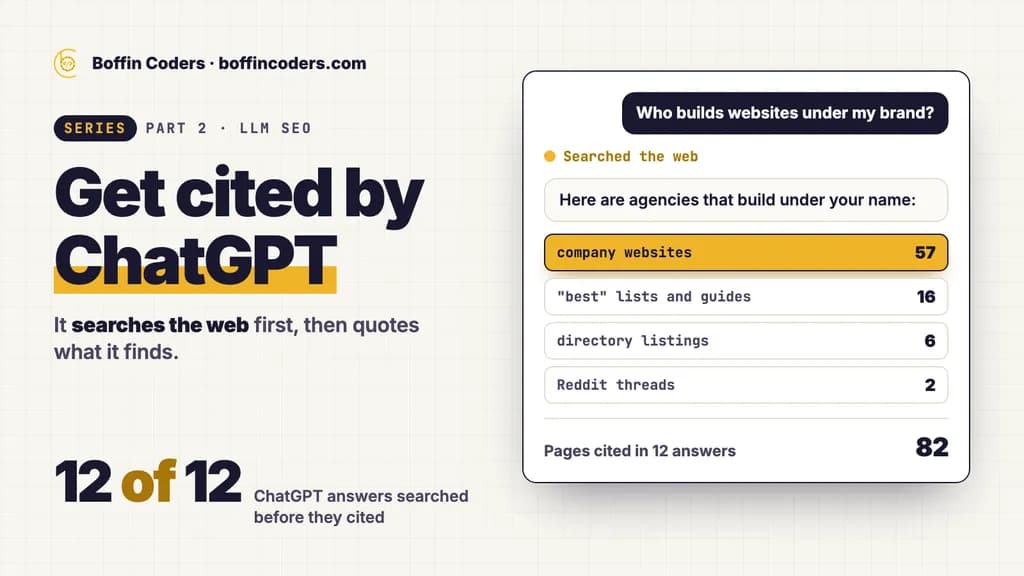
LLM SEO is the work of getting your pages quoted when ChatGPT and other AI assistants answer a buyer's question. To get cited by ChatGPT, a page has to turn up in the web searches ChatGPT runs, then say something specific enough to quote. Five changes do most of the work: put the search's words in your title and H1, make promises a buyer can check, keep your facts the same on every site, be listed where ChatGPT looks, and let OpenAI's search crawler read your site.
Those five changes come from watching ChatGPT choose its sources. On 16 October 2026, Boffin Coders asked ChatGPT six questions an agency owner asks when looking for a white-label development partner. Each question ran once from the United States and once from the United Kingdom. All 12 answers searched the web before answering. One question never said "white label". It asked who could build websites "under my brand". ChatGPT searched for "white label" anyway, and every page it cited for that question used the term in its title.
What is LLM SEO?
LLM SEO is one name for making your pages easy for an AI assistant to find, trust and quote. LLM stands for large language model, the kind of AI behind ChatGPT and Gemini. You will also see the same work called GEO (generative engine optimisation), AEO or AI SEO. The work is the same under each name. For how it relates to classic search work, see how GEO and SEO differ.
LLM SEO builds on SEO. ChatGPT cites pages that its web searches return, so a page that no search can find is a page it cannot cite. What LLM SEO adds is attention to the exact words those searches use, and to claims short and specific enough to quote in one line.
How does ChatGPT search choose the pages it cites?
ChatGPT search chooses its pages in three steps, according to OpenAI's own help pages. First it decides whether a question would benefit from current information from the web. If it would, ChatGPT rewrites the question into one or more targeted searches, which it may send to partner search providers. After reading the first results, it may run more specific searches. Then it writes the answer, with citations to the sources it used.
The same help page says ChatGPT may use the searcher's general location, worked out from their IP address, when it rewrites the question. It ranks what it finds by several factors meant to surface relevant, reliable information, and no site is promised a place.
To be eligible at all, OpenAI says a site must let its search crawler, OAI-SearchBot, read the pages. The site's host or content delivery network must also let requests from OpenAI's published search crawler IP addresses through.
What did ChatGPT cite when agencies asked for a white-label partner?
ChatGPT cited mostly agencies' own pages for the exact service asked about, titled with the words it searched for. "Best companies" lists and how-to guides came next, then directories, review sites, Reddit and LinkedIn. The check used a commercial search-data API that returns each ChatGPT answer with the searches it ran and the sources it cited. The 12 answers cost under US$0.05 to collect. These were the six questions, as typed:
- How do I find a reliable white label development partner
- I run a marketing agency, who can build websites for my clients under my brand
- Recommend a white label app development company
- White label Shopify development company for agencies
- White label WordPress development partner for agencies
- Who is the best white label web development company for agencies
Every answer searched the web first
All 12 answers searched before they answered. ChatGPT ran 19 searches in total, one or two per answer, each 8 to 16 words long. The searches returned 10 to 32 pages per answer, and each answer cited 4 to 10 pages. Three of the real searches show how it rewrites a question:
- "white label website development agency UK pricing WordPress agency partners 2026", for the question about websites "under my brand"
- "white label WordPress development partner agency reviews Reddit"
- "how to vet white label software development agency partner due diligence client references security NDA contract"
The same habits run through all 19. Every search included "white label" and "agency" or "agencies". Six of the 10 searches run from the UK added "UK", which fits what OpenAI says about location. Six of the 19 added the current year. Three asked for reviews, two named Reddit and two asked about pricing.
The titles carried the words ChatGPT searched for
The question about building websites "under my brand" never used the trade's name for the service. All four searches ChatGPT ran for it did, two from each country, and all nine pages it cited for that question used the term in the title. So the buyer's phrase started the search, and the trade's term decided which pages it found.
Across the check, the searches returned 211 pages, and 181 of them had "white label" in the title. Of the cited pages that also appear in those search results, 60 of 64 did, and 28 of the 64 titles said who the service was for ("for agencies", "for UK agencies"). A page whose title lacked the words of the search rarely made it into an answer.
What the 12 answers cited
What was cited | Pages | Answers citing one |
|---|---|---|
A company's own website (19 of them a home page) | 57 | 11 of 12 |
"Best companies" lists and how-to guides | 16 | 7 of 12 |
A listing on a directory, review site, freelance marketplace or map | 6 | 4 of 12 |
Reddit threads | 2 | 1 of 12 |
A link to search LinkedIn | 1 | 1 of 12 |
All cited pages | 82 | 12 of 12 |
A page counts once in each answer that cited it. One of the 16 lists was an article posted on LinkedIn, so LinkedIn appeared in two answers.
The US answer to "how do I find a reliable white label development partner" named no development company at all. It cited two guides and sent the reader to search a directory, a freelance marketplace and LinkedIn. A question about how to choose got a method, and the method pointed to the places where suppliers are listed.
How to get cited by ChatGPT: what to change on your pages
To get cited by ChatGPT, change five things on and around your pages. Each one comes from what the 12 answers did, or from OpenAI's own documentation.
Put the search's words in your title and H1
Name each service the way your market names it, in the page title and the H1. In the check, 60 of those 64 cited pages carried "white label" in the title, and many also named the buyer or the market. Give each service you sell its own page, titled for that service, so a narrow search has an exact match.
Then use the buyer's own phrase in the body as well. The buyer who typed "under my brand" was matched to pages titled "white label". A sentence that uses both phrases lets the page answer the question in either form.
Make promises a buyer can check
Describe what you do in concrete terms a buyer can check: a contract term, a delivery rule, the place where the work lives. One UK answer listed Boffin Coders fourth and described us with three promises taken from our white-label websites page: non-circumvention agreements, delivery under the agency's brand, and work in a repository the agency names. The same answer described the first company on its list with three promises from that company's own page, about confidentiality, client contact and payment. Its closing note said the list rested on what providers publish about themselves, and told the reader to check quality, prices and references before choosing.
A line such as "fast, reliable and affordable" gives ChatGPT nothing it can repeat as a fact. "Code in the repository you name from the first commit" does.
Keep the same facts on every site
ChatGPT also reads what other sites say about you. Seven of the 12 answers cited a list or a guide, and in the answer that named Boffin Coders, the third company's two citations were a review site and a list article. Your name, services, location and promises should read the same on your site, your directory profiles and any list that includes you. Where they differ, ChatGPT has two versions to choose from, and you do not control which one it repeats.
Be listed where ChatGPT looks
Four of the 12 answers cited a directory, review site, freelance marketplace or map listing. ChatGPT's searches asked for reviews three times and named Reddit twice. Keep a complete profile on the directories and review sites your buyers use, and ask clients to review you there. Where buyers in your field compare suppliers on Reddit or LinkedIn, answer their questions as a person, with useful detail.
Let OAI-SearchBot crawl your site
Check your robots.txt for OAI-SearchBot. OpenAI's crawler documentation says sites that block it will not be shown in ChatGPT search answers, though they can still appear as plain navigational links. A rule that names it should allow it:
1User-agent: OAI-SearchBot
2Allow: /
GPTBot is a separate choice. It collects content that may be used to train OpenAI's models, and OpenAI says each setting is independent, so a site can block GPTBot and still appear in ChatGPT search. ChatGPT-User, which may visit a page when a person asks ChatGPT a question, is not used to decide what appears in search. After a robots.txt change, OpenAI says it can take about 24 hours for its systems to adjust. Then check that your host or content delivery network lets OpenAI's published search crawler IP addresses through.
Is ChatGPT SEO different from SEO for Google?
ChatGPT SEO is mostly the same work as SEO for Google, with three differences. ChatGPT writes its own searches, so your titles must match the words it searches with, which may differ from the buyer's. It reads your site with its own crawler, which you allow or block separately. And its citations do not show in Google Search Console.
You can still measure it. In the check, 85 of the 144 links ChatGPT placed in its answers carried utm_source=chatgpt.com, and visits through those links show in your analytics under that source. To see whether ChatGPT cites you at all, put your buyers' questions to it every month and record the searches it ran and the pages it cited.
Where should you start?
Start with the pages that sell, whether you run an agency or your own business. A practical order:
- Ask ChatGPT your buyers' questions from each country you sell to, and note the searches it runs and the pages it cites.
- Retitle your service pages with the words those searches use.
- Rewrite vague claims as promises a buyer can check.
- Update your directory and review profiles so they match your site.
- Check robots.txt and your firewall for OAI-SearchBot and OpenAI's search crawler IP addresses.
If you run an agency and your clients ask why ChatGPT never mentions them, the work is these five steps, done every month for every client site. Boffin Coders does that work under your brand as white label SEO for agencies. We never contact your client unless you ask, and you see each month's work before you pay. To talk it through for one client site, send us a partner enquiry.
Keep reading

Pinkal Rana
SEO and AI Search Lead
Pinkal leads search strategy at Boffin Coders, from classic SEO to how brands get named in AI answers on Google, ChatGPT and Perplexity (AEO and GEO). Pinkal writes about what actually gets a business cited by AI search, using data from real checks.
Frequently asked questions
LLM SEO is the work of getting your pages found, trusted and quoted by AI assistants built on large language models, such as ChatGPT and Gemini. It builds on ordinary SEO, because ChatGPT cites pages that its web searches return. It adds attention to the words those searches use, to specific claims an assistant can quote, and to what other sites say about you.
Not answered here?
Need this built?
We build websites and apps for businesses, and work behind digital agencies as their development team. Tell us where things stand on a 20-minute call.