What Is White Label AI SEO, and How Do Agencies Deliver It Under Their Own Brand?
- October 21, 2026
- 9 min read

SEO and AI Search Lead
White label AI SEO is search work a partner does on your clients' sites so that Google's AI Overviews, ChatGPT and Gemini can find, quote and cite them, sold by your agency under its own name. Most of it is SEO you may already sell: pages that answer each buyer question in its own words, facts written plainly and structured data that matches the page. The new part is the checking, with the same buyer questions put to the AI engines every month.
Your clients have started asking why ChatGPT names a rival and not them. You sell SEO. Is this the same job, or a new one you cannot staff?
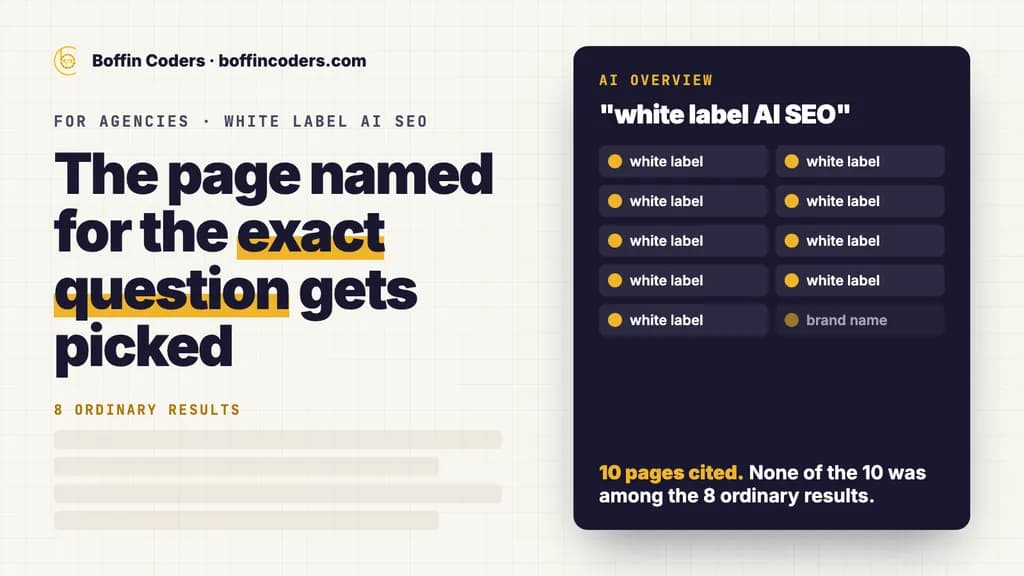
We read Google's AI Overview for the words "white label AI SEO" in October 2026. It cited 10 pages. None of the 10 was among the 8 ordinary results on the same page, and 9 of the 10 titles carried the words "white label". That one check shows the pattern: ranking helps, but the page named for the exact question is the one that gets picked.
What is white label AI SEO?
White label AI SEO means a partner does the AI search work on your client's site and your agency sells it under its own name. Your client deals only with you. The partner never contacts them, and the results come back to you to report in your own format.
The "AI" part covers the answers people now read before the links: Google's AI Overviews and AI Mode, ChatGPT with search, Gemini, Perplexity and Copilot. Each one searches the web, reads a handful of pages and writes an answer with links to some of them. The work is to make your client's pages the ones it reads and links.
Two kinds of offer use the same name. Some providers sell software: a dashboard with your logo that tracks mentions. Others sell fulfilment: people who change the pages. A dashboard shows the score. The page changes move it, and they are where the hours go.
Why are clients asking for it now?
Because the answer now sits above the links. In a check we ran on 12 ordinary questions in the US and the UK, 21 of 23 Google results pages showed an AI Overview at the top. A buyer who reads that summary may never scroll to the tenth blue link.
The same happens off Google. When a buyer asks ChatGPT for a supplier, it searches the web and names a few businesses. The business that is not named never learns it was left out. Your client hears about it from a friend, or from a sales call that went to someone else, and then asks you.
That makes it a retention question for your agency as much as a new service. A client who believes their SEO agency cannot help with AI answers starts looking for one that can.
Is AI SEO different from the SEO your agency already sells?
Mostly it is the same work, and Google says so itself. Its page on AI features says there are no additional requirements to appear in AI Overviews or AI Mode, and no special schema.org structured data to add. A page has to be indexed and eligible to show with a snippet, the same bar as an ordinary result.
What changes is which of your client's pages gets picked. Three checks we ran in October 2026 point the same way:
Check | What the AI answers cited | What it shows |
|---|---|---|
Five questions our own site timezones.in answers, Google AI Overviews, US | 21 citations, 11 from sites with a first-page result for the same question, 19 titles naming the exact subject | Ranking helps, the title decides |
12 questions our own pages answer, AI Overviews, US and UK | 200 citations in 21 overviews, 93 from sites with a top-ten result, 171 titles sharing a key word with the question | Most citations came from outside the top ten |
"white label AI SEO", AI Overview, US | 10 citations, none among the 8 ordinary results, 9 titles with the words "white label" | The page named for the exact question got picked |
For an agency this is good news. An SEO team that already writes pages for buyer questions is most of the way there. The gap is usually three things. The question is buried under a generic heading. The answer comes after three paragraphs of background. The facts about the business differ from page to page.
What does the partner change on your client's site?
Six kinds of change, most of them small, made on the client's own site and the listings that describe it.
Headings that are the buyer's questions
Take the questions the client's buyers type, from Search Console, the People also ask box and the sales team's inbox. Each one becomes a heading on the page that should answer it, in the buyer's words. An engine that searches "how much does a loft conversion cost in Leeds" looks for a page that asks the same thing.
An answer of 40 to 80 words under each heading
The first paragraph under each heading answers it on its own, with the number, the place or the condition in it. This is the passage an AI answer lifts. Background comes after it, never before.
Facts that agree everywhere
The business name, what it does, where it works, who it serves and how long it has traded should read the same on the home page, the about page, the Google Business Profile and the directory listings. When two pages give two versions of a fact, the engine has to choose one, and it may choose the wrong one.
Structured data that matches the page
Organization, LocalBusiness, Service, and FAQPage where the page really has questions and answers. Google says no special markup is needed for AI features, so schema is not a trick here. It is a second, machine-readable copy of facts already visible on the page, and it must say the same thing.
Fixes in the code
Text that appears only after JavaScript runs in the browser, pages blocked in robots.txt, slow mobile pages and broken canonical tags all need a developer, not a content writer. A partner with developers on the same team makes the fix instead of writing it into a report for someone else to do.
The other sites that mention your client
We put six agency questions to ChatGPT in the US and the UK, 12 answers in all, and it searched the web for every one. Of the 82 pages it cited, 57 were companies' own websites, 16 were lists and guides, and 6 were directory, review and map listings. So the client's own site comes first, and the listings and lists that name it come next.
How do you measure AI search results for a client?
With a fixed list of questions and the same routine every month. A version any agency can run:
- Pick 10 to 20 questions the client's buyers ask, written the way a person would type or say them, with the town or the type of customer in them.
- Ask each engine you report on: Google (read the AI Overview and AI Mode), ChatGPT with search, Gemini and Perplexity. Use a clean browser session with no history.
- Record four things for each answer: whether the client is named, whether a client page is linked, which page it is, and which other sites are cited.
- Repeat the same questions each month and compare. One run is a snapshot, because answers change from week to week.
- Tie each change to the work: the page edited that month, the listing corrected, the review added.
Our AI visibility check walks through the method question by question, and the rest of the AI search optimization series covers each engine in turn.
Report AI answers beside rankings and clicks, not instead of them. Most of your client's visits still come through ordinary results, and the same pages serve both.
What does your agency keep, and what does the partner do?
The split decides whether the partnership protects your client relationship or puts it at risk.
Your agency keeps | The partner does |
|---|---|
The client, the contract and the price you charge | The page changes agreed in each month's plan |
The strategy and the sign-off on every change | The structured data and the fixes in the code |
The report your client reads | The monthly check of the AI answers |
Every conversation with the client | A spreadsheet of what changed and what moved, sent to you |
A partner should sign a non-circumvention agreement before it learns a client's name, and never contact your client unless you ask. Your report stays yours. The partner sends you the results, and you present them in your own format and your own words.
What should you never promise a client about AI answers?
A place in an AI answer. The engines decide what they cite, the answers change from week to week, and the same question can get a different answer for a different person. Promise what you control instead: which questions you track, which pages you change each month, and an honest record of what the engines said before and after.
Be careful with anything sold as a shortcut. Google's page says you do not need new machine-readable files, AI text files or special markup to appear in its AI features. A plan built mostly on files and markup leaves out the page work that decides what gets cited.
How do you add white label AI SEO to the retainers you already sell?
As a line inside the SEO retainer, not a separate product. The client already pays for monthly search work. Add the question list, the monthly check and the page changes it leads to, and give AI answers their own line in the monthly report.
Scope it per client. A local service business in one town needs fewer questions than a software company selling into four countries. Start with the client who asked first, run the routine for three months, and use what you learn to price the next one.
If you would rather have the work done for you, under your brand and invoiced after you see each month's results, white label SEO for agencies is where Boffin Coders does it.
Keep reading
Pinkal Rana
SEO and AI Search Lead
Pinkal leads search strategy at Boffin Coders, from classic SEO to how brands get named in AI answers on Google, ChatGPT and Perplexity (AEO and GEO). Pinkal writes about what actually gets a business cited by AI search, using data from real checks.
Frequently asked questions
White label AI SEO is AI search optimisation that a partner delivers and your agency sells under its own name. The partner changes your client's pages so Google's AI Overviews, ChatGPT and Gemini can quote and cite them, checks the AI answers each month and sends you the results. Your client deals only with your agency and never meets the partner.
Not answered here?
Need this built?
We build websites and apps for businesses, and work behind digital agencies as their development team. Tell us where things stand on a 20-minute call.