AI Visibility Check: How to See Whether AI Search Mentions Your Business
- October 16, 2026
- 10 min read

SEO and AI Search Specialist
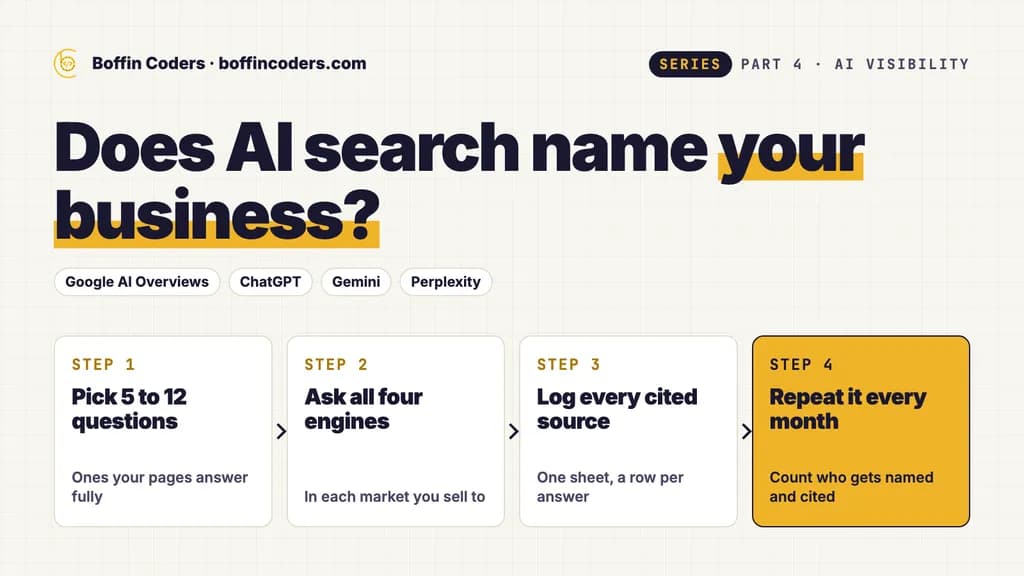
An AI visibility check shows whether AI search names your business, or cites your pages, when a buyer asks a question you can answer. Choose 5 to 12 questions that your pages answer in full, put each one to Google, ChatGPT with search, Gemini and Perplexity, and log every cited source in one sheet. Repeat it every month. By hand it costs only your time. With many questions or markets, a paid API does the same work for under one US cent per answer.
Boffin Coders ran this check on 16 October 2026: six buyer questions in ChatGPT and twelve in Google, each asked in the US and the UK. All 12 ChatGPT answers searched the web first. One of them, a UK answer to "who is the best white label web development company for agencies", listed Boffin Coders fourth and linked to the page it read. It quoted three plain facts from that page: an agreement not to approach the agency's clients, delivery under the agency's brand, and work kept in a repository the agency names.
What does an AI visibility check tell you?
An AI visibility check tells you, question by question, whether an AI answer appears, which sources it cites, and whether your business or your pages are among them. It also shows which sites the engines trust for your subject. In the Boffin Coders check on 16 October 2026, Google showed an AI Overview for 21 of 23 searches, and those overviews cited 200 sources between them.
Read the sources even when you are not among them. YouTube was the most cited site in that check, with 29 of the 200 citations, then LinkedIn with 7 and Reddit with 6.
What can Search Console show?
Search Console now has a Search Generative AI performance report. Google announced it in June 2026 and rolled it out to all websites by 31 August 2026. It shows how often your pages appeared in AI Overviews and AI Mode, with the pages, countries, devices and dates, and the same impressions stay in the main Performance report. It counts impressions only, so it tells you that a page was shown, not which question was asked or what the answer said. ChatGPT, Gemini and Perplexity are not in Search Console at all, so the citations still need a sheet of their own.
Which questions should go into an AI visibility check?
Put 5 to 12 questions into the check. Each should be a question a buyer asks before choosing a supplier, and each should be answered in full by one page on your site. Five is enough for the first run by hand. Write each question next to the page that should answer it, because that pairing is what you score every month.
Pick questions that make the engine search
An engine can only cite your page when it searches the web. When Boffin Coders put five time-zone questions to four engines on 7 October 2026, ChatGPT and Gemini searched for only two of them and answered the other three from memory, with no source. On 16 October, all 12 ChatGPT answers to buying questions, such as "recommend a white label app development company", searched first. Questions where the buyer compares, chooses or needs current facts give you a citation to win.
Phrase them the way buyers type them, with the country
Type each question the way a buyer types it, as in "I run a marketing agency, who can build websites for my clients under my brand", one of the six prompts on 16 October. For a bookkeeping firm in Toronto, the list might hold "how much does a bookkeeper cost in Canada" and "bookkeeper for contractors in Toronto".
Add the country when the answer depends on it, or run the list from each market you sell to. ChatGPT often adds the country itself. In the UK run, it put "UK" into its searches for 5 of the 6 questions, although none of them named a country, and in 6 of the 12 answers it added the year. Google differs by country too: two of the twelve questions showed an AI Overview in the US and none in the UK on the same day.
How do you check if AI search mentions your business?
To check if AI search mentions your business, put each question to four engines on the same day and write down what every answer cites: Google, ChatGPT with search, Gemini and Perplexity. Use a private browser window for Google and a temporary chat in ChatGPT, so your own history and saved memories do not shape the answer.
- Search the question in Google. Note whether an AI Overview appears. If it does, expand it and copy every source link it shows. Copy the first page of results too, for the page-one count.
- Ask ChatGPT with search turned on. When it searches, it lists the pages it used as sources. Copy each one, and look for your business name in the answer.
- Ask Gemini the same question. Record whether it gave linked sources or answered from memory.
- Ask Perplexity. It shows sources with every answer. Copy them in the order shown.
- Fill in the sheet the same day. Paste in the answer text too, so you can reread what the engine said about you.
By hand, you see the answers for the place you are in. To see another market's answers, ask someone there to run the questions, or use a paid API that sets the country for each call. Five questions in four engines is 20 answers a month for one country.
What should the sheet record?
The sheet needs one row for each question, engine, country and run, with the same columns every month so that runs compare line by line. The example row is a bookkeeping firm checking a price question in Canada.
Column | What to write | Example |
|---|---|---|
Date | The day of the run | 3 November |
Question | Exactly as typed | how much does a bookkeeper cost in Canada |
Country | Where the answer was seen | Canada |
Engine | The engine and its mode | ChatGPT with search |
Searched | Did the engine search the web? | Yes |
Sources cited | Every cited URL, in order | 7: three firm sites, two directories, a forum thread, a video |
Named | Your business in the answer, with the words used | No |
Your page cited | Your URL among the sources | None |
Page-one sources | Cited sites with a first-page Google result for the question | 4 of 7 |
Your page for it | The page that should answer the question | yoursite.com/bookkeeping-prices |
Keep the question text fixed from month to month, because a reworded question is a new question. Track new questions in a separate block.
What do you count each month?
Count three numbers each month: the answers that name your business, the answers that cite one of your pages, and the share of all cited sources that come from sites with a first-page Google result. The first two tell you whether you are visible. The third tells you whether ranking on Google is your way into the answers.
A name and a citation are different results. An answer can name a business it read about on a directory or a forum, without linking to its site. Count that on the named line only, and note the source.
The page-one share tells you where to put the work. In both Boffin Coders checks, about half the sources in Google's AI Overviews came from sites that also held a first-page result: 11 of 21 on 7 October and 93 of 200 on 16 October. Ranking helps, and the other half came from sites without one.
Work out each count as a share of the answers that searched, since an answer from memory has no sources to win. If you sell in more than one country, keep the counts per country.
Why run an AI visibility check every month?
Run an AI visibility check every month because the answers change. AI engines write each answer fresh, the pages they search keep changing, and a page you rewrite has to be crawled again before any engine can quote the new text. One run is a snapshot of one day. The same questions, run month after month, show the trend.
Country changes the answer too. On 16 October, the question "who is the best white label web development company for agencies" produced a different list of firms in the US and in the UK. A run from one country would have recorded only one of the two lists.
What should you fix first after the check?
Start with the questions where your page already holds a first-page result but no AI answer cites it, because the engines can find that page. The GEO vs SEO guide shows how to edit a page so an engine can quote it. Work in this order:
- Edit the pages that rank but are not cited. Put the answer in the first two sentences of the section, use the buyer's words in the heading, and add a table where the reader compares options.
- Retitle pages whose titles miss the buyer's words. In the 16 October check, 171 of the 200 citations in AI Overviews had a title that shared a main word with the question.
- Answer where the engines already look. Where video, forums or directories carry most of the citations, add your answer there too, as a short video, a forum reply or a complete directory profile.
- Write the missing page. If no page of yours answers a question in full, write one and keep the question in the next run.
Where you are named, read what the engine quoted, and make sure those facts read the same on your site and on every profile. They are the lines an engine passes on to the buyer.
Running the check for clients
An agency can run the same check for every client site, with one question list and one sheet per client. Here a paid API starts to make sense: ten clients with ten questions in two countries is 200 Google searches a month, before any AI chat engine. Boffin Coders runs this check each month as part of its white label SEO services, and the results go into the spreadsheet the agency receives for its client report, under the agency's brand.
Should you check by hand or with a paid API?
Check by hand while you track up to about a dozen questions in one country. Move to a paid API when you track more questions, more countries or more than one site. An API sends each question from the country you choose and returns the answer with its sources as data, ready for the sheet. The 35 checks Boffin Coders ran on 16 October 2026 cost about US$0.17 in total.
That was 23 Google searches at US$0.0035 to US$0.0055 each and 12 ChatGPT answers at US$0.004 each. The 7 October check, 20 calls across four engines, cost US$0.07.
For ChatGPT, the API also returns the searches the engine ran before it answered. One UK answer searched for "white label WordPress development partner agency reviews Reddit", adding two words the buyer never typed, which shows where else your name needs to appear.
API calls can fail. One UK search on 16 October failed twice, which is why that run has 23 Google results and not 24. Mark a failed call as missing, so it is never counted as an answer that left you out.
Start this month with five questions and one country, and keep the sheet even if the first run shows nothing of yours, because the second run is the first one you can compare against. If you would rather have the check run for your site every month, send the questions and the pages you want tracked and you get a reply about them.
Keep reading
Santosh Kumari
SEO and AI Search Specialist
Santosh Kumari works on technical SEO and AI search visibility, from site fixes to the structured data and page formats that AI answers quote. Santosh Kumari writes about practical changes that help search engines and AI understand a page.
Frequently asked questions
An AI visibility check costs only time when you run it by hand: five questions in four engines is 20 answers to read and log each month. A paid API costs less than one US cent per answer. A run of 35 checks in October 2026, 23 Google searches and 12 ChatGPT answers in the US and the UK, cost about US$0.17.
Not answered here?
Need this built?
We build websites and apps for businesses, and work behind digital agencies as their development team. Tell us where things stand on a 20-minute call.