How to Rank in AI Overviews: What 200 Citations Share
- October 16, 2026
- 10 min read

SEO and AI Search Specialist
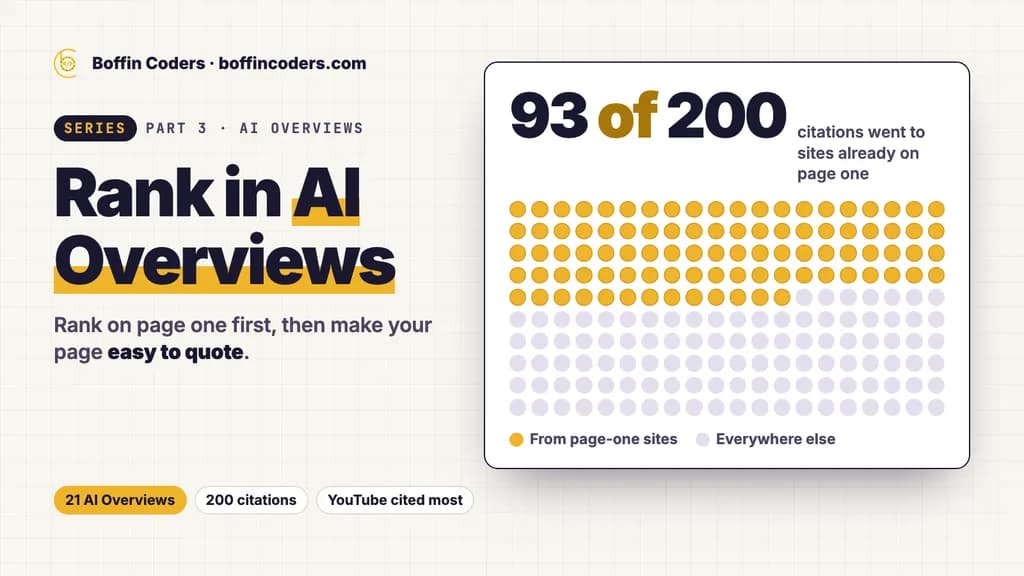
How to rank in AI Overviews has a two-part answer: rank on Google's first page for the question, then make your page easy to quote. Google says a cited page only has to be indexed and eligible for a snippet, with no special markup or AI file. In our check of 21 AI Overviews, 93 of the 200 citations went to sites that also held a first-page result, and YouTube was cited more often than any other site.
Ranking in an AI Overview means being one of the links Google cites beside its answer. To see what those links have in common, we searched Google for 12 questions that our own pages answer, in the United States and the United Kingdom, on 16 October 2026. That made 24 searches, and 23 returned a results page. For each one we recorded every source the AI Overview cited and the first 20 ordinary results below it, through a commercial search-data API (desktop, English, one run per search). GEO vs SEO explains how a citation differs from a ranking.
What does Google say decides which pages AI Overviews cite?
Google's answer is that ordinary search decides. Its guide to optimising your site for generative AI features says these features rest on its core ranking and quality systems, and calls the work "still SEO". The page on AI features and your website sets one condition for a supporting link: the page must be indexed and eligible to show in Google Search with a snippet. There are no extra technical requirements.
Both pages say you do not need an llms.txt file, other AI text files or special schema.org markup, and the guide adds that Google Search ignores llms.txt files. Nor do you need to cut a page into small chunks or write in a special way for AI, because Google's systems understand synonyms and can show the relevant part of a longer page.
AI Overviews may use "query fan-out", running related searches across subtopics, so an overview can cite a wider set of pages than the classic list of results shows. And an overview appears only when Google's systems judge that it adds something to the classic results, so many searches get none.
How often did an AI Overview appear, and what did it cite?
An AI Overview appeared on 21 of the 23 results pages. The two without one were UK searches on technical subjects: upgrading Next.js to version 16, and Swift Package Manager in Flutter. The same searches in the US did show an overview, so read any single run as a snapshot.
The 21 overviews cited 200 sources between them, from 2 to 17 each. Those 200 links went to 124 different sites, and 96 of those sites were cited once. A top-10 result means the site also held one of the first ten ordinary results for that search.
Question searched | AI Overview shown | Citations | From sites with a top-10 result |
|---|---|---|---|
GEO vs SEO | US and UK | 17 | 1 |
How much does it cost to hire a React developer | US and UK | 30 | 9 |
How to build a location-based app | US and UK | 25 | 14 |
How to redesign a website without losing SEO | US and UK | 22 | 13 |
How to split large Excel files in Node.js | US (UK search not returned) | 2 | 1 |
How to upgrade Next.js to version 16 | US only | 7 | 5 |
Outsourcing web development for agencies | US and UK | 17 | 10 |
Stripe Elements vs Stripe Checkout | US and UK | 20 | 15 |
Swift Package Manager in Flutter | US only | 6 | 4 |
Website handover checklist | US and UK | 11 | 7 |
What is a dedicated development team | US and UK | 22 | 12 |
White-label SEO for agencies | US and UK | 21 | 2 |
All 12 questions | 21 of 23 searches | 200 | 93 |
Which sites were cited most often?
YouTube led by a wide margin, then LinkedIn, Reddit and Stripe's documentation.
Source | Citations | Overviews that cited it |
|---|---|---|
YouTube videos | 29 | 13 |
LinkedIn articles and posts | 7 | 7 |
Reddit threads | 6 | 6 |
Stripe's documentation | 6 | 2 |
Next.js documentation and blog | 4 | 1 |
Do you need to rank on page one to appear in an AI Overview?
Sites on page one supplied just under half of the citations. Of the 200 citations, 93 went to a site that also held one of the first ten ordinary results for the same search, and 64 of those were the very page that ranked. Count the first 20 results instead of 10 and the share rises to 120 of 200.
The share depended on the subject. On the Stripe question, 15 of the 20 citations came from sites on page one, and on the US Next.js upgrade it was 5 of 7. On the two marketing questions it fell to 1 of 17 for GEO vs SEO and 2 of 21 for white-label SEO for agencies. Our reading is that where many pages say much the same thing, the overview draws from a wider pool, and that pool includes videos. Of the 80 citations from sites with no result in the first 20, 14 were YouTube videos. Fan-out may explain part of the rest: the overview can run related searches, and a page that ranks for one of those can be cited without ranking for yours.
Rank for the question itself first, then answer the narrower questions around it as sections of the same page. Google says that making a separate page for every variation, mainly to manipulate results, breaks its spam policy on scaled content.
How to optimize for AI Overviews on pages you already have
If you want to know how to optimize for AI Overviews, start with the pages that earn impressions for their question in Search Console, since Google already finds and ranks them.
Answer the question in the first two sentences under a heading that asks it
Use the buyer's question as the heading, in the words they type, and answer it in the first two sentences below it. Answering first is what a reader wants, and it gives the overview a clean passage to show beside its link.
The passages Google showed from cited pages fit this pattern. On the dedicated team question, 13 of the 22 held a one-sentence definition, "A dedicated development team is...", and in 6 of them the definition came straight after a heading that asked the question. On the React cost question, 15 of the 30 passages contained a price. If your answer sits in the fourth paragraph, move it to the top of the section.
Put the subject in the title the way people search for it
Of the 200 citations, 178 went to a page with at least half of the question's main words in its title, leaving out small words such as "how", "to" and "what". Every main word appeared in 89 of the titles. On the dedicated team question, 19 of the 22 cited titles held all three: dedicated, development and team. Since Google's systems understand synonyms, the aim is a plain title that names the subject, with no need to repeat a keyword.
Add a short video for how-to topics
YouTube's share was highest on the "how to" questions. On the four of them, videos took 18 of the 56 citations, and on how to build a location-based app they took 10 of 25. Of the 29 YouTube links in the whole check, 17 pointed to a set moment inside the video.
Google's guidance says its AI search features can bring in relevant images and video, and its video documentation says it gives priority to the moments a creator marks, through structured data or the timestamps in a YouTube description. For a how-to page, record the steps on screen, add timestamps with step names to the video's description, and embed the video next to the written steps on your page.
Take part where people ask the question
After YouTube, the most cited sites were ones where people discuss things in public: LinkedIn, with 7 citations from articles and posts, and Reddit, with 6 threads. Stack Overflow and Quora added three more.
Google says its AI features can show what people say about products and services in blogs, videos and forum discussions, and that chasing inauthentic mentions "isn't as helpful as it might seem". So answer real questions in the threads where your buyers ask them, under your own name, and turn what you learn from your own projects into LinkedIn articles.
Keep your facts in line with the official documentation
On technical questions the overview leaned on the maker's own pages. For Stripe Elements vs Stripe Checkout, 10 of the 20 citations went to Stripe's documentation, product and support pages. For the US Next.js upgrade, 4 of 7 went to the Next.js docs and release posts. For Swift Package Manager in Flutter, 3 of 6 were issues on the plugin projects' own GitHub pages and one was a post from the Flutter team's LinkedIn account.
When the official answer sits next to yours, a page that names an old version or uses different terms gives the overview a reason to cite something else. Name the version you tested, use the terms the documentation uses, and link to the page you followed. Keep your own figures identical across your pages too, so the overview never has two answers to choose from.
Make sure nothing keeps the page out
Check these before you rewrite anything:
- Allow crawling. Google asks that robots.txt, and any CDN or hosting layer in front of the site, let its crawler in.
- Confirm the page is indexed. The URL Inspection tool in Search Console shows whether it is.
- Leave snippets on. Google's robots meta tag guide says a nosnippet rule, or max-snippet set to 0, keeps a page's content out of AI Overviews and AI Mode. Keep data-nosnippet off your answer too.
- Put the answer in the HTML the server sends. Google can process JavaScript that is not blocked, but calls SEO on JavaScript frameworks generally more complex. Server-rendered text is the simplest route.
- Check that no rule blocks snippets. Google's robots meta tag documentation says a nosnippet rule, or max-snippet set to 0, keeps a page's content out of AI Overviews and AI Mode. Remove it from any page you want quoted.
- Watch the Generative AI performance report. It shows how often links to your site appeared in AI Overviews and AI Mode, by page, country, device and date.
When these fail across a whole site, that is work for a technical SEO agency before any rewriting.
How to rank in AI Overviews: which pages to change first
Start with the pages closest to being cited, and work in this order:
- List the questions your buyers ask and search each one, noting which show an AI Overview and which pages it cites.
- Pick your pages that rank in the first 20 results for a question with an overview. In our check, sites in the first 20 took 120 of the 200 citations.
- Rewrite the opening of each section so the heading asks the question and the first two sentences answer it, with the figure or version the reader came for.
- Add the narrower questions that the cited pages cover as sections of the same page, and a short video where the topic is a how-to.
- Search the same questions again each month and compare the cited pages with yours.
The same order works for your own site and for a client's. If you want a second view on which of your pages are closest to being cited, send us the questions your buyers ask and the pages that should answer them, and we will reply with the changes we would make first.
Keep reading
Santosh Kumari
SEO and AI Search Specialist
Santosh Kumari works on technical SEO and AI search visibility, from site fixes to the structured data and page formats that AI answers quote. Santosh Kumari writes about practical changes that help search engines and AI understand a page.
Frequently asked questions
No. Ranking helps, but it does not promise a citation. Of the 200 citations we recorded across 21 AI Overviews, 93 went to sites that also held one of the first ten results for the same search, and 64 were the very page that ranked. Google also says that a page meeting every requirement may still not be indexed or shown.
Not answered here?
Need this built?
We build websites and apps for businesses, and work behind digital agencies as their development team. Tell us where things stand on a 20-minute call.