White Label SEO Pricing: What Should Your Agency Pay and Charge?
- October 25, 2026
- 8 min read

SEO and AI Search Lead
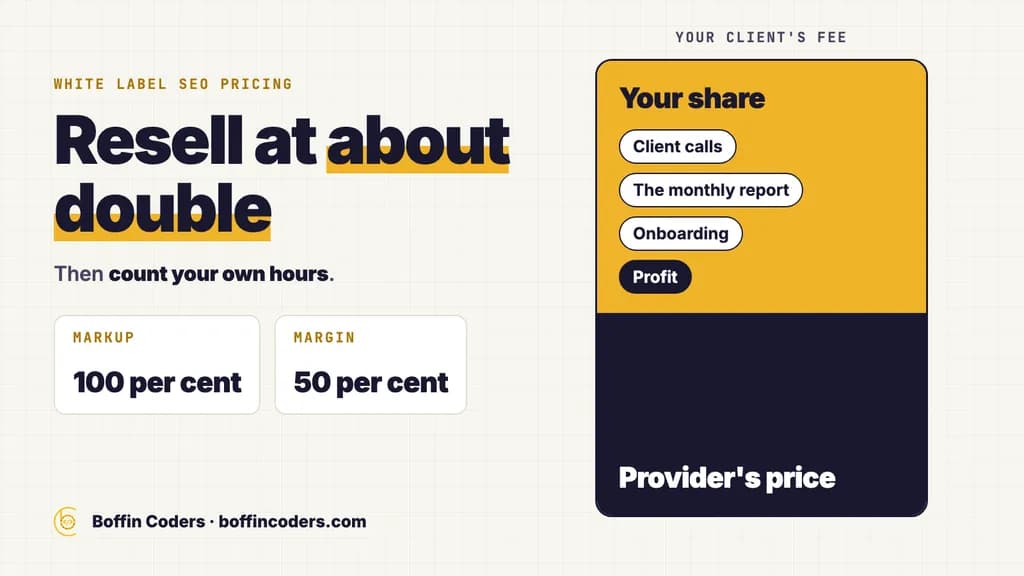
White label SEO pricing comes in three shapes: a monthly plan for each client site, an hourly rate, or a fee for each keyword. On the US price lists that rank for this search, plans for one client start at US$299 or US$399 a month, and the guides beside them say to resell at about double. What sits inside the plan matters more than its price: the hours of real work, the kind of links, who writes the report, and whether you can stop when a client leaves.
Two plans can cost the same and deliver very different months. That gap is where an agency either earns its margin or loses the client.
How much does white label SEO cost?
We read the first page of US results for "white label seo pricing" on 23 October 2026. Six of the seven pages from businesses opened. Three of them are price lists, and all three sell a monthly plan for each client, starting at US$299 or US$399, described by what it includes and not by hours of work. The two markup guides both start from doubling: charge your client twice what the provider charges you.
The market uses three pricing models. This is how they compare on the pages that rank:
Pricing model | What you pay for | What the US first page shows | What to check |
|---|---|---|---|
Monthly plan for each client | A fixed list of tasks each month | Entry plans at US$299 or US$399 a month, and top plans up to US$2,999 on one list | How many hours of specialist time the plan holds |
Hourly | The time worked, at a stated rate | US$75 to US$200 an hour in one cost guide | A monthly cap, so the hours cannot run away |
A fee per keyword | Each keyword the provider targets | About US$75 to US$300 a keyword each month in the same guide | Whether the fee follows rankings or leads |
One of the price lists adds a layer the others do not show on the plan itself: an agency fee every month, US$500 while you have fewer than five client accounts and US$100 from five. Read the whole page before you compare two plans. So when someone asks how much does white label SEO cost, the honest answer is the plan price plus any agency fee, shared across your client accounts.
What a monthly white label SEO plan usually includes
The three price lists describe their plans in counts. A plan holds a number of page optimisations a month, a number of content pieces, a number of backlinks a month or a quarter, Business Profile posts, citations, review replies and a reporting dashboard. Extra locations and website changes cost more each month. One list prices a Business Profile package at US$100 a month for each profile.
Counts are easy to compare and easy to misread. Four links a month says nothing about where the links come from, and one list describes the links in its cheapest plan as six low-authority links a quarter. Ten page optimisations can mean ten title tags or ten rewritten pages. Ask what each count means in hours and in outcomes before you put the plan in a proposal.
What should you charge your client for white label SEO?
Most agencies resell white label SEO at about double the provider's price. Both markup guides on the US first page start there, and one calls it the 2x rule. The reason for doubling is simple: your half pays for selling the work, managing the client and writing the report, and what is left is profit.
Markup and margin are not the same number
Markup is your profit as a share of what the provider charges you. Margin is your profit as a share of what your client pays. Mix them up and you price too low.
Say the provider charges you US$450 a month for one client.
Your price to the client | Your profit | Markup | Margin |
|---|---|---|---|
US$675 | US$225 | 50 per cent | 33 per cent |
US$900 | US$450 | 100 per cent | 50 per cent |
US$1,125 | US$675 | 150 per cent | 60 per cent |
A 50 per cent markup sounds generous and leaves you a third of the fee. One of the guides suggests markups from 80 to 170 per cent, depending on the kind of offer, from basic local work up to campaigns across several locations.
Count your own hours before you set the price
Your share of the fee has to pay for time the provider never sees. Client calls, the monthly report, onboarding a new site and answering "why did we drop for this keyword?" all sit with you. Write down the hours each client takes your team in a normal month, multiply by what an hour of your team costs, and take that from your share first. A client who needs two calls a month can turn a 50 per cent margin into a loss.
Why can two plans at the same price deliver different work?
A plan is a list of outputs, and outputs vary in effort. Two plans at US$399 can hold very different months of work:
- A link from a real site in the client's trade takes outreach and time. A directory listing or a low-authority blog takes minutes.
- A page written from the client's own services and questions takes research. A generic article takes far less.
- Fixing why pages are not indexed can take a day or a week, and a plan that counts "optimisations" rarely says which.
- A live dashboard shows numbers. It does not tell your client what changed and why, and that explanation is what keeps them.
So ask every provider the same questions before you sign:
- How many hours of a specialist's time sit behind this plan each month?
- Where do the links come from, and can I see last month's list for a current client, with names removed?
- What do I receive each month, and in what form?
- What happens when a client leaves in the middle of a month or a term?
- Will you ever contact my client? The answer should be no, unless you ask.
Which white label SEO packages fit which kind of client?
White label SEO packages work best when the client's month looks the same every month. They work worst when the work changes from month to month. This is a practical way to match the pricing to the client:
Your client | What the month needs | Pricing that fits |
|---|---|---|
One location, such as a plumber, a clinic or a salon | Business Profile, reviews, citations, a few local pages | A small monthly plan, or a few hours a month |
Several locations | A profile and a page for each location, kept in line | A plan with a fee for each extra location, or hours that grow with the locations |
A competitive service or an online shop | New content, technical fixes, links from the trade | Hours, because the work shifts from month to month |
A site with deep problems, such as a failed migration or pages Google will not index | A fixed first phase, then ongoing work | Hours for the first phase, then a monthly plan |
The table also tells you when to walk away from a cheap plan. If the client's market is competitive, a plan built for a single-location plumber will not move it, and your client will blame you, not the provider.
What hidden costs eat an agency's SEO margin?
The plan price is only part of what you pay. Watch for these:
- An agency fee. One of the price lists charges one every month on top of the client plans.
- Setup fees and minimum terms. The cost guide on the same results page warns about both, and all three price lists advertise no long-term contract, which is the standard to ask for.
- A notice period longer than your client's. If your client can leave with 30 days' notice and your provider wants three months, you pay for two months of work nobody buys.
- Report writing. If the provider sends raw numbers, someone on your team turns them into a report every month.
- A change of provider. A move means a new onboarding, new access and often a dip while the new team learns the site.
How does hourly white label SEO pricing work in practice?
Hourly pricing puts the effort on the invoice. You see how many hours went into a client each month, and you can match the hours to the plan you sold. The risk is a bill that grows, so hourly work needs a monthly scope agreed before the month starts.
At Boffin Coders, white label SEO is quoted per client from the scope, whether that is SEO, backlinks, social media or app store optimisation, and the hours it needs, at US$10-22 an hour. It runs month to month, and the invoice comes after you have seen the month's work. Each month your agency gets the results in a spreadsheet: what shipped, with a link to each change, what moved in Search Console, and what comes next. You prepare the report for your client under your own brand. A mutual NDA and non-circumvention are signed before scoping, and Boffin Coders never contacts your client unless you ask. Work for AI search is priced the same way, and white label AI SEO explains what that covers.
Whichever provider you choose, compare plans on hours, links and reporting, then set your price at about double and check that your own hours still fit inside your share. If you would rather hand the work to a partner and keep the client and the margin, our white label SEO services page shows how a first month is scoped.
Keep reading
Pinkal Rana
SEO and AI Search Lead
Pinkal leads search strategy at Boffin Coders, from classic SEO to how brands get named in AI answers on Google, ChatGPT and Perplexity (AEO and GEO). Pinkal writes about what actually gets a business cited by AI search, using data from real checks.
Frequently asked questions
White label SEO costs about US$299 to US$399 a month per client site at the entry level of the US price lists that rank for the question, read on 23 October 2026, with top plans up to US$2,999. Hourly providers charge for the time worked instead. Compare what each plan includes in hours, links and reporting, not only the monthly figure.
Not answered here?
Need this built?
We build websites and apps for businesses, and work behind digital agencies as their development team. Tell us where things stand on a 20-minute call.