What questions should you ask a white-label partner?
- October 19, 2026
- 10 min read
Founder, Boffin Coders
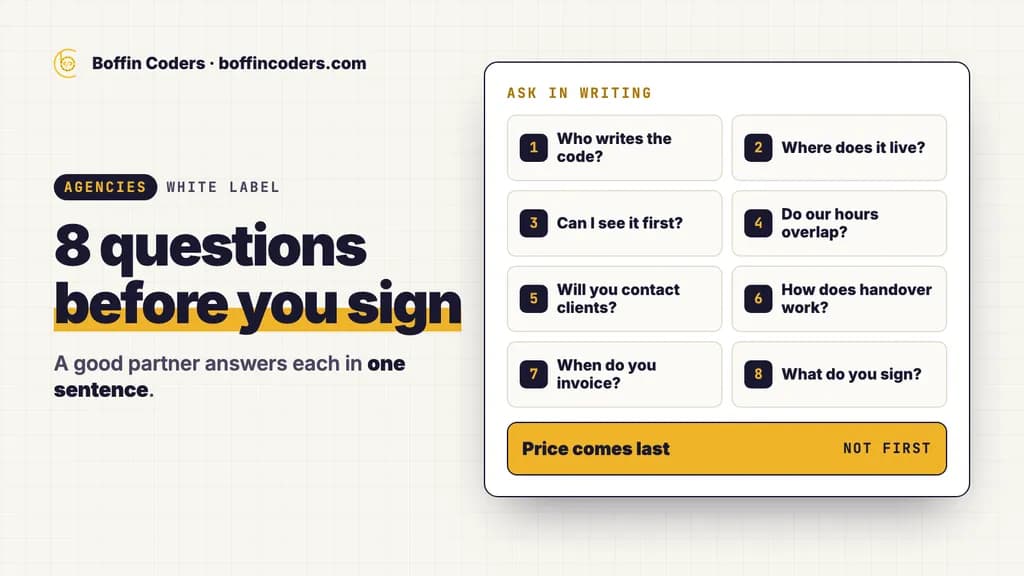
Ask a white-label partner eight questions before you sign: who writes the code, where the code lives, how you see the work before your client does, when your working hours overlap, whether they will ever contact your client, what happens at handover, when they invoice, and what they sign to keep the work confidential. A good partner answers each one in a sentence, in writing. This guide gives the answer to listen for, and the answers that should worry you.
The price is the last question, not the first. A cheap partner who loses you a client is the most expensive one you will ever hire.
What is a white-label partner?
A white-label partner is a company that does work for your agency which you sell to your clients under your own name. Your client briefs you, sees your brand on every deliverable and pays you. The partner builds, tests and supports the work behind you and never appears in front of your client. For a web or app agency, that usually means development: websites, web applications, mobile apps or SEO fulfilment, delivered into your tools and your client's accounts.
The arrangement works only if three things hold. The work is good enough to carry your name. Your client stays yours. And you can see everything before your client does. Every question below tests one of those three.
How do you choose a white-label partner?
Choose a white-label partner by asking the questions below in writing, then testing the answers with one small first piece of real work before you commit to more. Look for proof you can open yourself: public reviews you can read and live work you can install or visit. Boffin Coders, for example, is rated 4.9 across 20 independent reviews on Clutch and GoodFirms, and publishes eleven apps of its own on the stores.
A small first piece tells you more than any sales call. You see how they ask questions, how they write a scope, how their code reads and how they behave when something goes wrong. Pick a piece your client is waiting for but that would not hurt the relationship if it ran a little late. If the partner invoices only after you have seen that work, you have taken almost no risk.
Questions about who does the work
The questions about who does the work tell you whether you are hiring a team or a reseller of other people's time. Ask who writes the code, where it lives from the first day, and how each change reaches you before it reaches your client. At Boffin Coders the code is written by our own employees in Mohali, with no subcontracting, and it goes into the repository you name from the first commit.
Who writes the code?
Ask for the names and roles of the people who would work on your first project, and whether they are employees or contractors. Then ask the follow-up: "If you are busy, does any of this go to another company?" A partner that passes work on is adding a third party to your client's project without telling you.
Where does the code live?
The answer you want is "in your repository, or your client's, from the first commit". Code that lives in the partner's own account until the end of the project is code you do not control. If the partnership ends badly, you are negotiating for your client's own software. Who should own each account a project needs, and the role to grant a developer, covers the full list.
How do I see the work before my client does?
Every change should arrive as something you can read before your client sees it: a pull request in your repository with notes on what changed and how it was tested, or a staging site only you can open. Ask to see an example from a past project, with the client's details removed. You present the work to your client yourself, so you should never be surprised by it.
Can I speak to an agency you already work with?
Ask for one. A partner who works with agencies should be able to put you in touch with another agency owner, with that owner's permission, or point you to public reviews written by agencies. Ask that owner two things: what went wrong on a project, and how the partner handled it. Every partnership has a bad week. What you are checking is whether the partner told the agency early, fixed it without being chased, and kept the client out of it. Public reviews help here too, because the partner cannot edit them, and the critical ones tell you as much as the good ones.
Questions about hours and communication
Ask a white-label partner exactly when their working day falls on your clock, how you reach them outside it, and where updates appear. Boffin Coders works Monday to Friday, 9am to 6pm IST, takes calls in your working hours when you need them, replies usually the same working day, and posts updates in your own Jira, Slack or project board. A partner who can state this in one sentence has thought about it.
When do our working hours overlap?
Ask for the partner's office day on your clock, not theirs. Ours, on the clocks of the places we work with most, is:
- London: 3:30am to 12:30pm GMT (4:30am to 1:30pm BST)
- Dublin: 3:30am to 12:30pm GMT (4:30am to 1:30pm Irish summer time)
- Amsterdam: 4:30am to 1:30pm CET (5:30am to 2:30pm CEST)
- New York: 10:30pm to 7:30am EST (11:30pm to 8:30am EDT)
- Los Angeles: 7:30pm to 4:30am PST (8:30pm to 5:30am PDT)
- Sydney: 1:30pm to 10:30pm AEST (2:30pm to 11:30pm AEDT)
- Auckland: 3:30pm to 12:30am NZST (4:30pm to 1:30am NZDT)
Read that list two ways. Where the hours overlap with yours, you get a shared part of the day for calls and quick questions. Where they do not, you get a build day that finishes before yours starts, with the progress in your repository by your morning. Ask any partner the same question and check the answer against a clock.
How will we talk, and where will updates appear?
The good answer is "in your tools". Your client's project should not move into a partner's own ticket system that you have to check separately. Ask who your single contact is, how quickly they reply, and what a normal week looks like: stand-ups, sprint reviews, a written summary. Then ask what happens when that person is on holiday.
Questions about your client
The questions about your client test whether the partner could ever become your competitor for that account. Ask whether they will contact your client, whether their name appears anywhere in the work, and whether your client's project will show up in their portfolio. Boffin Coders signs non-circumvention before scoping, never contacts your client unless you ask, and keeps white-label work out of its portfolio.
Will you ever contact my client?
The only good answer is "no, and we will sign that before you tell us who the client is". A promise on a call is not enough. A non-circumvention clause is the written version: the partner agrees not to approach, sell to or take work from the clients you introduce. Ask for it to be signed before scoping, not after the first invoice.
Will my client ever see your name?
Check the places a name hides: the footer, the code comments, the app store listing, the email that sends password resets, the error pages and the partner's own portfolio. Ask the partner to confirm each one. Your client should be able to look anywhere in the work and find only your agency.
Questions about handover and the end of the work
Ask what happens when the project ends or the partnership stops, before it starts. The answer you want is that there is nothing to hand back, because the code, the hosting and every other account were in your client's name from day one. Boffin Coders works this way on every project: we are added to your client's accounts as members, so removing us is a few clicks.
What happens if we stop working together?
Ask the partner to describe the last day of a partnership, step by step. The good answer is short: you remove them from each account, stop sharing the password vault and replace the keys they used. If the answer involves transferring a repository, moving hosting or waiting for files, the accounts are in the wrong place today.
The same thinking applies when you take a site over from someone else. The website handover checklist lists what to collect, in order, so nothing is left in the previous developer's name.
Questions about money and contracts
Ask when the partner invoices, what you see before each invoice, and which contracts they sign before scoping. The answer to listen for is that you are invoiced after you have seen and reviewed the work, never up front. Boffin Coders invoices after you have reviewed each piece of work, and signs a mutual NDA and non-circumvention before scoping, so your client's details and the work stay confidential.
When do you invoice?
Ask whether they want a deposit, payment before each sprint, or payment after you have seen the work. Payment after the work keeps the partner's incentive where yours is: on finishing something you would put your name on. Then ask how changes are priced. Small adjustments should be part of the work, and bigger changes should be scoped as new work before anyone starts them.
What do you sign to keep the work confidential?
Keep this question simple. Ask which contracts the partner signs, and when. The answer you want is that they sign the contracts that keep your data and your client's data confidential, a mutual NDA, a non-circumvention clause and a data processing agreement, before scoping. Your own lawyer can then read them against your client contract.
What answers should worry you?
Some answers should make you pause before you sign, whoever gives them. These are the ones to listen for on any first call:
- "We will move it to your repository at the end." Then it is not in your repository now.
- "We can start on Monday if you pay this week." Payment before you have seen any work puts all the risk on you.
- "Our team lead will pass it to the developers." Ask to meet the developers.
- "We never sign anything before the project starts." Confidentiality and non-circumvention are signed before you share the brief.
- "We will send you a weekly report." A report is useful, but it is not a pull request you can read.
- "Overlap does not matter." It always matters. A good partner shows you their day on your clock and tells you how they work across it.
None of these alone means a partner is wrong for you. Each one is a reason to ask the next question, and to start with a small piece of work.
If you want to put these questions to us, the white-label development page sets out how we work with agencies, and each market page on it shows our office day on your clock. Ask us these questions on a call, and we will answer each one in writing afterwards.
Keep reading
Manoj Sethi
Founder, Boffin Coders
Manoj founded Boffin Coders in 2017 and leads its work with agencies: white-label builds, delivery and partnerships. Manoj writes about how agencies can add development capacity without losing control of their clients.
Frequently asked questions
A white-label development partner is a company that builds websites, apps or other development work for an agency, which the agency sells to its clients under its own brand. The client briefs the agency and deals only with the agency. The partner works behind it, in the agency’s tools and the client’s accounts, and its name appears nowhere in the work.
Not answered here?
Need this built?
We build websites and apps for businesses, and work behind digital agencies as their development team. Tell us where things stand on a 20-minute call.