SEO for cleaning companies: how you get into the map in every town you serve
- October 1, 2026
- 7 min read

Co-Founder, Boffin Coders
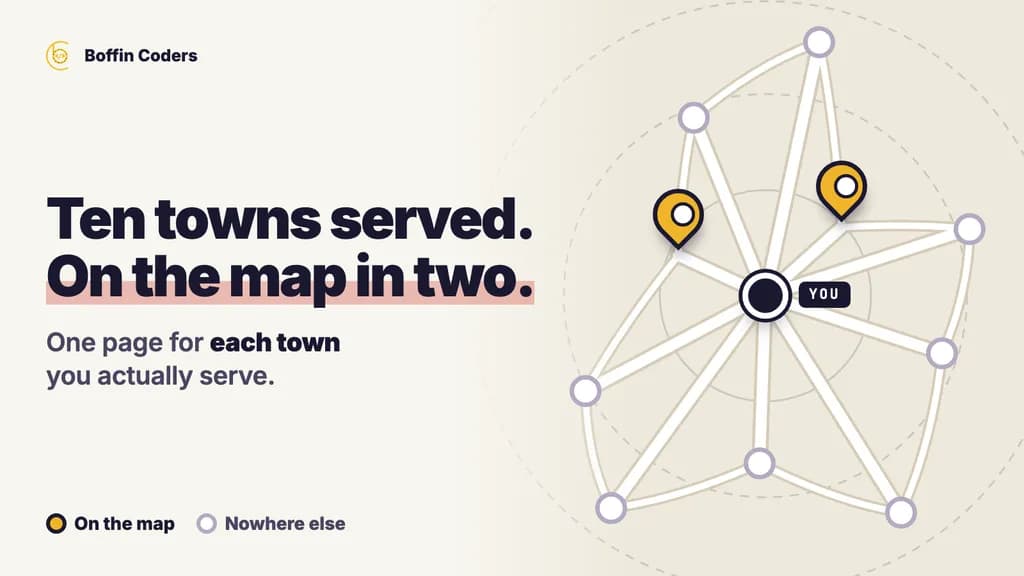
Someone who needs a house or an office cleaned searches for the service and the town, looks at the three businesses Google shows on the map, and calls one of them. SEO for cleaning companies is mostly the work of being one of those three, in every town you serve. It depends on four things: the Google listing, one honest page for each area, reviews with recent dates, and a site that shows a price and a phone number. Here they are in the order they usually pay back.
SEO for cleaning companies starts on the map
A cleaner goes to the customer, so Google treats a search for cleaning as local. For "deep cleaning" with a town name, or "office cleaning near me", it shows a map with three businesses above the ordinary results, and most people choose from those three. Google says its local results are based mainly on relevance, distance and prominence: how well your listing matches the search, how close you are to the person searching, and how well known you are, which includes your reviews.
Distance is the one you cannot change, which is why a business serving ten towns can appear on the map in two and nowhere else. The work below makes you relevant and known in the other eight.
Two different people are searching. A homeowner who wants a regular clean or a move-out clean is usually on a phone and wants a from-price and a number to call. An office manager searching for commercial cleaning or janitorial services is usually at a desk, and wants a quote form, a list of what is included, and proof that your staff are vetted and insured. Give each of them their own page.
Set up your listing as a service-area business
Most cleaning companies do not have customers visiting their premises. Google's rule for that case is plain: if you do not serve customers at your address, remove the address from your profile and set service areas instead. You can list up to 20, by town, postal code or district. Choose the towns you actually send teams to, not every town within reach.
Then check the rest of the listing against Google's guidelines for representing your business:
- Name. Your real business name, as it appears on your vans and your invoices. Adding words such as "cheap", "best" or a town name is against the guidelines and can get the profile suspended.
- Categories. The primary category is the work you most want more of, such as house cleaning or commercial cleaning. The others go in as secondary categories.
- Services and hours. Every service you sell, listed separately, with the hours your office answers the phone.
- Photos. Your own team, your own vehicles, rooms you have cleaned. Not stock photographs.
One page for each town you actually serve
This is the part most cleaning websites miss. A cleaning company we work with served 15 nearby towns from one generic service page, and did not appear in the map pack for most of them. Before the work, the site had 300-400 visitors and, by the client's count, 10-12 inbound leads a month. We built a page for each service area, rewrote the titles and descriptions, linked the pages to each other, made the site faster on a phone, optimised the Google Business Profile, collected reviews and made the business listings consistent across directories. After six months the business had five times more enquiries by the client's count, without spending more on ads, and appeared in the map pack for several neighbourhoods. The cleaning service case study has the detail.
A cleaning company, six months
One page for 15 towns was the problem. One page per town was the fix.
Residential, commercial, deep cleaning and move-in or move-out work, sold across 15 nearby towns from a single generic service page, and missing from the map in most of them.
15
towns served
From one generic service page before the work began.
10-12
leads a month, before
From 300-400 visitors a month, and no map-pack place in most service areas.
5x
enquiries after six months
Without more ad spend, and in the map pack for several neighbourhoods.
There is a limit. Google's spam policies name doorway pages: many near-identical pages made to rank for similar searches, such as one page per town with only the town name changed. Those pages do not help, and they can hurt the whole site. The difference between a doorway page and a real area page is whether the page says something true about that town that no other page on your site says.
Real page or doorway page
The test is what the page says that no other page does
| On the page | Doorway page | Real area page |
|---|---|---|
| The town | The name swapped into the same paragraph | The districts you cover, and the days your teams are there |
| Services | The full list, copied from the home page | What you actually do there, such as office contracts in the business district |
| Price | None, or the same line as every other page | Your from-price, and any travel charge for that area |
| Proof | Stock photographs | A job photographed in that town, and reviews from customers there |
| Contact | A generic form | The same number and quote form, with the town already filled in |
The town
- Doorway page
- The name swapped into the same paragraph
- Real area page
- The districts you cover, and the days your teams are there
Services
- Doorway page
- The full list, copied from the home page
- Real area page
- What you actually do there, such as office contracts in the business district
Price
- Doorway page
- None, or the same line as every other page
- Real area page
- Your from-price, and any travel charge for that area
Proof
- Doorway page
- Stock photographs
- Real area page
- A job photographed in that town, and reviews from customers there
Contact
- Doorway page
- A generic form
- Real area page
- The same number and quote form, with the town already filled in
If you have nothing specific to say about a town, do not make a page for it. List it on a single page of areas you cover, and put your effort into the towns where you have real jobs, real customers and real reviews.
Reviews: the dates matter more than the total
People read the newest three reviews and look at when they were written. A long list of old reviews loses to a few from last month, so the habit that matters is a steady flow, not a single push.
- Ask every customer on the day the job is done, with a text message that contains the direct link to your review form.
- Reply to every review, including the bad ones, in plain words. A calm reply to a complaint tells the next reader more than the complaint does.
- Never offer a discount or a free clean in return for a review. Google's review policies do not allow it.
Your website: the price and the phone number first
The listing brings the visit. The website decides whether the phone rings. For cleaning business SEO the site has fewer jobs than people think, and all of them belong on the first screen of a phone:
- A phone number that calls when tapped, at the top of every page.
- A from-price for your main services: a regular clean, a deep clean, a move-in or move-out clean. A customer who cannot see any price assumes yours is high.
- A quote form with four or five fields: the area, the size of the home or office, the type of clean, and a preferred day.
- For commercial work, a separate page with what is included, how you vet staff, your insurance, and the same short quote form.
- A first screen that loads quickly on a mobile connection.
Keep your business name, phone number and service area the same everywhere they appear: the site, the Google listing, and every directory you are listed in. When they differ, Google is less sure the listings describe the same business.
What to measure every month
Website visitors are the wrong number to watch. Watch three things instead:
- Calls, from the listing and from the site, counted separately.
- Form fills, split into residential and commercial.
- Map position for your service and each town you serve, such as "carpet cleaning" with the town name. Check it from inside that town, because the map changes with where the person searching is standing.
If calls and form fills are not moving by the third month, something in the listing or the area pages is wrong, and it is worth finding out what before you spend more.
Local SEO for a cleaning business: who does the work
Many owners run the listing and the reviews well themselves. The area pages and the website take longer, and that is where most ask for help. Website and local SEO for cleaning and home-service businesses covers all four parts: the listing, a site that takes the call, a review request after every job, and a monthly report on calls, form fills and map position. The local business package is US$550 a month, month to month with no contract, and everything is set up in your own accounts. It starts with a free check that returns the three things costing you customers, within two working days.
What to check this week
Checks for this week
Twelve checks, most of them on your own phone
Your Google listing
- Address hidden if customers never visit youSet as a service-area business instead.
- Service areas match the towns you send teams toGoogle allows up to 20. Choose real ones, not everything within reach.
- Your real business name, and nothing addedNo "cheap", no "best", no town name.
- Primary category is the work you want mostHouse cleaning or commercial cleaning, the rest as secondary.
- Photos of your own team and vehicles
Your reviews
- The newest review is from this month
- Every review has a reply, including the bad ones
- A review link goes out after every jobBy text, on the day the job is done.
Your website, on a phone
- A number that calls when tapped, on the first screen
- A from-price for your main cleans
- A quote form of four or five fields
- A separate page for commercial workWhat is included, staff vetting, insurance.
Start with a search on your own phone for your main service and the name of each town you serve, and write down where you appear on the map. Then open your Google listing and check that the address is hidden if customers never visit, that the service areas match the towns you actually work in, and that the name is your real business name and nothing more. Look at the date of your newest review, and send a review link to every customer you clean for this week. Finally, open your website on the same phone and see whether the number, a price and the quote form are all on the first screen, because whatever is missing from that list is the work, whether you do it yourself or hand it to someone else.
Related: Local SEO for cleaning and home-service businesses · The local business package · How a cleaning service got five times more enquiries
Keep reading
Jyoti
Co-Founder, Boffin Coders
Jyoti co-founded Boffin Coders and looks after client relationships and how projects run from first call to handover. Jyoti writes about hiring, process and what makes a development partnership work.
Frequently asked questions
SEO for cleaning companies is mostly local. For a cleaning search with a town name, Google shows three businesses on a map, and most people call one of those three. Four things decide whether you are one of them: a Google listing set up as a service-area business, one honest page for each town you serve, reviews with recent dates, and a site that shows a price and a phone number first.
Not answered here?
Sell SEO to your clients without hiring an SEO team
Boffin Coders is the search team behind agencies: technical SEO, local SEO and answer-engine optimisation, delivered under your brand. You see the work before you pay.
Need this built?
We build websites and apps for businesses, and work behind digital agencies as their development team. Tell us where things stand on a 20-minute call.