Scaling AI Automation: Enterprise Integration with Model Context Protocol (MCP)
- June 1, 2026
- 5 min read
Founder, Boffin Coders
-1024x576.webp&w=3840&q=75)
The Legacy Trap: Why Custom API Glue Fails Enterprise AI
Before the emergence of the Model Context Protocol (MCP), connecting an AI agent to private database records or Customer Relationship Management (CRM) data was a tedious task. Developers had to write custom middleware, unique schemas, and API translation layers for every single endpoint they wanted to expose to an LLM:
1[Agent Client] ──► [Custom API Glue] ──► [Legacy CRM API] ──► [CRM Data]
2(Spaghetti code)      (Custom Parser)       (Proprietary Format)
This legacy approach introduced three significant operational bottlenecks:
- High Maintenance: Any minor change in the underlying CRM database schema broke the custom API parser, leading to immediate agent failure.
- No Standardization: Every developer built tools differently, making it impossible to share capabilities (like search, file read, or query execution) across different agents.
- Security Vulnerability: Exposing raw APIs to LLMs without a secure abstraction boundary often allowed agents to execute unauthorized queries or manipulate restricted fields.
Standardizing AI Integrations with MCP
The Model Context Protocol (MCP) is an open-source standard designed to eliminate custom API integration glue. Under the hood, the 2026 specification operates as a stateless protocol (meaning the server doesn't retain session data between requests, drastically improving scale-out capabilities) over standard HTTP.
MCP introduces a standardized set of message schemas (JSON-RPC 2.0 format) that allow LLM clients to:
- Discover Resources: Discover files, databases, and semantic data stores (`resources/list`).
- Inspect Tools: Query the actions that can be performed against the data source (`tools/list`).
- Execute Operations: Safely run specific code or read/write requests through strict parameters validation (`tools/call`).
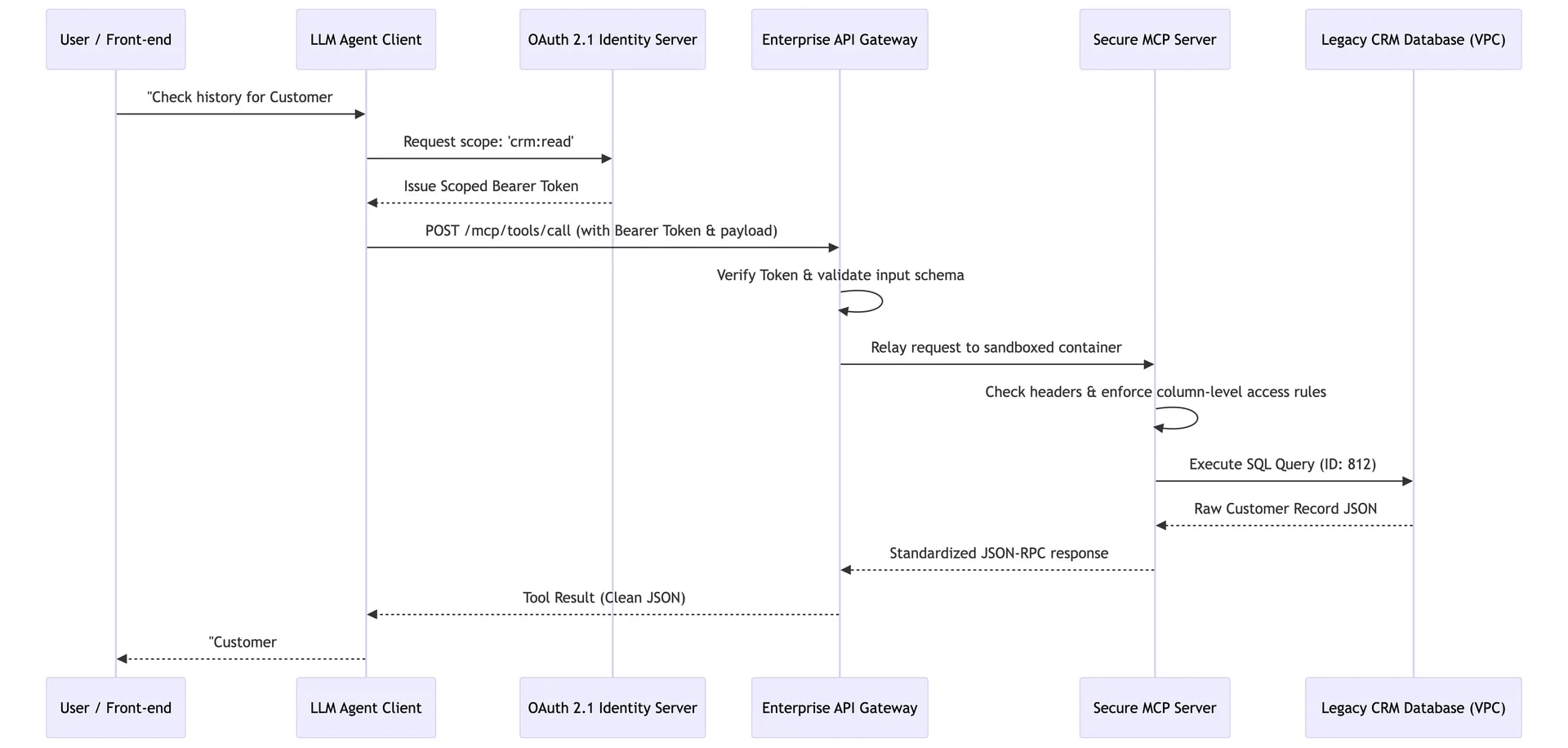
To protect sensitive data, the system leverages enterprise-grade authentication frameworks like OAuth 2.1 to sandbox the AI agent. The agent is only granted temporary, scoped access tokens, preventing it from executing queries beyond its designated workspace boundaries.
The Boffin Coders Secure Architecture
At Boffin Coders, we implement MCP to securely bridge legacy enterprise data structures with modern autonomous agents.
Here is the high-level architecture diagram illustrating an MCP Server safely exposing CRM customer records to an LLM client, sitting behind a secure gateway and OAuth 2.1 authorization boundary:
Code Blueprint: Building an Authorized MCP Server
Here is a TypeScript blueprint showing how Boffin Coders implements a stateless MCP Server using the official @modelcontextprotocol/sdk to securely expose CRM database queries.
Code Snippet: CRM Data Connector with OAuth 2.1 Scopes Validation
1import { McpServer } from "@modelcontextprotocol/sdk/server/mcp.js";
2import { ResourceTemplate } from "@modelcontextprotocol/sdk/common/resources.js";
3import { z } from "zod";
4
5// 1. Instantiate the stateless MCP server
6const crmMcpServer = new McpServer({
7  name: "BoffinCoders-CRM-Connector",
8  version: "1.2.0"
9});
10
11// 2. Define the secure customer lookup tool
12crmMcpServer.tool(
13  "get_crm_customer",
14  {
15    customerId: z.string().describe("The unique numeric ID of the CRM customer"),
16    includeBilling: z.boolean().default(false).describe("Whether to include invoice details")
17  },
18  async ({ customerId, includeBilling }, extra) => {
19    // A. Enforce OAuth 2.1 token validation from headers
20    const authHeader = extra.headers?.["authorization"];
21    if (!authHeader || !authHeader.startsWith("Bearer ")) {
22      return {
23        content: [{ type: "text", text: "Error: 401 Unauthorized - Missing OAuth Token" }],
24        isError: true
25      };
26    }
27
28    const token = authHeader.substring(7);
29    const tokenClaims = verifyTokenClaims(token); // Decodes and checks signature
30
31    // B. Verify required scopes
32    if (!tokenClaims.scopes.includes("crm:read")) {
33      return {
34        content: [{ type: "text", text: "Error: 403 Forbidden - Insufficient token scopes" }],
35        isError: true
36      };
37    }
38
39    // C. Query secure database within column-level access rules
40    try {
41      console.log(`Executing query against CRM database for Customer ID: ${customerId}`);
42      const clientRecord = await queryCrmDatabase(customerId);
43
44      if (!includeBilling) {
45        delete clientRecord.creditCardDetails;
46        delete clientRecord.billingHistory;
47      }
48
49      return {
50        content: [{ type: "text", text: JSON.stringify(clientRecord, null, 2) }]
51      };
52    } catch (dbError) {
53      return {
54        content: [{ type: "text", text: "Database lookup failed or record not found." }],
55        isError: true
56      };
57    }
58  }
59);
60
61// Helper Mock functions:
62function verifyTokenClaims(token: string) {
63  // Decode JWT and extract details
64  return { orgId: "acme", userId: "user-921", scopes: ["crm:read"] };
65}
66
67async function queryCrmDatabase(id: string) {
68  return {
69    id,
70    name: "Apex Enterprises",
71    contact: "finance@apex.com",
72    billingHistory: "$12,400 paid",
73    creditCardDetails: "•••• •••• •••• 4812"
74  };
75}
Key Takeaways for Enterprise AI Scale
By moving away from bespoke integrations and adopting the Model Context Protocol (MCP), enterprises can deploy autonomous agents with peace of mind:
- Unified Interface : The agent client doesn't need to know *how* to talk to your CRM, database, or ERP. It simply asks the MCP server for a listing of available tools.
- Stateless Scalability: MCP servers run in lightweight containers (like Docker or serverless functions) that scale out effortlessly as traffic grows.
- Tight Guardrails: Column-level sanitization and OAuth token checks guarantee that the agent never reads or modifies files outside of its permission sphere.
Keep reading
Manoj Sethi
Founder, Boffin Coders
Manoj founded Boffin Coders in 2017 and leads its work with agencies: white-label builds, delivery and partnerships. Manoj writes about how agencies can add development capacity without losing control of their clients.
Need this built?
We build websites and apps for businesses, and work behind digital agencies as their development team. Tell us where things stand on a 20-minute call.