-1024x576.webp&w=3840&q=75)
Technologies Used
1- THE DIAGNOSIS
1. Executive Summary
In competitive rental markets, speed is not an operational detail — it is a revenue lever.
Our client, a property management company responsible for over 1,000 residential units, was losing approved tenants not because of pricing, location, or property quality — but because of paperwork latency.
Lease generation required up to 48 hours due to fragmented manual workflows. In high-demand markets where tenants evaluate multiple properties simultaneously, that delay created a silent but costly leakage in conversions.
The consequence was predictable:
- Qualified tenants received approval
- Leasing staff began preparing documents
- Competing properties sent leases within hours
- Prospects signed elsewhere
In short, the company had optimized lead generation, but the closing mechanism was broken.
Boffin Coders approached the problem not as a document-generation task, but as a transaction acceleration challenge.
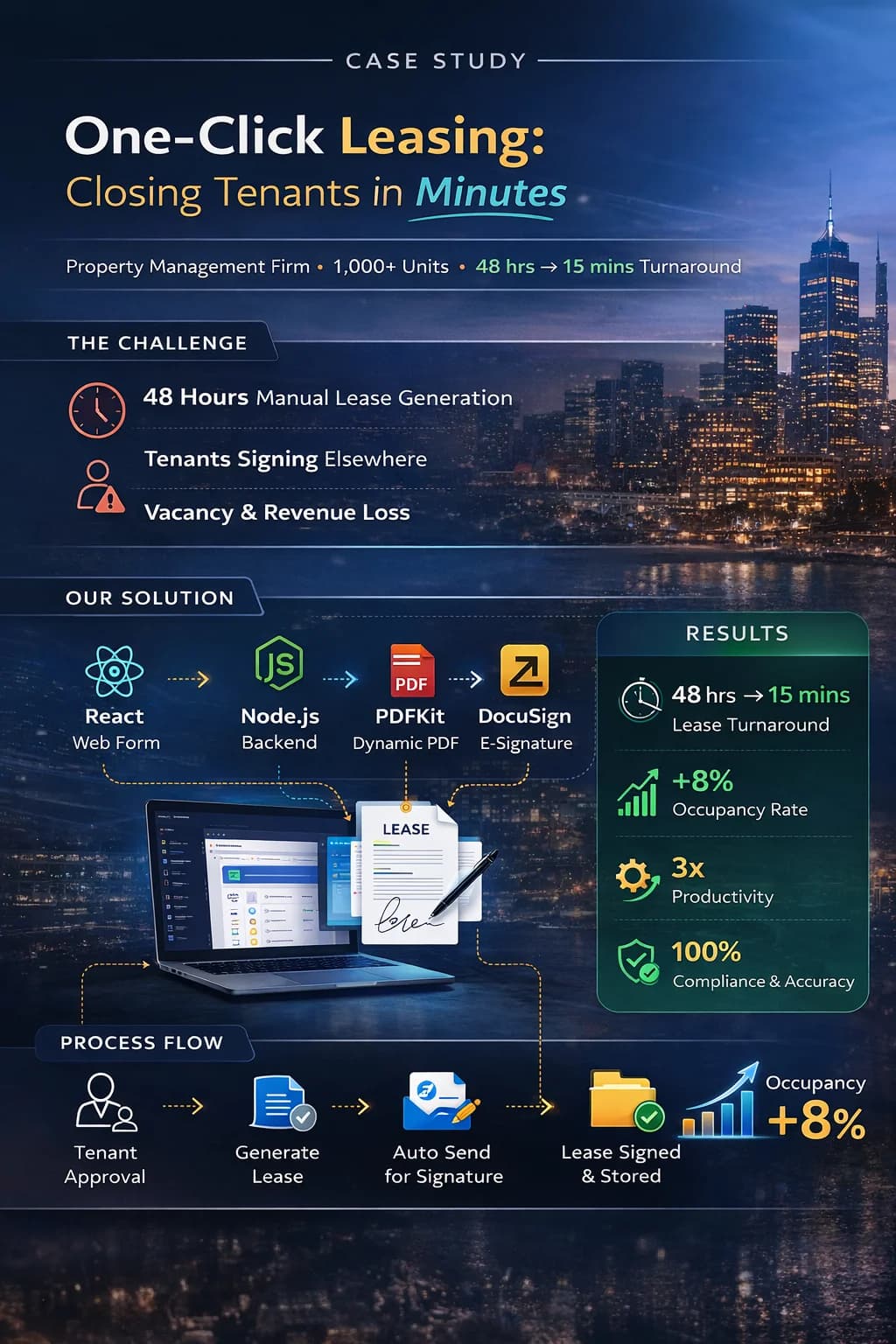
We engineered a One-Click Leasing System powered by React, Node.js, PDFKit, and the DocuSign API that transformed lease preparation into a 15-minute automated process.
The results were immediate and measurable:
- Lease turnaround time reduced from 48 hours → 15 minutes
- Occupancy rate increased by 8%
- Leasing team productivity improved by 3×
- Tenant conversion friction eliminated
More importantly, the organization gained a scalable digital leasing infrastructure capable of supporting future portfolio expansion.
This case study details how Boffin Coders diagnosed the root cause, designed a robust architecture, and delivered a system that turns tenant approvals into signed leases within minutes.
2. The Client Context
When Leasing Speed Becomes a Competitive Advantage
The client operates in a mid-to-large metropolitan rental market where inventory turnover is rapid and tenant expectations are high.
Their portfolio includes:
- 1,000+ residential units
- Multiple apartment communities
- A centralized leasing operations team
- A steady inflow of qualified tenant applications
From a business standpoint, the company had already invested in key growth drivers:
- Digital property listings
- Online tenant applications
- Screening automation
- CRM-based lead tracking
On the front end, the leasing funnel performed well.
However, the final stage — lease execution — remained entirely manual.
The process looked like this:
- Tenant submits application
- Screening team approves applicant
- Leasing staff gathers tenant data
- Lease coordinator prepares the document
- Legal template is manually edited
- Document converted into PDF
- Sent via email for signature
This workflow required coordination between three different roles:
- Leasing agent
- Lease administrator
- Compliance reviewer
Each handoff added delays.
If the lease coordinator was unavailable or handling multiple requests, the document generation queue would grow quickly.
In practice, leases took 24–48 hours to reach tenants after approval.
In slower markets, this delay might be tolerable.
In a competitive rental environment, it is fatal.
The client estimated that 15–20% of approved tenants never signed leases — not because they changed their minds, but because another property moved faster.
Every lost tenant meant:
- Additional marketing costs
- Increased vacancy days
- Operational inefficiency
The leadership team recognized the issue but initially viewed it as a staffing bottleneck.
Their first instinct was to hire additional coordinators.
But hiring more people would only scale the inefficiency.
What they needed was systemic automation.
That is where Boffin Coders entered the conversation.
3. The Diagnostic Phase
Looking Beyond the Symptom
When organizations approach software agencies, they often request a specific feature.
In this case, the initial request was straightforward:
"We need a faster way to generate leases."
But experienced engineering partners know that speed problems are rarely just technical problems.
They are usually workflow problems disguised as software requests.
Before writing a single line of code, Boffin Coders conducted a structured diagnostic phase to understand the operational reality.
Our audit focused on four dimensions:
- Workflow Mapping
- Data Dependencies
- Document Complexity
- System Integration Points
Workflow Mapping
The first step was to reconstruct the entire lease creation journey.
We interviewed leasing staff and mapped every step involved in preparing a lease document.
What initially appeared to be a simple administrative task revealed a surprisingly complex chain of activities.
A typical lease required assembling information from multiple sources:
- Tenant personal details
- Property unit information
- Rent amount and security deposit
- Lease duration
- Addendums based on local regulations
- Property-specific clauses
Because these elements lived across different systems and spreadsheets, staff had to manually gather them before creating the document.
This process introduced three major inefficiencies:
- Repeated data entry
- Human error risk
- Coordination delays
The workflow depended heavily on individual availability.
If the lease coordinator was busy, the entire process stalled.
Data Fragmentation
The second discovery was a classic enterprise problem: data fragmentation.
Key inputs for lease generation lived in different locations:
- Tenant data → Application system
- Property data → Internal property management software
- Legal templates → Static documents
- Lease pricing → Spreadsheet maintained by finance
Because these systems were not integrated, the team relied on copy-paste operations.
Manual data transfer may seem harmless, but at scale it creates operational friction.
In this case, the average lease required 15–20 manual field insertions.
Multiply that by dozens of leases per week and the hidden cost becomes obvious.
Document Complexity
Lease agreements are not static documents.
They are dynamic legal instruments that vary based on multiple conditions:
- Property location
- Lease duration
- Furnishing status
- Pet policies
- Parking availability
- Local regulatory requirements
The client's legal templates contained dozens of conditional clauses.
Because the system lacked dynamic generation capabilities, staff had to manually enable or remove sections of text.
This introduced another major risk:
Compliance errors.
Incorrect clauses in a lease can lead to legal disputes or regulatory exposure.
Automation was not only about speed — it was also about accuracy and legal consistency.
The Root Cause
After completing the audit, the conclusion became clear.
The company did not have a lease generation problem.
It had a transaction orchestration problem.
Three systemic issues were slowing down the process:
1. Fragmented data sources: Critical information required to generate leases was spread across multiple tools.
2. Manual document assembly: Staff had to edit legal templates manually, introducing delays and risk.
3. Lack of digital signature integration: Even after generating the document, sending it for signature required additional manual steps.
In essence, the leasing workflow was designed for a paper-first era, not a digital-first rental market.
It required building a fully automated digital leasing pipeline.
The Strategic Insight
At Boffin Coders, we believe the most valuable software does not simply digitize existing processes.
It redefines them.
Instead of asking:
"How can we generate leases faster?"
We reframed the problem as:
"How can we convert tenant approval into a legally binding lease with a single action?"
That shift in thinking laid the foundation for the architecture we designed.
The goal was ambitious but clear:
From approval → to signed lease in under 15 minutes.
Achieving that required a system capable of:
- Collecting structured tenant data
- Dynamically generating legally compliant lease documents
- Automatically initiating digital signatures
- Tracking completion status in real time
In other words, we needed to transform leasing into a one-click transaction.
2 — THE ARCHITECTURE
Engineering a 15-Minute Leasing Pipeline
After the diagnostic phase revealed that the core issue was transaction orchestration rather than document creation, the next step was to design a system capable of converting tenant approval into a legally binding lease within minutes.
The objective was not simply automation. The client needed predictable, scalable, and legally compliant automation that could eliminate delays caused by manual coordination.
Boffin Coders therefore designed a digital leasing pipeline where data flows seamlessly from tenant approval → lease generation → digital signature → record storage, with minimal human intervention.
This architecture transformed what had historically been a 48-hour administrative workflow into a 15-minute digital transaction.;ll
Solution Strategy: Designing for Transaction Speed
Before building the system, our engineering team evaluated multiple solution approaches.
Option 1: Automating Existing Templates
One possibility was to automate lease templates inside the client’s current property management system. While this would reduce some manual work, the platform imposed strict limitations on document logic and integrations.
It would improve efficiency slightly, but it would not solve the core problem of slow lease execution.
Option 2: Third-Party Lease Automation Tools
Several PropTech platforms provide ready-made lease automation software. However, these tools often come with significant trade-offs:
- Limited customization for legal clauses
- Expensive per-document licensing fees
- Restricted integration with internal systems
For a firm managing more than 1,000 residential units, relying on such tools would create long-term operational constraints.
Option 3: Custom Leasing Infrastructure (Chosen Approach)
Instead of adapting existing systems, Boffin Coders recommended building a custom lease generation engine integrated directly with the client’s operational workflows.
This architecture would:
- Automatically collect tenant and property data
- Dynamically assemble lease agreements
- Generate PDFs programmatically
- Trigger digital signature workflows instantly
- Track document completion in real time
Most importantly, the system would become a reusable infrastructure asset that supports long-term growth rather than a temporary fix.
The final architecture consisted of four layers:
- Data Input Layer – captures tenant and property details
- Lease Generation Engine – processes rules and template logic
- Document Processing Layer – dynamically generates lease documents
- Digital Signature Layer – executes and tracks lease signing
Technical Deep Dive: Why This Tech Stack
The technology stack was selected to balance speed, reliability, and long-term scalability.
React — Structured Data Interface
The leasing interface was built using React, allowing leasing agents to prepare lease requests quickly and efficiently.
The React interface enables agents to:
- enter tenant and property information
- validate lease data instantly
- review contract details before generation
- trigger lease creation with one action
React’s component-based structure also ensures long-term maintainability while delivering fast UI performance.
Using this interface, leasing staff can prepare a lease request in under two minutes.
Node.js — The Transaction Engine
At the center of the system sits a Node.js service layer responsible for orchestrating the entire leasing workflow.
Node.js was selected because it handles API-driven and asynchronous workflows extremely efficiently.
The Node.js service performs several critical functions:
- aggregating tenant and property data
- applying lease rules and conditions
- triggering PDF generation
- integrating with the digital signature platform
- monitoring signing status
Because lease transactions involve multiple system interactions, Node.js ensures the process remains fast, reliable, and non-blocking.
PDFKit — Dynamic Document Generation
Lease agreements require dynamic clause insertion and precise formatting.
Using PDFKit, Boffin Coders built a document generation engine capable of programmatically assembling lease contracts.
This system automatically inserts:
- tenant details
- property-specific policies
- conditional legal clauses
- deposit and payment structures
Every document is generated consistently, eliminating manual editing errors while ensuring legal accuracy.
DocuSign API — Instant Lease Execution
Generating a lease is only part of the process. The document must also be signed quickly and securely.
To achieve this, we integrated the DocuSign API directly into the workflow.
Once the lease document is generated:
- The Node.js service sends the document to the signature platform
- Signature fields are assigned automatically
- Tenants receive a signing request immediately
- Completion updates are returned to the system in real time
This allows tenants to sign the lease from any device within minutes, dramatically accelerating the closing process.
Architecture Flow
The automated leasing system operates as a five-step pipeline.
Step 1 — Lease Request Initiation: A leasing agent enters tenant and property information through the React interface.
Step 2 — Data Processing: The request is sent to the Node.js backend where business rules validate the data.
Step 3 — Document Generation: PDFKit dynamically generates a legally compliant lease document.
Step 4 — Digital Signature Workflow: The lease is sent to the tenant through the digital signature platform.
Step 5 — Completion Tracking: Once signed, the system records the completed lease and updates internal records.
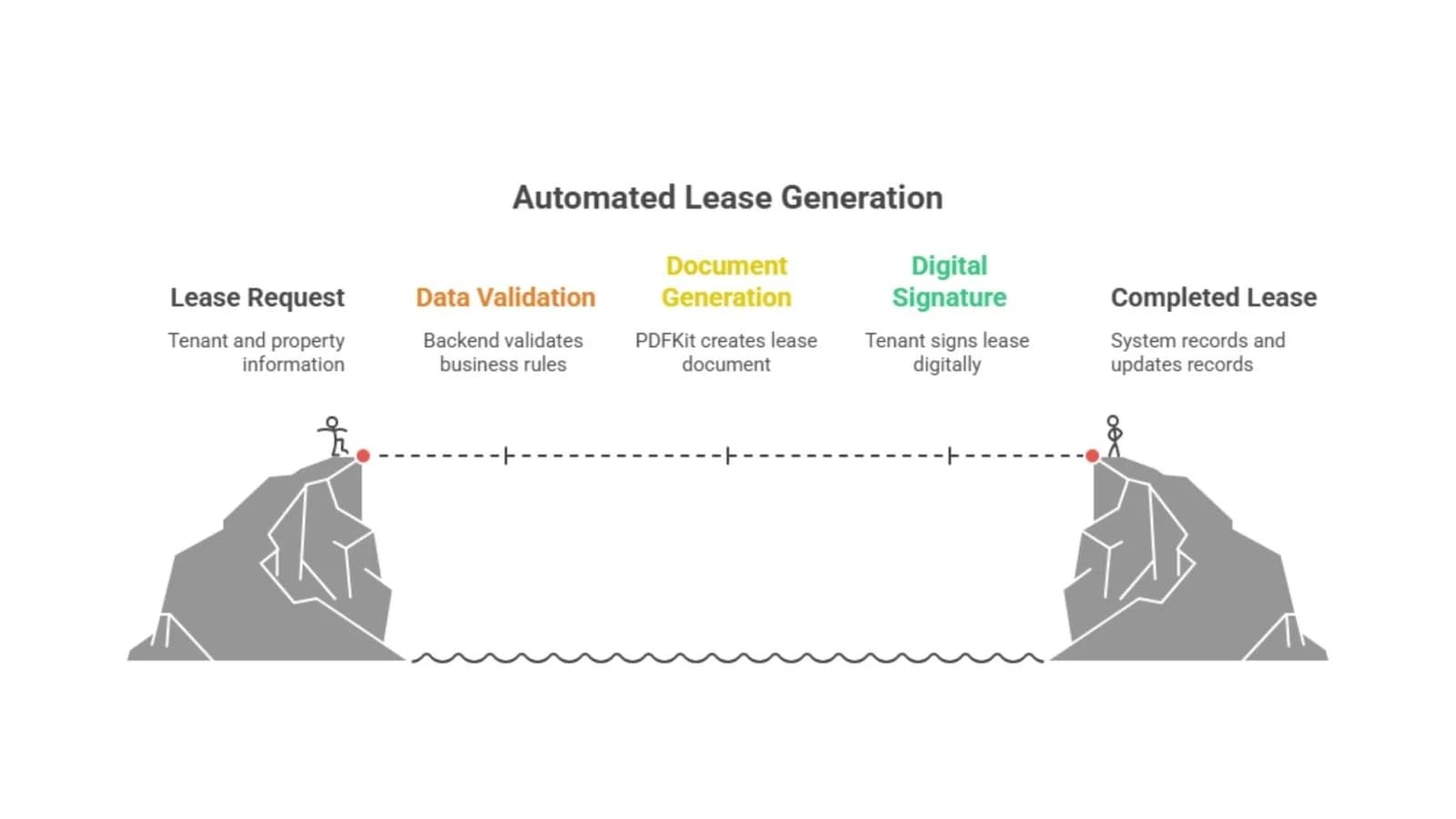
This pipeline compresses a process that once required multiple staff members and several days into a single automated workflow.
3- ROI & FUTURE
From Faster Paperwork to Revenue Acceleration
Technology investments should ultimately be measured by business impact, not features.
The leasing platform built by Boffin Coders was designed to remove friction from the final stage of the rental funnel: converting approved tenants into signed residents.
By reducing the lease execution timeline from 48 hours to approximately 15 minutes, the client fundamentally improved their ability to close deals quickly.
Lease Turnaround: 48 Hours → 15 Minutes
Previously, lease preparation involved multiple manual steps including document editing, formatting, and email coordination.
These processes often delayed lease delivery for 24–48 hours.
With the automated system:
- Leasing agents select an approved tenant
- The platform pulls tenant and property data automatically
- The lease document is generated instantly
- The digital signature request is sent immediately
The entire transaction now completes in roughly 15 minutes.
This speed ensures tenants receive the lease while they are still committed to the property decision.
Occupancy Increased by 8%
Before automation, the client experienced a hidden problem in their leasing funnel.
Approved tenants were sometimes lost because the lease process was too slow.
Once automation was implemented:
- Lease delivery became immediate
- Tenants could sign documents from their phone
- Leasing agents could close deals during the same interaction
As a result, the firm reported an 8% increase in occupancy.
For a portfolio of over 1,000 residential units, this translated into a significant revenue improvement.
Leasing Productivity Increased 3×
The new platform also transformed the daily workflow of the leasing team.
Previously, staff spent hours handling administrative tasks such as editing documents and tracking signatures.
With the automated system:
- Lease creation became a one-click process
- Documents were generated automatically
- Signatures were tracked in real time
This allowed leasing teams to focus on tenant engagement, property tours, and closing deals.
Overall operational productivity increased nearly threefold.
Future Outlook: A Scalable Leasing Infrastructure
The system was designed not only to solve today’s problem but also to support the client’s long-term growth.
Because the platform is built on scalable Node.js architecture, it can easily handle higher transaction volumes as the property portfolio expands.
Future enhancements may include:
- Automated tenant onboarding
- Deposit and payment integrations
- Advanced leasing analytics
- Digital move-in documentation
Together, these capabilities create the foundation for a fully digital leasing ecosystem.
Conclusion
In competitive rental markets, the time between tenant approval and lease signing can determine whether revenue is captured or lost.
By redesigning the leasing workflow and engineering a scalable automation platform, Boffin Coders transformed a slow administrative process into a 15-minute digital transaction.
The results were clear:
- Lease turnaround reduced from 48 hours to 15 minutes
- Occupancy increased by 8%
- Leasing productivity increased 3×
- Legal consistency improved
More importantly, the client now operates with a modern leasing infrastructure built for long-term growth.
Ready to Build Something
That Actually Works?
Stop patching legacy code. Let's engineer a platform that scales with your ambition.