White Label AI Voice Agent: What Should Your Agency Check Before Reselling One?
- November 15, 2026
- 8 min read

Co-Founder, Boffin Coders
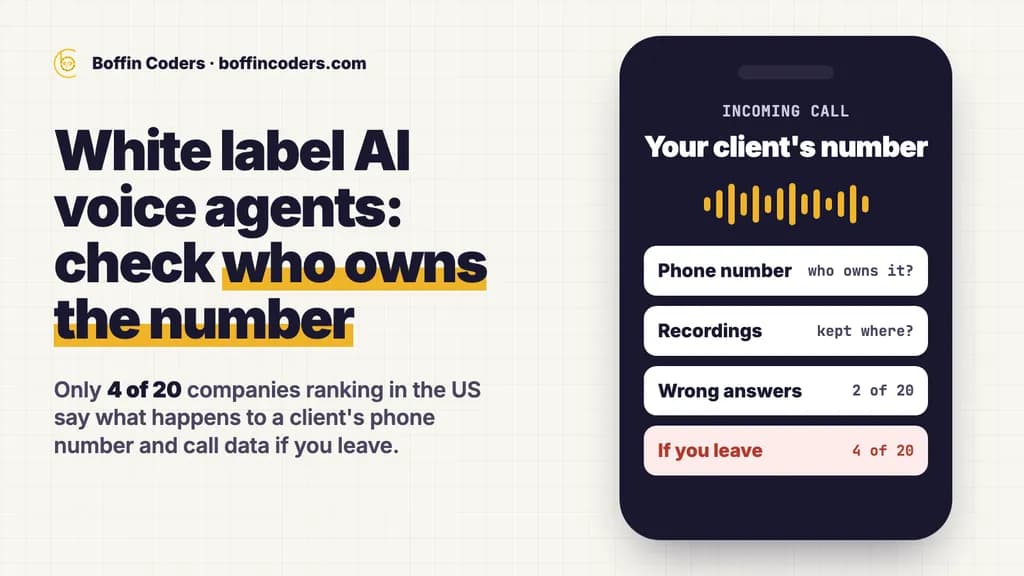
A white label AI voice agent is a phone agent that answers your client's calls under your agency's brand while another company runs the platform underneath. Before you resell one, get four answers in writing: whose account holds the client's phone number, where the recordings and transcripts are kept, what the agent does when it does not know an answer, and what happens to all of it if you leave the platform. The monthly fee and the price per minute are the easy part to compare.
On 13 November 2026 we read the pages of the 20 companies that sell or compare these platforms in Google's top 20 results in the US for "white label ai voice agent" and "white label ai receptionist". Of the 20, 14 talk about the cost per minute and 10 say the agent can pass a call to a person. Only 4 say what happens to a client's agents, phone number or call data if you cancel or move to another platform. Two mention wrong or made-up answers, and two mention telling callers they are speaking with an AI.
What is a white label AI voice agent?
A white label AI voice agent is three parts in a row, sold under your name. Speech to text turns the caller's voice into words, a language model decides what to say, and a synthetic voice says it. A phone line carries the call between the caller and the agent. The white label platform wraps those parts in a dashboard that carries your logo and domain, lets you set your own prices and often bills your clients through your own payment account.
Your client's callers hear the greeting, the voice and the client's own number. Nothing in the call names the platform. So when a call goes wrong, the caller blames your client, and your client calls you.
An AI receptionist is the same agent given one job. It answers the line, answers common questions from the client's own information, books an appointment or takes a message, and puts the caller through to a person when needed. For a clinic, a salon or a plumber, that usually means the calls that come in after hours or while everyone is busy with a customer.
How do agencies resell AI voice agents to their clients?
There are three routes, and most of the pages we read sell the first one.
Rent a white label platform | Bring your own keys to a toolkit | A partner builds it on your accounts | |
|---|---|---|---|
What you pay | A monthly agency plan, minutes on top | A toolkit fee, plus each provider's usage | A written scope for the build, then usage |
Who holds the phone number | The platform, unless you bring your own | You or the client, in a carrier account | The client, in its own carrier account |
Where recordings live | The platform's dashboard | The providers you chose | Storage the client controls |
Who changes the script | You, inside the platform's settings | You | The partner, or anyone you hand the code to |
What happens when you leave | The platform's terms decide | You keep your keys and accounts | Everything already sits on your side |
Renting is the fastest start. Most agency plans on the pages we read cost between about US$100 and US$500 a month with a pool of included minutes. Usage beyond the pool is billed by the minute, and most of the rates quoted fall between about US$0.07 and US$0.31 a minute, depending on the models and the voice. The phone line and the number are often billed on top. Bringing your own keys removes the platform's markup but makes you the support desk for every part. A partner build costs more at the start. It pays when a client needs what a platform will not give: its own number and records on its side, a link into its own booking system, or speech to text on its own server.
Who owns the client's phone number and call recordings?
Ask this first, because the phone number is the part your client cannot replace. It is printed on the van, listed on the Google Business Profile and saved in customers' phones. If the number was bought inside the platform's account, the platform's terms decide whether it can move. If it sits in a carrier account in your client's name and is only pointed at the agent, the client keeps it whatever happens to you or the platform. Several of the platforms we read let you bring a number in this way, over a SIP connection or by forwarding calls from the client's carrier.
Recordings and transcripts come next. They show what callers ask, what the agent got wrong and what was promised to whom. Find out where they are stored, how long they are kept, who can play them back and whether they export in a format another system can read. It is the same rule as for every account you set up for a client, covered in who should own hosting and domain accounts.
Our own rule comes from a system we run. On IELTS Builder, a live exam platform for a coaching institute, spoken answers are transcribed by a Whisper model on the platform's own server, the recordings stay in its own private storage, and a teacher approves every grade before a student sees it. The setting that could send audio to a hosted service is held by the client, not by us and not by a vendor. How that works is in speech to text that keeps the recording. For a client that will not send call audio to a vendor, self-hosted speech to text is where a voice agent starts.
What should the agent do when it does not know the answer?
It should say so, then take a message or put the caller through, and never guess. A language model will give a confident answer to almost any question, and on a phone line a confident wrong answer about a price, an opening time or a free appointment turns into a complaint at your client's front desk. Only two of the 20 pages we read mention wrong or made-up answers at all.
Five rules keep an agent in line:
- Answer only from the client's own information. Opening hours, services, published prices and booking rules. Anything outside that becomes a message for a person.
- Say it is an AI in the first sentence. Callers trust an agent that is straight with them, and it protects the business that runs it.
- Put the caller through to a person when asked. If nobody is free, take a message with the caller's number and the reason for the call.
- Confirm bookings in the client's own system. A slot is booked when the client's calendar or a member of staff accepts it, not when the agent says so.
- Use a stock voice. Never a clone of a real person's voice, even with their permission.
These are the rules we build every phone agent to. We hold our own site's assistant to the same standard: the prompt, a check on every answer in code and a spending limit each stop a different failure, as described in LLM guardrails. The same rules hold for a website chatbot with its own knowledge base.
What does a white label AI receptionist cost you each month?
Work the cost out per client before you set a price, because minutes are the line that grows with every busy week. Fill in this table with your own figures:
Line | Where the figure comes from | Your figure |
|---|---|---|
Platform fee | Your agency plan divided by your active clients | |
Minutes | Calls a month times the average call length, beyond the included pool, times the rate a minute | |
Phone number | The carrier's or the platform's charge for the client's number | |
Set-up | Your hours to write the script, load the client's information and test calls | |
Monthly care | Your hours to read transcripts, fix wrong answers and update hours and prices |
The last two lines are the ones agencies leave out of the price. An agent whose transcripts nobody reads falls behind the client's prices and opening hours, and the first sign is usually a caller complaining. Price the care into the monthly fee from the start, and agree with the client who reads the transcripts each week.
When does a partner-built voice agent make more sense than a platform?
When the client's number, records or systems have to stay on the client's side. A platform is fine for a salon that wants its phone answered after hours. A clinic group, a trades business with its own job system or a firm that will not send call audio to a vendor needs an agent built around what it already owns.
That is the work we take on for agencies. We build the transcription and the handover to a person first, then the script your client approves, then the voice, and we measure it on the client's own recordings before it goes live. The code, the model and the recordings stay on your client's side when we hand over. We work under your brand, sign non-circumvention before scoping and never contact your client unless you ask. AI work runs at US$25-40 an hour, and agency work is sold in two-week sprints at US$2,000 per sprint, invoiced after you have seen what was delivered. Our longest clients have stayed with us since 2017.
If you would rather have your clients' voice agents built than rented, our white label AI development team builds them under your brand, and you see each one working before any invoice.
Keep reading
Jyoti
Co-Founder, Boffin Coders
Jyoti co-founded Boffin Coders and looks after client relationships and how projects run from first call to handover. Jyoti writes about hiring, process and what makes a development partnership work.
Frequently asked questions
A white label AI receptionist is an AI phone agent that answers a business's calls under an agency's brand. It answers common questions from the business's own information, books appointments or takes messages, and puts callers through to a person when needed. Another company runs the platform underneath, and callers hear only the client's greeting, the voice and the client's own number.
Not answered here?
Need this built?
We build websites and apps for businesses, and work behind digital agencies as their development team. Tell us where things stand on a 20-minute call.