IELTS Builder Canada: 200 mocks off paper, onto the format students now sit
- IELTS Builder Canada
- September 23, 2026
- 9 min read
Manoj Sethi
Founder, Boffin Coders
Key Outcomes
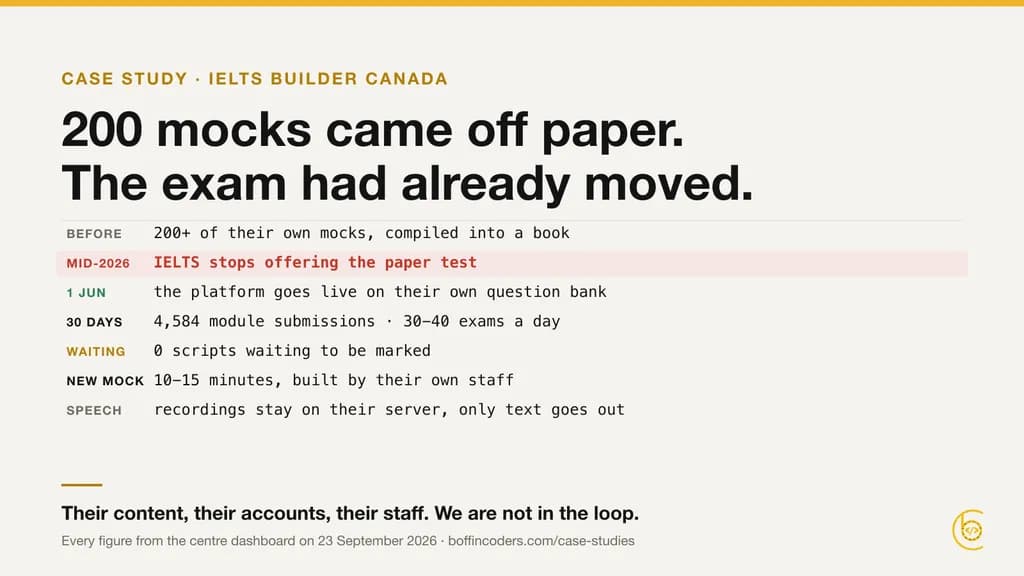
4,584
submissions in 30 days
Reading, Listening, Writing and Speaking, on the dashboard for 23 September 2026.
0
scripts waiting to be marked
Listening and Reading are marked on submission. Teachers review Writing and Speaking.
200+
mocks moved off paper
The bank the institute wrote itself, rebuilt for the on-screen format.
10-15 min
to build a new mock
From their existing material, by their own staff, without us.
Technologies Used
Written 23 September 2026. Every number on this page is from the centre dashboard on that date or from the institute directly. IELTS Builder Canada is named with their permission.
The deadline that moved the exam
In mid-2026 IELTS stopped offering the paper-based test. All tests are now delivered on computer, with timelines varying by market and a "Writing on Paper" option in some of them.
For a coaching institute that is not an administrative change. It is a training problem, because the skills that decide a band score moved with the format.
Look at what actually changed, module by module. In Writing, a student used to fill an answer booklet by hand, so handwriting speed and legibility mattered. Now they type into a text box, so typing speed matters and handwriting does not. In Reading, a long passage used to be a page you could annotate in the margin and flick back to. Now it is a scroll box with an on-screen highlighter, and finding a line again is a different physical skill. In Listening, the ten minutes at the end for transferring answers to an answer sheet are gone, because there is no answer sheet. And Speaking, which was always a person across a table, is the one module that did not move at all.
None of that is about English. A student can know the English and still lose a band to the interface, and the only defence is having sat the real thing enough times that the interface stops being a variable.
What the institute stood to lose
IELTS Builder Canada is a coaching institute in Brampton, Ontario, teaching General Training and Academic, online and in person.
Over years they had written more than 200 of their own mocks and compiled them into a book. That bank was the thing that separated them from the centre down the road. Official practice material is limited and public, and students have often already seen it. A centre with its own bank can put a student in front of unseen questions in week one and again in week nine, which is what actual preparation looks like.
When paper ended, the book was suddenly teaching the wrong format. Their best asset was stranded in the one container the exam had just left.
The second problem was quieter and cost more. A teacher marked a script, wrote feedback on it, and handed it back. The student read it once, put it in a bag, and lost it. All of that expertise was spent once and then gone. Nobody could compare a student's third attempt against their twelfth, because the evidence went home in a folder. The institute was producing a genuinely valuable thing several hundred times a month and then throwing every copy away.
What we built
A computer-delivered mock platform, live since 1 June 2026, running the institute's own question bank.
- Their content, on screen. The 200+ mocks rebuilt in the format students now sit, with timed sections, audio that plays once, and no transfer time at the end of Listening.
- Marked on submission. Listening and Reading are scored the moment a student finishes, with bands converted automatically.
- Writing and Speaking captured and scored, with AI feedback the teacher can read, correct or override before it reaches the student.
- Class exams by code. An instructor issues an exam or batch code and a whole class sits the same mock at the same time.
- Feedback that stays. Every attempt and every comment lives in the student's own portal, so it can be read again and compared against earlier attempts.
The part that decided the project
The hard requirement was not any of the above. It was that the institute had to be able to add a mock without us.
A platform that only we can load content into is a platform the institute rents. Their bank stops being theirs the moment the only route into it runs through a vendor's ticket queue. So the authoring side had to be usable by a teacher with the material already in front of them, in the gaps between classes, rather than by a developer.
It takes their staff ten to fifteen minutes to build a new mock from material they already have. That number is the one we would defend hardest, because everything else on this page follows from it. A centre that can add a mock in a quarter of an hour runs daily practice. A centre that files a request and waits runs practice when the vendor gets round to it.
How it runs now
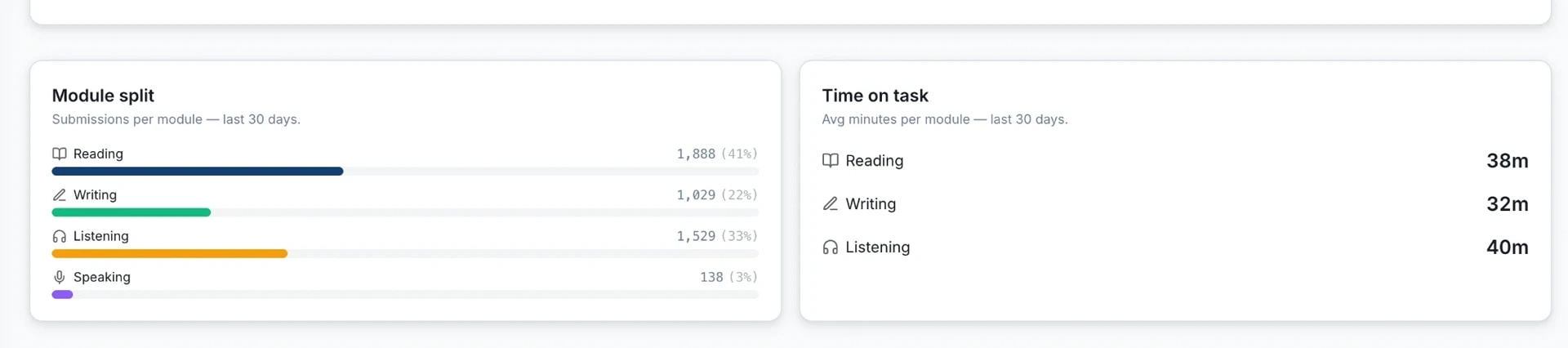
In the thirty days to 23 September 2026 the platform took 4,584 module submissions: 1,888 Reading, 1,529 Listening, 1,029 Writing and 138 Speaking. That is thirty to forty exams on an ordinary day, with 417 students active in a single week and twenty to twenty-five sitting concurrently at the peak of a live class.
On the day of that screenshot, forty-five submissions had come in and nothing was waiting to be marked.
Sit with the first number for a moment. Marking 4,584 scripts by hand is about 153 a day, every day, weekends included, before anybody teaches a class. It is not that institutes chose to run mocks less often than this. They could not run them at all at this volume, which is why realistic practice used to be rationed.
The platform does not remove the teacher from that. It removes them from the part that was never judgement. Of those 4,584, the 3,417 Reading and Listening submissions are marked against an answer key, which is arithmetic. The 1,167 Writing and Speaking submissions still need a person, and that is about thirty-nine a day rather than 153. A teacher reading thirty-nine drafted assessments and correcting the ones they disagree with is a working day. A teacher marking 153 scripts from scratch is not.
Average time on task reads 38 minutes for Reading, 32 for Writing and 40 for Listening. Those numbers matter more than they look. They say students are pacing themselves against exam timing rather than clicking through to see the score, which is the entire point of practising in the real format. A platform where that figure collapsed to nine minutes would be a platform being gamed.
The most-attempted exam over that period was "DAILY CLASS PRACTICE" with 798 submissions. The platform became routine rather than an occasion.
The speech part, and where the line sits
Speaking practice needs two things a text platform does not: a voice to ask the questions, and a transcript to score against.
Both run on the institute's own server. Text-to-speech uses a local Kokoro model. Transcription uses a local Whisper model loaded in the backend process. The student's recording never leaves the server it was uploaded to. Only the resulting text is sent to a language model for scoring, and which provider that is can be switched from the admin without a deploy.
That matters more than it sounds. The students are visa applicants and, in some cases, minors, and their voices are biometric data. "Where does the recording go?" is a question an institute should be able to answer in one sentence. This one can.
It is not free. A speech model running on an ordinary CPU is slower and slightly less accurate than a hosted speech API, and transcription runs one at a time so that four of them do not take the rest of the platform down. That is acceptable here because transcription happens after a spoken turn ends rather than while a student waits, and the number that has to stay small is the time before the student sees a band at the end. We wrote up the whole pipeline, including what it costs, in why your speech-to-text sends the recording when it only needed the words.
What the platform is ready to take on next
An institute evaluating this will ask what else the same foundation can carry. The platform was designed around the centre's own content and a teacher's judgement, and the next pieces extend that design rather than replace it.
Proctoring follows the same rule as the marking. A teacher decides, so proctoring on this platform would flag a moment for a teacher to review and never fail a student on its own. That keeps a person in charge of anything that affects a result, which matters when the students are visa applicants and, in some cases, minors. Inside a centre, invigilation is a person in the room, and a flag simply gives that person a shorter list to check.
Connecting to a school's learning system follows the published standard rather than a private integration. An LTI launch would be built to the school's published spec, so a student signs in once and lands in the right mock. SCORM packages and an xAPI learning record store take the same route: the school names the standard it runs, and the connection is built to that standard.
Outcome reporting is the institute's to publish. Every submission is already recorded, so band distributions and progress over time are a reporting layer on data the platform holds. The institute chooses when those figures are ready to share and what they say about their own students.
Who runs it
They do. The platform runs in their accounts, on their content, with their students, and their staff build new mocks themselves in ten to fifteen minutes from material they already have. We are not in the loop for a class to sit an exam.
That was the point. An institute whose question bank lives inside a vendor's product has swapped one dependency for another.
If you run a centre
This was built for one institute, on their material, in their accounts. If the format change has left your own question bank stranded in a book, that is the same problem and it has the same shape.
We also build software for schools, where the shape is different: administration, attendance, fees and a parent app rather than exams. That page says plainly which parts are running with a client, which are built and ready for a school, and which are specified and ready to build.
The first call is twenty minutes with the person who would build it, and you leave with a clear next step, confirmed in writing within one working day.
Running a school or a coaching centre?
Twenty minutes with the person who would build it. You will get a straight answer on what is running today, what is built and waiting, and what would be a new build.