
Healthcare software development company in India, for clinics and patients

Boffin Coders is a healthcare software development company in India that builds patient portals, booking, practice systems and integrations with the practice software a clinic already runs. We build for clinics, practice groups and health-tech teams, in your own accounts, with AI only where a clinician reviews what it drafts. One healthcare website we built is live, and this page sets out how we build the rest, check by check.

Projects from $4,000. Developers $18-38 an hour, or from $3,000 a month.

  • Booking and patient portals
  • Drafts a clinician approves
  • Runs in your own accounts

Running a dental, physio or veterinary practice rather than building software? Dental marketing and practice websites are on the clinics page.

2017

Shipping software since

Same owners, same team

18

People in one office

Developers, designers and SEO in Mohali

100%

IP ownership

Your repository from the first commit

1 day

Reply time

One working day, every enquiry

Proof, with the stage stated

What we have built for healthcare, and how we build the rest

One healthcare website is live, one practice's search and redesign is done, and two patterns a clinic needs are running for clients in other sectors. Everything else on this page is how we build it, with the architecture walked through on a call.

Live

Clinevo

A healthcare services website we built in Next.js and Node, laid out for accessibility and easy reading on any screen. The Clinevo project page shows the stack and links to the live site.

Service pages for home care, respite care, community support and specialised care, with accessible navigation and a clear route to each service for patients and the families choosing for them. It is a website and front end, not a clinical system, and we describe it as nothing more.

Built with
Next.js, Node.js and TypeScript, on AWS
Built for
Patients and the families choosing care
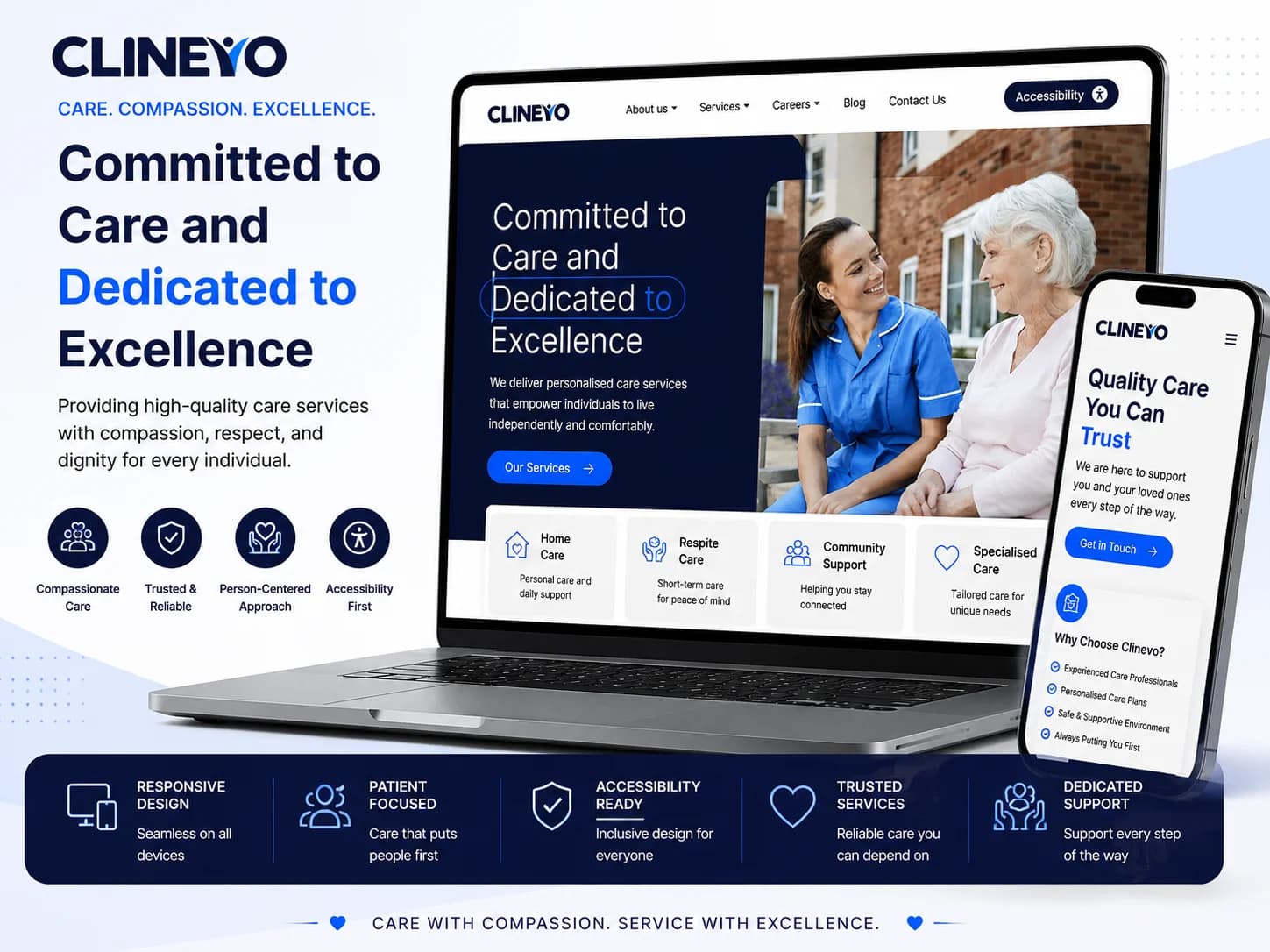
The Clinevo care services website we built, on a laptop and a phone
Clinevo, the screenshot from its project page.
Done with a client

Praxis Dreierlei

Search rankings and a redesign for a physiotherapy practice. The owner's review sits below, on GoodFirms, where we cannot edit it, and what we changed for the practice is written up.

The work
Search rankings and a website redesign
Review
5 out of 5 on GoodFirms, from the owner
Running in education

Speech to text on your own server

Our exam platform turns spoken answers into text on a server we control, so no recording goes to a transcription company. The write-up on speech to text that keeps the recording is the same design a clinic needs for dictation.

Model
Whisper, inside the server’s own process
Audio sent to an AI vendor
None, in local routing
Where it runs
IELTS Builder Canada, since June 2026, 4,584 submissions in a thirty-day window
Before a student sees a grade
A teacher approves it
Running in outreach

AI that drafts and never sends

An outreach tool where the model writes, a person reads, and only then does anything go out. The piece on letting AI write the email but never send it sets out the same rule a clinical letter needs.

What the model returns
Text, into an editor
Send tool given to the model
None
A warning overridden
Only with a written reason
Where it runs
Our own new-business outreach
How we build it

How we build the clinical pieces, set out before the call

Each of these is built on a published standard, with a clinician signing off anything that reaches a patient. Much of our client work sits under strict NDA, so we walk you through the architecture on the first call rather than after the quote.

  • Records exchanged over FHIR or HL7 v2
  • Prescribing flows with a clinician sign-off
  • Remote readings routed to a clinician for review
  • A patient portal or clinical system in your own cloud account
Client reviews

Reviews we cannot edit

Published on Clutch and GoodFirms. Every card links to the original, and a client who reviewed us on both appears once.

5.0
“They managed the project efficiently, delivering on time with clear communication.”
M

Manager

Healthcare Solutions Company

Verified review on Clutch· March 2025
5.0
“Boffin Coders improved my search rankings and redesigned my website. They were professional, easy to work with, and delivered great results. Boffin Coders really gets in the topic of the problem and suggests different solutions.”
D

Dirk Habermann

Owner, Praxis Dreierlei

Verified review on GoodFirms· July 2024
The problem

Where healthcare software goes wrong

Most clinics do not need more software. They need the software they have to stop sending work back to reception. These are the four places it usually breaks, and each is something a build can fix.

Patients ring for what a portal could do

Booking, moving an appointment, a form before the first visit, a copy of a receipt. When the website cannot do them, the phone does, and reception spends the morning on calls a patient portal would have taken.

The website and the practice system do not talk

A booking form that emails reception, who retype it into the practice system. Every retyped field is a chance to book the wrong slot. Where an old system is the real blocker, legacy modernisation is usually a fix rather than a rebuild.

Health data ends up in someone else's account

A form builder, a chat widget, a transcription service. Each one can copy patient information to a vendor the practice never assessed, and nobody finds out until someone asks where the data went.

Clinicians type up what they already said

Notes, referral letters and summaries get written after the appointment, often in the evening. Drafting them with AI saves that time only if a clinician reads every draft before it is filed or sent.

What we build

Patient portal development, booking and practice software

Four kinds of work, each scoped to what the proof above supports. If you came looking for hospital management software development in India, read the second card first: we build for clinics and practice groups, and we say where that stops. For the wider picture of a full hospital system, our guide to cloud-native hospital management software covers the architecture.

01

Patient portal and booking

A patient portal where patients book, move and cancel appointments, fill in forms before they arrive, read their own letters and pay an invoice, on the web and, if you want one, in an app. We build it as a web application on your own cloud account, and booking reads real availability from the practice system rather than keeping a second diary.

Built with

  • Next.js
  • Node.js
  • PostgreSQL
  • Flutter or React Native
  • Stripe

What it includes

  • Book, move and cancel
  • Forms before the visit
  • Letters and documents
  • Reminders by email or text
  • Invoices and payment
  • Access for a parent or carer
02

Practice and clinic systems

Scheduling across clinicians, rooms and sites, patient records kept the way your clinic actually keeps them, note templates, rotas and invoicing. For a practice group, one view across every site, with each site's data separated by role. This is the part people call hospital management software. At clinic and practice-group scale we build it. A full hospital system is a different build, covered in the FAQ below.

Built with

  • React
  • Node.js
  • PostgreSQL
  • Role-based access
  • Audit log

What it includes

  • Clinicians, rooms and sites
  • Note templates
  • Access by role, per site
  • Rotas and cover
  • Invoicing
  • A log of who opened what
03

Integration with the practice software you run

Most clinics already run a practice management system, and many of those publish an API. We read and write through the interface the vendor documents, so a booking made on the website lands in the diary and a new patient's form lands in their record. Where a system speaks HL7 or FHIR, we use it. Before quoting, we tell you what the vendor's API allows, which calls need the vendor's approval, and how we test them in its sandbox.

Built with

  • REST APIs
  • FHIR
  • HL7 v2
  • Webhooks
  • Node.js

What it includes

  • Bookings into the diary
  • Forms into the record
  • Availability read live
  • No double entry
  • Retries when the vendor is down
  • Every change logged
04

AI drafting a clinician reviews

Dictation turned into text on a server you control, then drafted into a letter or a note that a clinician reads, edits and approves. The model never files or sends anything. Both halves run today in other sectors, which is why we offer them here and nothing further along.

Built with

  • Whisper, self-hosted
  • Your cloud account
  • Node.js
  • Review queue

What it includes

  • Dictation to text
  • Letters and summaries drafted
  • A clinician approves every draft
  • Nothing sent by the model
  • Recording stays on your server
  • Every edit logged
Where AI sits

AI that drafts, and a clinician who decides

The model writes, the clinician decides, and the recording never leaves a server you control.

The time AI saves a clinic is typing, not diagnosis. We use it to turn a dictated visit into a draft letter or note, and a clinician approves every draft before it is filed or sent.

Both halves are the patterns written up in the proof section above: speech to text that runs on your own server, and a model that can write but has no way to send. We do not build AI that makes a clinical recommendation, triages a patient or reads a scan, and we would not put one in front of your patients on the strength of a demo.

  • Dictation to text on your server

    Speech to text runs in your own cloud account. The recording is never sent to a transcription company.

  • Drafts, never sends

    Letters, referral summaries and notes are drafted for a clinician to approve. The model has no way to send or file them.

  • Forms read into the record

    An uploaded form is read into fields, and a member of staff checks them before anything is saved.

  • Answers from your own leaflets

    A website assistant that answers booking and preparation questions from your own pages, hands over to reception, and gives no clinical advice.

Drafts for review
Nothing sends itself
  • Referral letter
    Dictated 09:42, Dr A. Patel
    Awaiting review
    Approve Edit
  • Visit summary
    Dictated 10:15, Dr A. Patel
    Awaiting review
    Approve Edit
  • Follow-up note
    Dictated 11:03, J. Morgan, physio
    Approved, edited
Transcribed on your server. Drafted by the model. Filed only by a clinician.
Illustration. Names and times are invented.
How it works

How patient data is protected

We build the controls, and your compliance officer verifies them. Compliance sign-off stays with your officer and your policies, and nothing here says a system is certified. These are the four things we do on every build that touches patient data, and a compliance officer can check each one.

Access by role, and a record of it

Each person sees only what their role needs, enforced on the server rather than hidden in the interface. Every read and change of a patient record is written to an audit log your compliance officer can export and check.

Encrypted in transit and at rest

TLS on every connection, and encryption at rest on the database and file storage using your cloud provider's managed keys. The keys sit in your account, not ours, so revoking our access is a setting you control.

Security checks before release

Dependencies are scanned in the build pipeline, and the OWASP Top 10 is the checklist for code review. Before launch you can commission an independent penetration test, and we fix what it finds before the system takes a patient.

Your cloud account, your region

The system runs in your own AWS, Azure or Google Cloud account, in the region you choose, so where the data lives is your decision. Our people are added as members and removed when the work ends.

Documented interfaces

What a clinic system talks to

Each of these publishes an interface we can build against, and we read its documentation before quoting. The practice systems and the health standards are tested in the vendor’s sandbox first, and the quote says which lines need the vendor’s approval.

  • Cliniko API
  • Halaxy
  • Semble
  • FHIR R4
  • HL7 v2
  • Stripe
  • Twilio
  • Google Calendar
  • Microsoft 365
  • Whisper, self-hosted
What it costs

Published, not quoted on the call

In USD. Hourly and monthly rates move with the stack and the seniority, from a junior on routine work to a senior on complex builds. Nothing is quoted outside them, and if the number does not work for you, you have saved yourself a meeting.

A healthcare build starts at
$4,000
Scoped once, with the lines shown.
Short pieces of work
$18-38 an hour
By seniority and the work.
A developer by the month
From $3,000 a month
Month to month, a month’s notice either way.
Agency sprint
$2,000 per two-week sprint
Under your brand, fixed before we start.

Every price on one page →

Bring in the team

Hire developers for your healthcare project

Patient portals, practice systems and integration work with the records system you already run. Take the project, or hire the engineers and keep delivery in your own hands.

$18-38 an hour depending on the stack, or from $3,000 a month for a dedicated developer. Shortlisted profiles within two working days, and whoever you pick starts within one to two weeks.

Before the call

Before you hire a healthcare software development company in India

What we have built and how we build the rest, what it costs, whether it meets the rules, and where patient data lives. Plain answers, before the call rather than on it.

A healthcare services website for Clinevo, built in Next.js and Node and live today, and search rankings and a redesign for Praxis Dreierlei, a physiotherapy practice. Much of our client work is under NDA, so for a patient portal or a clinical system we walk you through the architecture on a call. What transfers is work running in other sectors: speech to text on our own server for an exam platform, and an outreach tool where AI drafts and a person sends. The rest of this page sets out how we build, and the checks your compliance officer runs.

Not answered here?

Bring the system your clinic runs on

Twenty minutes with the person who would build it. We tell you what we have built that applies, how we would build the rest, and what your compliance officer will want to check.