ChatGPT Instant Checkout: What Replaced It for Your Clients' Stores?
- November 19, 2026
- 10 min read

SEO and AI Search Specialist
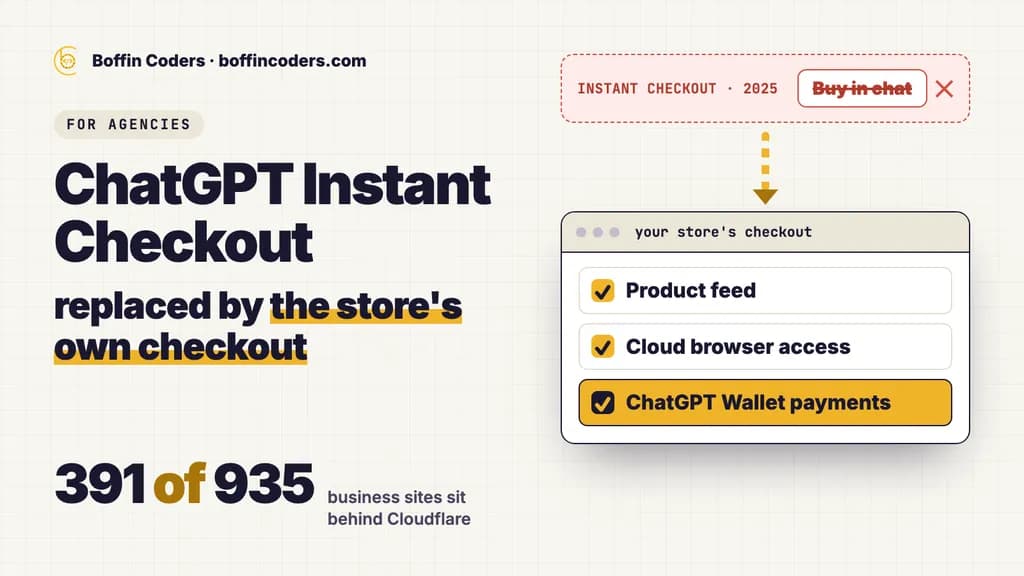
ChatGPT Instant Checkout no longer decides whether a client's store can sell in ChatGPT. On 24 March 2026 OpenAI said merchants would use their own checkout while it focused on product discovery, and on 13 November 2026 it launched ChatGPT Wallet, which pays on the store's existing checkout page. So the work has moved to three places: a product feed so ChatGPT can find the products, an edge that lets ChatGPT's cloud browser reach the store, and fraud rules that do not decline a real agent purchase.
OpenAI says its cloud browser can already use a website without an allowlist, but security settings can block it by accident. We read the home pages and robots.txt files of the businesses Google Maps lists for eight trades in Chicago, Dallas, Toronto, Calgary, Manchester, Leeds, Melbourne and Brisbane on 17 November 2026. Of the 935 sites that loaded, 391 sit behind Cloudflare, one of the four providers that OpenAI says check ChatGPT's signature automatically. Another 344 show no CDN in their headers, so that check is manual work. And 11 more refused our scripted visit outright, 10 of them through Cloudflare.
What happened to ChatGPT Instant Checkout?
ChatGPT Instant Checkout let shoppers pay inside the chat, and OpenAI stepped back from it in March 2026. OpenAI Instant Checkout launched on 29 September 2025 with the Agentic Commerce Protocol, built with Stripe. At launch, US shoppers could buy single items from US Etsy sellers in the chat, with Shopify merchants announced as coming soon. Merchants paid a fee on completed purchases and handled orders, payments and fulfilment with their own systems.
Why did Instant Checkout in ChatGPT stop?
On 24 March 2026 OpenAI wrote that the first version of Instant Checkout in ChatGPT did not give merchants the flexibility it wanted. Merchants would use their own checkout, and OpenAI would put its effort into product discovery. Trade press reported that month that the programme had not driven the sales retailers hoped for, and that retailers preferred to keep the transaction on their own sites.
OpenAI's commerce documentation today describes no in-chat checkout at all. It describes a journey: the customer says what they need, ChatGPT finds and compares options, and the purchase moves to the store's own website through ChatGPT's cloud browser, or to a plugin the business builds.
Instant Checkout (September 2025) | The store's own checkout (November 2026) | |
|---|---|---|
Where the customer pays | Inside the chat | On the store's checkout page, opened by ChatGPT's cloud browser, or through a plugin |
What the store had to build | An Agentic Commerce Protocol integration, after applying | Nothing for browser use. A product feed helps retail discovery. A plugin is optional |
Who handles the order | The merchant | The business: order, fulfilment, customer support and fraud decisions |
Who could pay this way | US shoppers buying from US Etsy sellers at launch | ChatGPT Wallet: ChatGPT Pro subscribers in the US, 18 or older, with eligible US-issued cards |
How does a ChatGPT checkout reach a client's store now?
A ChatGPT checkout now runs on the store's own page. The customer adds a card to ChatGPT Wallet once. Before each purchase they review the items, the total and the card, then approve it with a security check such as Face ID or a fingerprint. The payment network then supplies a payment token, a stand-in card number with its own security code and expiry date, and the store's existing checkout charges it.
OpenAI says ChatGPT Wallet works with existing checkout pages and payment forms, and that no Wallet-specific integration is required. The business keeps the customer relationship, pricing, fulfilment, returns and customer service. The Wallet launch post also says some sites may block these purchases by accident, which is the part your agency can check.
What does the store receive instead of a card number?
The store receives a network token, never the full card number. OpenAI's payment guide says to use the Payment Account Reference to link the token to the underlying account. The customer agrees to one transaction only, so the credential must not be saved and reused for another purchase. A subscription works if the checkout already supports recurring billing and the customer agrees to the recurring charges.
The rollout starts small. Wallet goes first to ChatGPT Pro subscribers in the US. Clients who sell to the UK, Canada or Australia can still sell on ChatGPT in the way that matters most today: being found in its product results. OpenAI's March update made product discovery available to Free, Go, Plus and Pro users.
What did 935 business websites show about ChatGPT access?
The read covered 969 business websites on 17 November 2026, one plain request to each home page and one to each robots.txt file: florists, dentists, accountants, plumbers, therapists, yoga studios, photographers and interior designers in the US, Canada, the UK and Australia. The response headers show which edge serves a site. They cannot show whether that edge lets ChatGPT's signed browser through, so read the table as a map of where to look, not a verdict on any site.
Finding | Sites |
|---|---|
Answered | 935 |
On a hosted platform (Squarespace 134, Wix 97, Shopify 61, Webflow 23) | 315 |
Self-run, through Cloudflare | 220 |
Self-run, through Vercel | 20 |
Self-run, through another CDN or edge | 36 |
Self-run, no CDN named in the headers | 344 |
Refused our scripted request with a 403 | 11 (10 through Cloudflare) |
Served through Akamai | 0 |
Three groups come out of it. On a hosted platform the edge belongs to the platform, so the access question goes to the platform's support. Your work there is the feed and the checkout. A self-run site behind Cloudflare or Vercel needs one setting at most. A self-run site with no CDN in its headers has its firewall at the host or in a security plugin, and that is where the manual check below applies.
The 11 refusals matter most. Their bot rules already turn away a plain scripted visit, so they are the first sites to test once an allow rule exists.
Which client sites need a firewall change for ChatGPT's cloud browser?
Only sites whose security settings block verified ChatGPT browser visits need a change, and OpenAI says the cloud browser needs no allowlist otherwise. Akamai, Cloudflare, HUMAN and Vercel check ChatGPT's request signatures automatically. Any other CDN or firewall needs the signature checked by hand before an exception is added.
OpenAI's agent access guide covers each provider. The steps for the most common edge in this read are below.
How do you allow ChatGPT's cloud browser on Cloudflare?
- Open the domain's security settings. In the Cloudflare dashboard, select the domain, then go to Security and Settings.
- Find the agent policies. Filter by Bot traffic and open AI Crawler and Agent access policies.
- Allow the agent. Under Personal Agents, set
dots, OpenAIto Allow (do not block), then save.
A site that runs its own WAF rules can allow the same traffic with a custom rule on bot detection ID 129220581. On Vercel no change is needed unless the site's own rules block the traffic. On Akamai, the agent appears as the verified bot ChatGPT Agent, which you place in a custom bot category set to Allow.
What if the site has no CDN that checks signatures?
Then someone has to check the signature in code. ChatGPT signs its browser requests with Web Bot Auth, which uses HTTP Message Signatures (RFC 9421). A signed request carries three headers: Signature, Signature-Input and Signature-Agent, the last set to "https://chatgpt.com". The public keys sit at https://chatgpt.com/.well-known/http-message-signatures-directory.
OpenAI's instruction is to verify the signature first and only then apply the exception. A rule that trusts the header alone would let in anyone who copies it. For a WordPress store on shared hosting this is real development work, usually at the host's firewall or in a small server-side check.
Does robots.txt decide whether ChatGPT finds a client's products?
Only one robots.txt line decides it: the one for OAI-SearchBot. That crawler decides whether a site appears in ChatGPT's search answers. GPTBot covers model training, and each setting is independent of the other.
OpenAI's crawler page also says ChatGPT-User visits pages for a user's request, and that robots.txt rules may not apply to it.
In the same read, 868 sites served a robots.txt file that could be parsed. Of those, 39 blocked GPTBot and 5 blocked OAI-SearchBot. None of the 183 Shopify and WooCommerce stores among them blocked OAI-SearchBot. So a client who blocked GPTBot to keep content out of training has not hidden its products from ChatGPT search. Being found and being cited are different jobs, and how to get cited by ChatGPT covers the second.
Does a client's store need a ChatGPT product feed?
A store that sells physical goods should send one, though browser use works without it. A ChatGPT product feed supplies structured catalogue data: products, images, prices and availability. It does not update a cart or confirm a purchase. When the customer acts, the live website or a plugin still checks the current offer.
- Claim the business. Start in ChatGPT Business Hub, where the client claims the business and grants your agency access.
- Verify identity. In the product section, complete the identity check that uploading products requires.
- Choose markets. Pick the countries and currencies the store sells in.
- Prepare the feed. Follow OpenAI's product feed schema, include the required fields in every record and keep each
item_idstable. - Deliver it. Pick one method: manual upload, a hosted HTTPS URL or SFTP, sending full snapshots.
What should ChatGPT merchants on Shopify do?
For ChatGPT merchants on Shopify, the feed is already handled. OpenAI said in March 2026 that Shopify merchants' product data reaches ChatGPT through Shopify Catalog, with no extra work for individual merchants. What stays with the store is how products are described and how its checkout treats agent purchases. The guide to Shopify agentic commerce for agencies covers what Shopify switches on by default.
What do payment and fraud settings need for agent purchases?
They need to recognise a legitimate agent purchase instead of declining it as a bot. Risk systems often judge a visit by its IP address and browser details, and ChatGPT's cloud browser can trip them. OpenAI is rolling out user signals in the standard Forwarded header: the user's network, IP address, country, masked network prefix, locale, time zone and browser.
1Forwarded: ip-country=CA
2Forwarded: locale=en-GB;tz="Europe/London"
If the client uses a payment or fraud provider, ask how it recognises these purchases and whether it reads the new header. If the client runs its own risk rules, start logging the header now. A decline here shows up as a lost sale with no error message, so review the declines before the client notices them.
What can your agency sell around ChatGPT commerce?
Most of this is short, billable work, and clients start asking about it once they hear of ChatGPT Wallet. The table sorts it by who needs it.
Work | For which clients | How often |
|---|---|---|
Edge check and agent allow rule | Self-run sites on Cloudflare, Akamai, Vercel or HUMAN | Once, then after any security change |
Signature check in code | Self-run sites whose CDN or firewall does not verify | One build |
Product feed set-up | Stores selling physical goods outside Shopify | Once, then the feed runs on a schedule |
Feed upkeep: stable IDs, prices, availability | Every store with a feed | Monthly |
Payment and fraud review | Stores with their own risk rules or providers | Once, then when declines appear |
A plugin for availability, carts or bookings | Stores with stock or slots that change often | One build |
The edge check and the robots.txt read are quick, and they show the client something concrete. The signature check, the feed and a plugin are development work, the part an agency may not want to staff for. If you would rather hand that build to a partner who works under your agency's name, our white label Shopify development team takes it on, and you see the first piece working before any invoice.
Keep reading
Santosh Kumari
SEO and AI Search Specialist
Santosh Kumari works on technical SEO and AI search visibility, from site fixes to the structured data and page formats that AI answers quote. Santosh Kumari writes about practical changes that help search engines and AI understand a page.
Frequently asked questions
OpenAI Instant Checkout is not how new merchants sell in ChatGPT today. In March 2026 OpenAI said merchants would use their own checkout while it focused on product discovery, and its commerce documentation now describes product feeds, cloud browser access to the store's website, ChatGPT Wallet payments and plugins instead. A purchase now completes on the store's own checkout page.
Not answered here?
Need this built?
We build websites and apps for businesses, and work behind digital agencies as their development team. Tell us where things stand on a 20-minute call.