Shopify Agentic Commerce: Can Your Clients' Stores Sell Through AI Agents?
- October 23, 2026
- 10 min read

Co-Founder, Boffin Coders
Yes, if they sell to customers in the United States, and most of the setup is already done for them. Shopify agentic commerce is switched on by default for eligible stores: Shopify Catalog sends their products to AI channels such as ChatGPT and Microsoft Copilot, and every store we checked answers AI agents through the same open protocol. So your clients do not need you to connect them. What decides whether an agent recommends their products is the product data, and that is work your agency can sell.
What is Shopify agentic commerce?
Agentic commerce is shopping done with an AI agent. A shopper describes what they need in a chat, the agent finds and compares products, and the shopper buys either inside the chat or on the store's own checkout. Shopify says AI-driven traffic to Shopify stores grew 8 times year over year in the first quarter of 2026, while orders from AI-powered searches grew nearly 13 times.
Most shoppers still do not let the agent buy for them. In Shopify's 2026 Global Holiday Retail Report, 65% of shoppers say they will use AI for at least one shopping task this season, and Shopify's research found only a third trusted an AI agent to buy on their behalf. So for now the agent mostly finds and explains, and the person still decides.
On Shopify the whole thing rests on three parts:
Part | What it does | Who sets it up |
|---|---|---|
Shopify Catalog | Holds each store's product data in a structured form AI agents can read, and keeps prices and stock current | Shopify, from the products already in the admin |
Agentic storefronts | The AI channels a store sells in, managed under | On by default for eligible stores |
Universal Commerce Protocol (UCP) | An open standard, co-developed by Shopify and Google, for how agents search a catalogue, build a cart and check out | Built into the platform |
None of the three needs an app or a developer to start, so the question a client brings you is a different one: why does the agent recommend someone else?
What do Shopify agentic storefronts switch on by default?
Shopify agentic storefronts start with every connected AI channel able to read a store's products, direct checkout on wherever a channel supports it, and the store enrolled in new AI channels as they arrive. All three sit behind one setting, Allow Shopify to manage for me, which is on by default.
How the buyer pays depends on the channel, according to Shopify's Help Center:
Channel | Where the buyer pays |
|---|---|
ChatGPT | On the store's own online checkout, in ChatGPT's in-app browser or a new tab |
Microsoft Copilot | In a Shopify-powered direct checkout inside Copilot, or on the store's checkout if direct checkout is off |
Google AI Mode and Gemini | In direct checkout, which is still rolling out, with products sent through the Google and YouTube sales channel |
Meta surfaces such as Muse | In direct checkout, when it is active |
To be eligible for ChatGPT and Copilot, a store must sell to customers in the United States, its products must be eligible for Shopify Catalog, and the owner must agree to Shopify's supplemental terms for agentic storefronts. For ChatGPT the store itself can be based outside the United States. The terms of service, privacy policy and return and refund policy must also be filled in under Settings > Policies. Shopify charges no fee for selling in ChatGPT or Copilot beyond the store's normal payment processing fees.
For a client outside the US, the first rule matters most: a client whose store does not sell to customers in the United States is not eligible for these two channels through Shopify. A missing refund policy is a smaller fix, and it can keep a store out without anyone noticing.
What did eleven Shopify stores show an AI agent?
We checked eleven public Shopify stores on 21 October 2026, to see what an AI agent finds when it arrives. They were the ten brands Shopify names in its own agentic commerce news, plus the independent illustrator's shop its holiday article links to. We read three things on each store, the same three things an agent reads.
What we read | What we found |
|---|---|
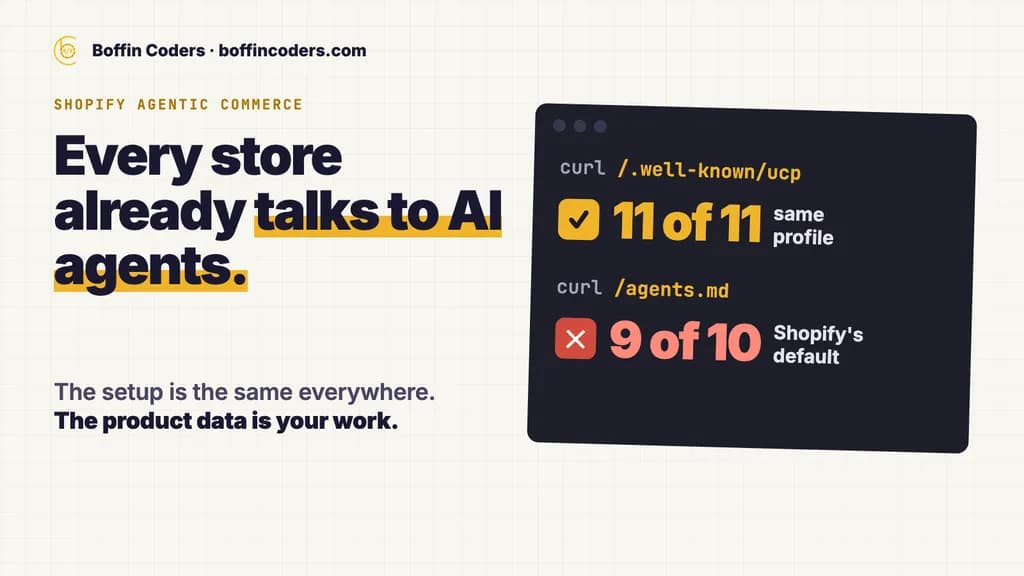
The UCP profile at | All eleven answered with the same profile contents: protocol version 2026-08-25, the same 11 capabilities and the same three payment handlers (card, Shop Pay and Google Pay) |
The agent tools at the endpoint the profile names | All eleven listed the same 13 tools, from |
The agent instructions at | Ten answered (one timed out twice). Nine served Shopify's default file, which explains how to shop and lists the store's policies but says nothing about what the store sells. One had rewritten it with a paragraph on what it sells and a product list with a line and a price range for each |
The protocol layer was identical from a large sportswear brand down to an independent illustrator. So it cannot be what sets one store apart in an AI answer. What differs is what the agent can learn about the products, and on nine of ten stores the agent's own instruction file was still Shopify's default.
How do you run the same check on a client's store?
Open a terminal and swap in your client's domain:
1curl -sL https://your-client-store.com/.well-known/ucp
2curl -sL https://your-client-store.com/agents.md
The first command shows the profile. It should name the protocol version and an MCP endpoint ending in /api/ucp/mcp. The second shows what the store tells agents about itself. If its first line starts with # Agent Instructions and it goes straight to shopping steps, the store is on Shopify's default, and there is no line in it about what the store sells or who it is for.
If every store has the same setup, what makes an agent recommend one?
The product data does most of the work. Shopify says ranking varies by AI platform but can include data quality, relevance, availability, pricing and engagement signals. Being eligible does not put a product in any particular answer either: each AI channel decides what to show for each request.
By default Shopify Catalog sends each product's title, description, options, images, price, availability and other main attributes. That works for a store whose data lives in those standard fields. Shopify's own guidance says Shopify Catalog Mapping helps most in stores with custom data, such as metafields or split product titles. These are the places to check:
What the agent reads | What to check on a client store | Where it is fixed |
|---|---|---|
Title and description | Does the description say who the product is for and what problem it solves, in the words a shopper would use? | The product itself |
Attributes kept in custom fields | Are size, material or fit held in metafields, metaobjects, tag prefixes or split product titles? | Shopify Catalog Mapping |
Variants | Are colours or sizes set up as separate products that should show as one listing? | Shopify Catalog Mapping, product grouping |
Sale prices | Should agents see compare-at prices as a strikethrough? | The compare-at price choice for Shopify Catalog |
The store's own description | Does | An |
Shopify's holiday article calls the test legibility: an agent has to work out what a store sells, who it is for and whether to trust it. Its point is that price is the one thing an agent sees at once, so anything else, such as why this product and who it is for, has to be written where an agent can find it. The Sales channels > Agentic page also lets you preview how a product appears in Catalog search and how it might rank, which gives you a before and after to show your client.
This is the same kind of work that gets a page cited in AI answers generally. If your team already does AI search optimisation for clients, product data is the next step of it.
What can your agency sell around agentic commerce for Shopify?
Agentic commerce for Shopify gives an agency two kinds of work: recurring work on the product data, and occasional build work. Most of it is invisible to the client until you show them the before and after.
Which work comes back every month?
This is the part that fits a monthly retainer:
- Map the catalogue. Map the attributes held in metafields and tags to the fields Shopify Catalog reads, and group variants that show as separate products.
- Rewrite the descriptions that matter. Start with the products that earn the most and describe them in the shopper's words.
- Write the store's agent file. Add an
agents.md.liquidtemplate that says what the store sells and for whom. One store in ten had done it in our check. - Check eligibility each month. Policies filled in, products eligible for Catalog, and the channel settings the client agreed to.
- Report the channel. AI orders show in the Shopify admin with the channel that sent them, so the monthly report can show what AI channels sold.
Which work is a one-off build?
These come up less often, and each is a project of its own:
- a shopping assistant on the client's own site, built on Shopify's agent tools and UCP (Shopify lets trusted agents complete checkout directly, and others hand the buyer to the store's checkout)
- a headless storefront, such as one on Shopify's Hydrogen library, set up so its products still reach AI channels through Shopify Catalog
- for a client that does not sell on Shopify, a set-up on Shopify's Agentic plan, which lists products in Shopify Catalog without moving the store and has no monthly subscription fee
What changes for checkout apps and analytics?
Direct checkout inside an AI channel can work differently from the store's own checkout. Shopify's Help Center lists the gaps for Microsoft Copilot, and they are the ones your clients will ask about:
- Copilot's direct checkout loads only the checkout blocks needed to complete an order. Upsells, custom fields and some validations may not show.
- Google Analytics and custom pixels do not fire there. Only server-to-server pixels run, for checkout started and completed.
- Local delivery, pickup in store and pickup points are not offered as delivery methods.
- Customers cannot be required to sign in before checkout.
ChatGPT is different, because the buyer pays on the store's own checkout, so every customisation and payment method still works. Across all AI channels, products sold only to business or wholesale customers are left out when Shopify can identify them. For headless stores, Shopify says the agentic storefront performance reports are not available yet. Agree with the client how you will measure this channel before you start, so nobody judges it by a dashboard that cannot see it.
If a client wants to opt out, turn off Allow Shopify to manage for me, then turn off Shopify Catalog access. It can take up to 7 days to stop. Products can still be found by ordinary web crawling, and Shopify's own Shop app keeps showing them, so a product that must not appear anywhere is set to Unlisted, which also hides it from sitemaps, search engines and the store's own search.
Should you build this in-house or with a white-label partner?
Build it in-house if you already have a Shopify developer with spare weeks and someone who writes product copy. The recurring work is mostly data and writing, and it needs to be checked each month. Use a partner when the build work arrives in bursts, or when a client wants a headless storefront or their own agent and your team is full.
A partner should work under your agency's name, in accounts your client owns, and send you a log of every product, template and setting changed. You keep the client and the price. Shopify work with us runs at US$15-30 an hour by seniority, and agency work can run in sprints at US$2,000 per two-week sprint. Larger custom storefronts are covered on our Shopify and headless commerce builds page. Either way, the invoice comes after you have seen the work.
If you would rather hand the whole job to a team that works behind your brand, our white-label Shopify development can take on the product data, the agent file and the builds for your clients' stores.
Keep reading
Jyoti
Co-Founder, Boffin Coders
Jyoti co-founded Boffin Coders and looks after client relationships and how projects run from first call to handover. Jyoti writes about hiring, process and what makes a development partnership work.
Frequently asked questions
Shopify agentic commerce adds no channel fee in ChatGPT or Microsoft Copilot. Shopify's Help Center says there are no fees for selling there, and the store pays only its standard payment processing fees. The Agentic plan, for brands that do not run their online store on Shopify, has no monthly subscription fee either. Paid apps, and the time spent improving product data, still cost money.
Not answered here?
Need this built?
We build websites and apps for businesses, and work behind digital agencies as their development team. Tell us where things stand on a 20-minute call.