How Much Does Website Maintenance Cost a Month?
- November 8, 2026
- 9 min read

Co-Founder, Boffin Coders
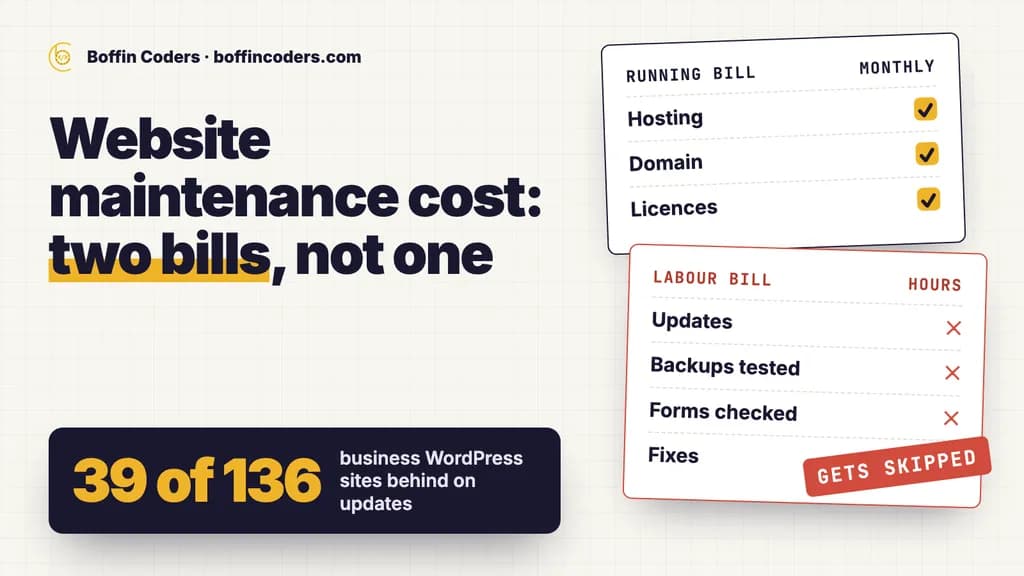
Website maintenance cost starts at about US$25 to US$100 a month for a business site if you count only hosting, a domain and a few tools. One worked example passes US$1,000 a month by paying a firm for nine to 12 hours at US$100 an hour. Both sit near the top of US results because they price two different bills, and the second one gets skipped. We read 136 business WordPress sites on 6 November 2026, and 39 were behind on WordPress itself.
A quote tells you little until you know which bill it covers, so sort that out before you compare two prices.
How much does website maintenance cost?
Website maintenance cost depends on whether a figure covers the running bill, the labour bill or both. We read the eight business guides we could open in the top 12 US results on 6 November 2026, and the figures below come from them.
This table shows how far apart they sit, and why:
Where it ranks in the US | What the figure counts | Figure |
|---|---|---|
Result 1, a hosting company | Keeping a business site running | US$25 to US$100 a month |
Result 2, a web firm | An online store: 9 to 12 hours at US$100 an hour, plus US$229 for the platform | US$1,129 to US$1,429 a month |
Result 3, a web firm | Basic maintenance work, by the hour | US$100 to US$250 an hour |
Result 6, a software firm | A brochure site: hosting, security, light content work, some developer time | US$50 to US$250 a month |
Result 10, a hosting company | Sites of small to medium businesses | US$35 to US$500 a month |
These are the guides' figures, not ours, and they show scale only. One guide says quotes can run from US$80 to US$2,400 a month for what sounds like identical work. The gap closes once you split the money into its two bills.
The running bill
The running bill is what you pay whether or not anybody touches the site: hosting, the domain, email and any paid plugins or themes. The guides put shared hosting at US$5 to US$25 a month and managed WordPress hosting at US$25 to US$80. A .com domain renews at US$12 to US$25 a year. A basic security certificate is free through Let's Encrypt, and many hosts add it for you.
The labour bill
The labour bill is hours multiplied by a rate, and it moves the most. The first-page rates above start at US$100 an hour, and websites and CMS work with us runs at US$12-30 an hour, so the same month of work can differ several times over. Ask any seller for the hours first. A price with no hours behind it cannot be compared with anything.
What does a month of website maintenance cover?
A month of website maintenance covers updates, backups, checks and small fixes, and the updates are the part that never stops. WordPress put out new releases on 18 separate days in the 12 months to 6 November 2026, three major versions among them, by our count of its release archive. That archive says only the newest version in the current series is safe to use and actively maintained.
This table lists the usual jobs:
Job | How often | Where the time goes |
|---|---|---|
Update WordPress, the theme and plugins | When each release lands | Testing the site after each one, and fixing what it breaks |
Back up files and the database | On a schedule, and always before an upgrade | Keeping copies away from the host's own server |
Test a restore | At least once a year | Bringing a backup up on a test site |
Check forms, bookings and uptime | Monthly, with an alert for outages | Sending a real enquiry through each form |
Renew the domain, licences and certificate | Yearly | Keeping cards and contact details current |
Content changes and small fixes | As they come up | Depends on how often your business changes |
WordPress updates its own core on most sites by default, according to its handbook, which removes some of this work. Plugins and themes, apart from special cases, update on their own only if someone turns that on. The PHP version your site runs on belongs to your hosting account, and no WordPress update will change it.
How many business websites are behind on updates?
About three in ten were behind on WordPress in our check. On 6 November 2026 we read the home pages and feeds of the WordPress sites Google Maps lists for accountants, dentists and plumbers in Chicago, Dallas, Manchester, Leeds, Toronto, Calgary, Melbourne and Brisbane. Of 192 sites, 175 answered and 136 showed a version number. We checked each one against WordPress.org's own list of versions.
This table shows what we could read and what we found:
What we read | Sites showing it | Sites behind |
|---|---|---|
WordPress version | 136 | 39: 22 marked outdated and 17 marked insecure by WordPress.org |
PHP version | 49 | 16 on PHP 8.1 or older, which gets no security fixes |
Elementor page builder | 77 | 33 on a release line older than the current one |
Yoast SEO plugin | 71 | 24 on a version older than 28 |
Copyright year in the footer | 131 | 30 showing a year before 2026 |
Across the first four rows, 160 sites showed at least one version we could read, and 69 of them were behind on at least one. The spread by country was wide: 20 of 44 Australian sites were behind on WordPress, against 4 of 29 in the UK.
Being behind covers two very different cases. Five of the 17 insecure sites had missed one release from nine days earlier, a gap a good plan closes within a week. Others were years back, and the oldest was on a WordPress version released in August 2018. An older plugin is a sign that nobody is watching, not proof of a flaw. Sites that hide their version are not counted, so the real figures may differ.
What happens if you skip website maintenance?
If you skip website maintenance, the work does not go away. It gathers, and you pay for it later in one large job. PHP is the clearest case. PHP 8.1 stopped getting security fixes on 31 December 2025, and PHP 8.2 stops on 31 December 2026, according to php.net. Moving a site that has sat for years means checking every plugin against the new version, which we cover in our guide to PHP end of life.
Cheap months can cost more over time. One guide on the US first page warns that sites run on US$20 a month are often the same sites that need a US$15,000 rebuild in year three. That is the guide's figure, not ours, but our check shows how common falling behind is: 39 of the 136 business WordPress sites we read were behind on WordPress itself.
Slow pages can come from the same neglect. Our guide to speeding up a WordPress site shows where to look first.
Does a Wix, Squarespace or Shopify site need maintenance?
A Wix, Squarespace or Shopify site needs less technical maintenance, because the platform handles updates and hosting for you and charges for that in its plan. Your monthly bill is the plan fee plus any paid apps. Someone still has to check forms and bookings, keep content current, renew the domain and test the site after an app changes.
A custom site sits at the other end. It has no plugin screen, but its frameworks ship security releases that a developer has to apply, as our notes on upgrading to Next.js 16 show. Budget labour hours every month for a custom build, even a quiet one.
Should you buy a website maintenance plan or pay by the hour?
Buy a website maintenance plan when your site changes rarely and you want updates handled, and pay by the hour when most of your needs are new content and new work. Website maintenance packages and care plans differ a lot in what they hold, so read one with these five questions:
- Ask how many hours the plan includes. One guide we read says packages should not be judged on hours at all. Ask anyway, along with what happens in a month that needs more.
- Ask who tests after an update. An update applied with no test is the cheap version of the job, and a broken contact form can sit unnoticed for weeks.
- Ask to see a restored backup. Only one of the eight guides we read mentions a backup that someone has actually restored. WordPress's backup guide says to keep at least three to five recent backups in different locations.
- Ask who holds the accounts. Hosting, the domain and paid licences should sit in your name, so leaving a provider does not cost you the site. Our guide on who should own your software accounts lists what to check.
- Ask what a report shows. Each month you should see what was updated, what was tested and what was fixed, with dates.
How do you check your own website in ten minutes?
You can check your own website from a browser and your WordPress login. These steps take about ten minutes:
- Find your WordPress version. Open
yourdomain.com/feed/, view the page source and look for ageneratorline ending in a version number such as?v=7.1.4. If you can log in,Dashboard > Updatesshows the same thing. - Compare it with the release archive. The archive lists the latest release at the top. If your number is lower, your site is behind.
- Read your PHP version. Go to
Tools > Site Health > Infoand open the Server section. Anything on 8.1 or older needs a move now, and 8.2 loses its fixes on 31 December 2026. - Count your waiting updates. Go to
Plugins > Installed Plugins. Note how many show a new version, and how many plugins you no longer use. - Ask when the last backup was restored. If nobody can give you a date, treat that as never.
If most of these come back behind, ask for a one-off catch-up price first and a monthly price second, because the two are different jobs.
Our longest clients have stayed with us since 2017, and we invoice after you see the work. If you would rather have this done for you, our WordPress developers can stay with your site month to month, handling updates and the fixes that follow them.
Keep reading
Jyoti
Co-Founder, Boffin Coders
Jyoti co-founded Boffin Coders and looks after client relationships and how projects run from first call to handover. Jyoti writes about hiring, process and what makes a development partnership work.
Frequently asked questions
How much website maintenance should cost per month depends on the hours your site needs. Guides on the US first page put a business site at about US$25 to US$500 a month. A worked example that pays a firm for nine to 12 hours passes US$1,000. Multiply the hours you are quoted by the hourly rate, then add hosting, the domain and licences.
Not answered here?
Need this built?
We build websites and apps for businesses, and work behind digital agencies as their development team. Tell us where things stand on a 20-minute call.