White Label Agency vs Freelancer: Which Should You Use?
- November 7, 2026
- 8 min read

Co-Founder, Boffin Coders
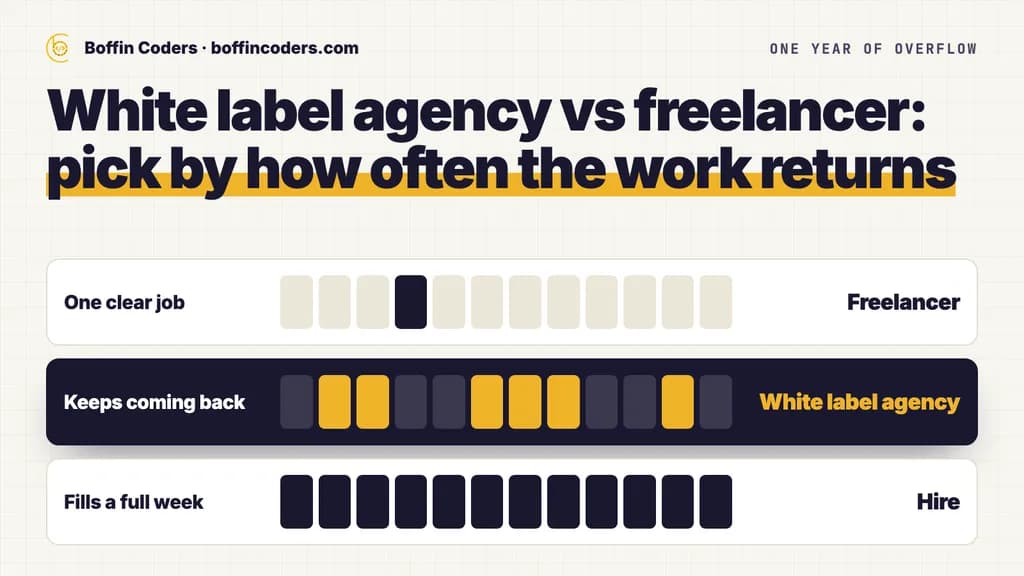
A white label agency is a company that does client work under your brand, so you keep the client, the price and the invoice while it carries the delivery. Use a freelancer for one clear job in one skill that you can check yourself. Use a white label agency when the overflow keeps coming back, needs several skills, or has a deadline that one person's illness would break. Hire only when one skill fills a full working week, month after month.
Picking the model is the easy part. Picking a provider is harder, because the pages that sell this work often leave out what you need most. We read the pages of 13 companies in the top 20 Google results for "white label agency" in the US, the UK, Australia and Canada on 5 November 2026. One of the 13 says when you pay. One says who keeps the accounts.
What is a white label agency?
A white label agency does work that another business sells as its own. A design studio wins a booking site and a monthly SEO contract, for example, and passes the build and the SEO to a white label agency. The client briefs the studio, sees the studio's logo on every file and pays the studio. The white label agency invoices the studio and stays out of sight.
The term covers marketing and development. All 13 companies we read sell marketing work such as SEO, paid ads or social media, and one lists mobile app development. So check the scope first. A provider that runs ad accounts well may not be the team you want writing your client's web application, and the way to find out is to ask who writes the code.
White label agency vs freelancer: what is the difference?
The main difference is who carries the delivery when something goes wrong. A freelancer is one person selling their own time. A white label agency is a team that answers for the result under your name, with other people to call on. Skill is rarely the deciding point, because a good freelancer will often do better work than a weak agency. So pick by how often the work returns.
Question | Freelancer | White label agency |
|---|---|---|
Who does the work? | One person you chose | A team, so ask who exactly |
Who manages the work? | You | The provider, and you review it |
What if that person is ill or booked? | Your deadline waits | Someone else picks it up, if the provider keeps cover |
How many skills can you buy? | Usually one or two | Several, such as design, build and SEO |
Whose name does your client see? | Yours, if you agree it | Yours, by default |
What does a quiet month cost? | Nothing | Nothing, unless there is a minimum term |
This table is for an agency selling work to clients. If you are a business owner with one app to build, the question becomes should I hire a freelancer to build my mobile app, and that guide answers it.
What do white label agency pages leave out?
White label agency pages explain the model well and often leave out the terms. Of the 13 companies we read, 7 mention confidentiality or an NDA, 5 rule out contact with your clients, 4 show a price and 1 says when you pay.
What the page states | Companies (of 13) |
|---|---|
Confidentiality or an NDA | 7 |
Contract length, or that there is no minimum | 6 |
No contact with your clients, or no approach to them | 5 |
A price or starting figure | 4 |
A small first step, such as one client or one project | 4 |
When you pay | 1 |
Who keeps the accounts or owns the work | 1 |
Mobile app development as a service | 1 |
We kept one page per company, the page that ranks, and counted a point only when the page states it in words. A menu link to a pricing page did not count. So this is a reading of first impressions, and a company may say more on another page or on a call. A company that stays silent on a page may still have a good answer. The count shows you where to spend your first call, because the missing terms are the ones that protect your margin and your client. The same questions apply to a freelancer.
How does white label work from brief to invoice?
How does white label work? In five steps, and your agency stays in front of the client at each one.
- Agree the terms. Sign confidentiality and no-approach terms before you share the client's name.
- Send a written brief. Give the scope, the deadline, and the accounts and repository the work will use.
- Let the provider build. Files, reports and test links carry your brand, never theirs.
- Review before your client sees it. Check the work against the brief, because your name goes on whatever you pass on.
- Invoice your client. The provider invoices you, you invoice your client, and the price you charge stays yours.
For a first build, this guide on how to outsource web development for agencies goes through what to keep and what to hand over.
When is a freelancer the better choice?
A freelancer is the better choice for one clear job, in one skill, that someone on your team can check. A theme change, a landing page, a bug in a stack you know or a set of illustrations all fit. You know what good looks like, so nobody has to manage the quality for you.
A freelancer also suits work with a soft deadline. If the person is busy for a week, nobody loses anything. Keep the good ones close. A freelancer who knows your standards can be worth more to you than any provider, and you do not have to pick one model for everything.
The risk grows with how much of your promise to a client rests on one person. When a launch date depends on someone who also has other clients, you are carrying a risk that your client cannot see.
When does a white label agency beat a freelancer?
A white label agency beats a freelancer when the overflow keeps coming back, needs several skills, or sits behind a client deadline you cannot move. These signs tell you that you have reached that point:
- You search for someone free every few weeks, and each new person needs your standards explained again.
- One client project needs design, build and SEO, and you are managing three people to deliver it.
- A client asks for work your team does not do, such as a mobile app, and you would otherwise turn it down.
The saving is mostly your own time. Hours spent finding people, briefing them and chasing them are hours you cannot bill. A white label agency runs that work itself, so your team reviews the result and talks to the client. That review still takes time, and you should plan for it on every job.
When should you hire someone instead?
Hire when one skill fills a full working week for most of the year and the work is already sold. Someone on your payroll learns your clients and your standards faster than an outside team can. The price is a salary in the quiet months too.
If the load looks steady but you are not sure it will last, a dedicated development team gives you the same people each month without adding them to your payroll. That lets you test the pattern before you commit to an employee.
What does each option cost in a quiet month?
Compare the cost per day of client work, never the day rate on its own. A hire costs the same in a quiet month as in a busy one. A freelancer or a white label sprint costs nothing in a month when you buy nothing.
One year of overflow | Hire | Freelancer or sprints |
|---|---|---|
Days you pay for | 230 | 60 |
Days of client work | 60 | 60 |
Days with no client work | 170 | 0 |
Illustration. Figures are invented.
To run this for your agency, divide what each option costs in a year by the days of client work it delivers. A hire can fill some of those empty days if you have other work to sell. Use your own salary and rates, and add your own hours, since a freelancer you manage takes more of your week than a provider who runs the work.
For scale, our agency sprint is US$2,000 for two weeks of work under your brand. SEO is priced differently, usually per client per month, and white label SEO pricing sets out the ranges and the markup.
What should you ask a white label agency before the first job?
Ask for the terms the pages leave out: when you pay, who keeps the accounts and the code, whether the provider will ever approach your clients, who exactly does the work, and whether you can start with one small piece. A good provider answers each one in a sentence, in writing. The full list of questions to ask a white label partner gives the answers to listen for.
Here is how we answer them, so you can hold us to it. We sign non-circumvention before scoping, we never contact your client unless you ask, the code goes into the repository you name from the first commit, and our invoice comes after you have reviewed the work. Our longest clients have stayed with us since 2017. Jonathan Hochmeir, who runs a web agency in Linz, wrote on Clutch: "They were always perfectly on time and tailored their work exactly to our needs."
If your overflow keeps coming back and you would rather have it built behind your brand, you can talk to a white label development partner about one small first piece.
Keep reading
Jyoti
Co-Founder, Boffin Coders
Jyoti co-founded Boffin Coders and looks after client relationships and how projects run from first call to handover. Jyoti writes about hiring, process and what makes a development partnership work.
Frequently asked questions
A white label business sells a product or service that another company makes, under its own brand. The buyer sees one name. In agency work, that means a web or marketing agency selling builds or SEO that a white label agency delivers, while the selling agency keeps the client, sets the price and sends the invoice.
Not answered here?
Need this built?
We build websites and apps for businesses, and work behind digital agencies as their development team. Tell us where things stand on a 20-minute call.