How Much to Charge for a Website: A Pricing Guide for Agencies
- November 3, 2026
- 8 min read

Co-Founder, Boffin Coders
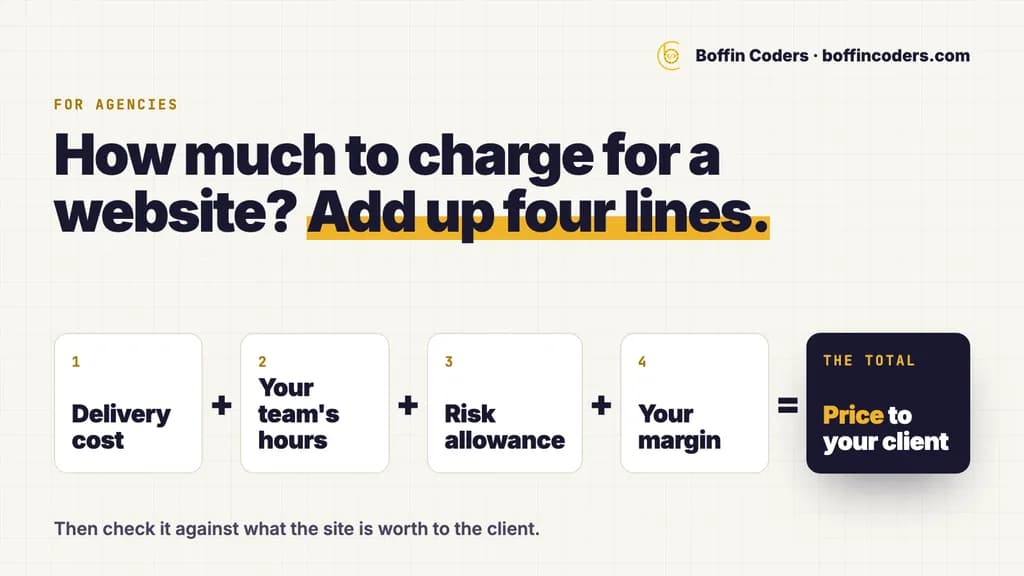
Charge what the website costs you to deliver, plus your own team's hours on the project, plus an allowance for risk and a margin, then check the total against what the site is worth to the client. That sum is your floor. The pricing guides on the US first page quote anything from US$300 a year for a do-it-yourself site to US$150,000 for an agency or freelancer build, so a market average will not set your price. Your own costs will.
We read the business guides on the US first page for how much to charge for a website on 27 October 2026 and opened three of the four. Two are written for the person buying a website. The one written for agencies puts the usual agency or freelancer price between US$12,000 and US$150,000, describes hourly, project, yearly and monthly pricing, and says your rate must at least cover your costs. None of the three works that sum through, and none covers pricing a site that a partner builds under your agency's name.
How much do agencies charge for a website?
The figures on that first page show how wide the market is. Each guide prices a different kind of site for a different buyer.
What the guide prices | Range it gives | Written for |
|---|---|---|
A do-it-yourself site, per year | US$300 to US$500 | Buyers |
A professional web designer | US$500 to US$10,000 | Buyers |
A business site built by a professional | US$2,000 to US$8,000 or more | Buyers |
A fully customised site from a web design agency | US$3,000 to US$10,000 or more | Buyers |
An online shop built by a professional | US$5,000 to US$15,000 or more | Buyers |
The usual agency or freelancer build | US$12,000 to US$150,000 | Agencies |
A five-page site for a café and a booking platform for a group of clinics are both "a website", and they sit at opposite ends of that table. Your client will compare your quote with the other quotes they get. Ask yourself "how much should I charge for a website like this one?" from your own costs first, and use the market as a sense check afterwards.
How to work out how much to charge for a website
Every website price has the same four lines under it. Work each one out for the job in front of you, add them up, and you have the lowest price you can quote without losing money.
The cost to deliver the build
This is what the design and code cost whoever does them. If your own developer builds it, count their hours at their full cost to you: salary, taxes, tools, equipment and the hours in a month nobody can bill. If a freelancer or a white-label partner builds it, it is their written price for the scope you agreed.
Your own team's hours
These are the hours an agency spends on a website that never appear in a build quote: discovery calls, the brief, design reviews, chasing the client for content and photos, rounds of feedback, testing on phones, the launch and training the client to edit pages. Count them from your last two finished projects rather than from memory.
An allowance for risk
Content arrives late, a client asks for a third round of changes, or a plugin does not do what everyone assumed. Add a buffer to the price for the small surprises, and write a scope that sends larger extra work to a priced change request.
Your margin
The margin pays for the time you spend selling, the quiet months and the growth of the agency. Decide the percentage once and apply it to every quote, so it is not discounted away one conversation at a time.
A worked example
This is how the four lines add up for a ten-page brochure site built by a partner. Replace each figure with your own.
Line | Example | Your figure |
|---|---|---|
Partner's written price for the build | US$2,400 | |
Your team: 20 hours at an internal cost of US$45 an hour | US$900 | |
Risk allowance: 15% of the two lines above | US$495 | |
Your cost | US$3,795 | |
Margin: 40% on top of your cost | US$1,518 | |
Price to your client | US$5,313, quoted as US$5,300 |
Illustration. Figures are invented.
Then check the total against value. Ask the client what a new customer is worth to them and how many more customers they expect the site to bring. If the price is less than a few months of that, it is an easy decision for them. If it is more, reduce the scope rather than your margin.
Should you charge by the hour, by the project or by the month?
Each way of charging puts the risk in a different place.
Model | How it works | Suits | What to watch |
|---|---|---|---|
By the hour | You bill the hours you spend | Unclear scope, fixes and small changes | Clients question every hour, and working faster earns you less |
Fixed project price | One price for a written scope | Brochure sites and clear briefs | Extra requests need a change request, or they eat the margin |
Monthly fee | A fee each month for the site plus ongoing work | Clients who change their site often or want SEO | Write down what one month includes |
Yearly fee | One fee a year for the site, upkeep and refreshes | Businesses that rarely update their site | Price the refresh or redesign into the year |
For most websites the cleanest mix is a fixed price for a written scope, then a monthly plan for everything after launch. Hourly billing suits fixes and small changes, where nobody can scope the work in advance.
What should a website price include?
Name each of these in the quote, with a number where one fits:
- how many page templates and how many pages, and who adds the pages after the first few
- how many design rounds, and what counts as a round
- who writes the words and who supplies the photos, and by when
- every form, booking tool, payment or other system the site connects to
- the basic search set-up: page titles, descriptions, and redirects from any old addresses
- checks for speed on phones and for people using screen readers
- training for the client's team, and how long you support the site after launch
- who pays for hosting and the domain, and whose account they sit in
Price separately anything that can grow on its own: copywriting, photography, an online shop, a members area, more than one language, and moving a large existing site. A site with years of pages that rank on Google needs every address listed, mapped to its new page and checked after launch, and that work belongs on its own line of the quote.
How do you price a website a white-label partner builds?
The sum is the same, but three things change when a partner builds the site under your name.
- Get the partner's price in writing first. Quote your client only after the partner has priced the same scope, line by line, so nothing you promised is missing from what they will build.
- Keep your own hours in the price. You still own the client, the brief, every call and the review of every page before your client sees it. A partner removes the build hours, not yours.
- Match the change rules on both sides. If your contract with the client sends extra work to a change request, the partner's agreement with you should do the same. Otherwise you pay for extras your client never pays you for.
Ask when the partner invoices. A partner who invoices after you have reviewed the work keeps your cash and your risk in step with the client's. Before you choose one, the guide to outsourcing web development covers what to hand over and what to keep.
How do you keep earning from a website after launch?
The build is paid once. A care plan, hosting and search work are paid every month, so put them in the first quote rather than after launch.
A monthly care plan covers updates, backups, security fixes and a set number of small changes each month. Hosting can sit inside it or alongside it. Search work is a separate monthly service with its own costs, and the sum for that is set out in white label SEO pricing. Price each one from its own hours, in the same way as the build.
What makes agencies undercharge for websites?
These mistakes push a website price below its cost:
- pricing the build and forgetting your own team's hours on the client
- leaving design rounds open, so a third and fourth round arrive at no charge
- starting before the content is ready, then waiting weeks with the project half done
- moving an old site for free, including its addresses and redirects
- matching the cheapest quote the client mentions instead of reducing the scope
The fix for each is to price from your own costs, write the scope down and send extra work to a change request. If you are working out how much to charge for website design on its own, the same four lines apply, with design hours in place of build hours.
At Boffin Coders, white-label websites are built in two-week sprints at US$2,000 per sprint, in your repository and under your brand, and invoiced after you have seen the work. If you would rather have the build done for you at a known price while you keep the client, see our white label web design service for agencies.
Keep reading
Jyoti
Co-Founder, Boffin Coders
Jyoti co-founded Boffin Coders and looks after client relationships and how projects run from first call to handover. Jyoti writes about hiring, process and what makes a development partnership work.
Frequently asked questions
How much you should charge for a website as an agency comes from a sum: the cost to deliver the build, your own team's hours, an allowance for risk and your margin. Check the total against what the site is worth to the client. The pricing guides on the US first page range from US$300 a year for a do-it-yourself site to US$150,000 for an agency or freelancer build.
Not answered here?
Need this built?
We build websites and apps for businesses, and work behind digital agencies as their development team. Tell us where things stand on a 20-minute call.