Should Your Agency Start Outsourcing Web Development?
- October 26, 2026
- 9 min read

Co-Founder, Boffin Coders
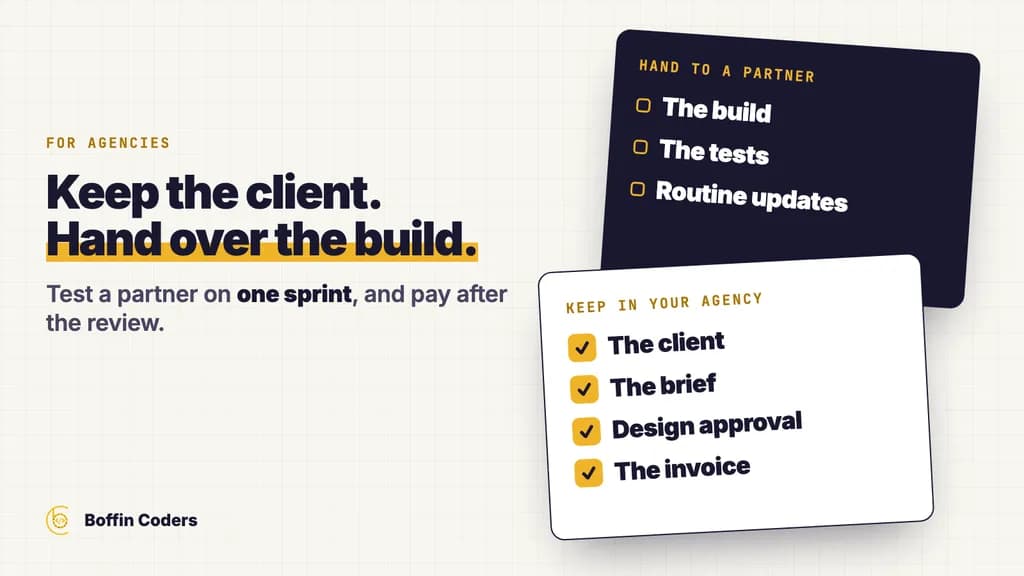
Outsourcing web development makes sense for an agency when you are turning down or delaying build work, or about to hire for a peak that will pass. Keep the client, the brief, the design sign-off and the invoice. Hand over the build, the tests and the routine updates. Start with one small piece your client is already waiting for, keep the code in your own repository from the first commit, and pay only after you have reviewed the work.
The usual advice is to test a partner on the big project, the one your team cannot staff. Start at the other end, with the smallest piece of work you know how to judge, and let the big project wait until you have seen how they write, test and talk.
What does outsourcing web development mean for an agency?
For an agency, outsourcing web development means another company builds the websites or web applications you sell, under your name. You keep the client, the pitch, the design approval and the invoice. The partner writes and tests the code in your tools and your client's accounts, and never speaks to your client. Agencies often call this white-label development.
A hire is a cost you carry all year. A partner is paid by the piece or by the month, so the cost stops when the busy season ends.
There are three common ways to buy that capacity:
Model | How it works | Suits | Watch for |
|---|---|---|---|
By project | A written scope and one price for the whole build | A one-off site with a clear brief | Every change becomes a new negotiation |
By sprint | A fixed block of time, usually two weeks, against a written scope for that sprint | Ongoing work, shifting priorities, a first test of a partner | Extra requests creeping into the sprint, so keep a written list |
Dedicated developer | One or more developers on your clients' projects, by the month | A steady pipeline, maintenance across many client sites | Paying for quiet weeks if the pipeline slows |
When should an agency outsource web development?
Outsource web development when the work you are turning down, or delivering late, is worth more than the time it takes to brief and review a partner. The clearest signs are a waiting list for builds, senior people stuck on routine updates, a stack your team does not know, or a peak that would need a hire you cannot keep busy afterwards.
Check your last quarter against these signs:
- You have told more than one client "we can start in six weeks".
- Your best developer spends days on plugin updates and small fixes instead of new builds.
- A client asks for a stack your team has not used, such as a headless CMS or an online store, and you would rather not learn it on their budget.
- A launch season or a large pitch would need a hire you could not keep busy after it.
- Your build margin is thin because senior time goes on work a junior could do.
Two or more of these, and outsourcing is worth a test.
When is outsourcing the wrong move?
Outsourcing is the wrong move when nobody at your agency can judge the work. If no one can read a pull request or test a staging site, you will not know whether the partner is good until your client tells you. Hire or train that reviewer first.
It is also the wrong move while the brief lives in one person's head. A partner can only build what is written down, so the first job is writing it down.
What should you outsource first, and what should you keep?
Keep everything your client sees and decides: the relationship, the brief, the design approval, the final check and the invoice. Outsource the work your client never watches being done: the build, the tests, the routine updates and the maintenance. Start with a small piece of real work that you can judge easily, so a poor first test costs little and still shows you how the partner works.
Keep in your agency | Hand to a partner |
|---|---|
The client relationship and every client call | Building pages, features and integrations |
The brief and the written scope | Writing and running the tests |
Design approval | Turning approved designs into code |
The final check before your client sees anything | Routine updates, fixes and maintenance |
The invoice to your client | Technical notes for the handover |
What makes a good first project?
A good first project is one your client is waiting for, that you could finish yourself if you had to, and that you can judge in an afternoon. A set of template pages on an existing site, a round of updates across several client sites, a landing page from an approved design, or the move of a small site to a new platform all work well.
Avoid the project that would lose you the client if it went wrong. That one waits until the partner has shown you their work twice.
How to outsource web development, step by step
To outsource web development without handing over your client, write the brief, sign the confidentiality contracts, give the partner access to your repository rather than theirs, agree how you will see the work before your client does, run one sprint, review it against the scope, and pay after the review. Then decide whether to scale.
1. Write the brief as if for a new employee
Include the goal, the pages or features, the designs, the content, the accounts involved, the deadline and what "done" looks like. If something needs a call to explain, write it down after the call. The brief is also your scope: anything that is not in it is a change, and changes are priced and planned as new work.
2. Sign the confidentiality contracts before you share the brief
Before you name your client, sign the contracts that keep your data and your client's data confidential: a mutual NDA, a non-circumvention clause and a data processing agreement. Non-circumvention is the one that stops the partner approaching your client, or taking work from them, behind your back.
3. Keep the code and the accounts in your name
Give the partner access to your repository, or your client's, from the first commit. Add them to the hosting and other accounts as members, never as owners. If the arrangement ends, you remove their access and you already have every file. Who should own each account a project needs lists them, with the role to grant a developer.
4. See every change before your client does
Agree that each change arrives as a pull request with notes on what changed and how it was tested, and that a staging site only you can open shows the result. You present the work to your client yourself, so nothing should reach them that you have not seen first.
5. Run one sprint, then review it against the scope
Two weeks is long enough to see how a partner asks questions, writes code and reports a problem, and short enough that a poor fit costs little. At the end, check what was delivered against what the scope says, line by line, before you look at anything else.
6. Pay after the review, then scale
Pay once you have seen and reviewed the work. If the first sprint went well, add a second, then a steady rhythm of sprints. When your pipeline is full all year, a dedicated development team working only on your clients' projects can replace the sprint-by-sprint arrangement.
How do you work out whether outsourcing pays?
Outsourcing pays when your price to the client is higher than the partner's price plus the hours your own team spends on the brief, the review and the client calls. Work it out per project with three numbers from your own books, before you quote. Then run the same sum on your last three builds to see what you would have kept.
Line | What to count | Where to find it |
|---|---|---|
A. Your price to the client | What you would quote for the whole build | Your proposal |
B. The partner's price | Their quote for the same scope, or the number of sprints times the sprint price | The partner's written estimate |
C. Your own hours | Brief, review, client calls and the final check, times your internal hourly cost | Timesheets from a similar project |
Your margin | A minus B minus C | Your sum |
Count line C honestly. Most of it falls on the first project, while you and the partner learn each other's way of working, and it shrinks after that.
Then compare the result with the same project built in-house: A minus (your developers' hours times their internal cost). If the two margins are close, the deciding factor is what you can do with the hours you freed. A waiting list that turns into signed projects is worth more than a few points of margin on one build.
What does it cost to outsource web development?
Partners price in three ways: a fixed price per project, a price per sprint, or a monthly price per developer. The figure depends on the stack, the complexity of the work and the seniority of the people on it. Ask for the price in writing for the model you want, and ask when they invoice: before the work starts, or after you have seen it.
The answer to the second question shows who carries the risk of a poor sprint. A partner who invoices after you have reviewed the work carries it, so their attention stays on finishing work you would put your name on.
Boffin Coders agency sprints are US$2,000 per two-week sprint, invoiced after you have seen the work. Boffin Coders employees in Mohali write the code, with no subcontracting, in the repository you name from the first commit, and two of our clients have paid us every month since 2017.
Is agency outsourcing cheaper than hiring?
Agency outsourcing can be cheaper than hiring, but the hourly price is the wrong test. A hire costs a salary, equipment, management time and the weeks before they are productive, and those costs run through the quiet months too. Agency outsourcing costs only the work you buy. The better test is whether you can sell the extra capacity, and whether the partner's work is good enough to carry your name.
If you would rather hand your next build to a partner that works this way, our page on white-label web development for agencies sets out how we work under your brand.
Keep reading
Jyoti
Co-Founder, Boffin Coders
Jyoti co-founded Boffin Coders and looks after client relationships and how projects run from first call to handover. Jyoti writes about hiring, process and what makes a development partnership work.
Frequently asked questions
Outsourcing web development, for an agency, means another company builds the websites or web applications you sell under your own name. You keep the client, the brief, the design approval and the invoice. The partner writes and tests the code in your repository and your client's accounts, and never speaks to your client. Agencies often call it white-label development.
Not answered here?
Need this built?
We build websites and apps for businesses, and work behind digital agencies as their development team. Tell us where things stand on a 20-minute call.