How GEO/SEO took a solar installer’s traffic up 500% in three months
- March 3, 2026
- 6 min read

Santosh Kumari
SEO and AI Search Specialist
Technologies Used
The solar industry is expanding rapidly. But while demand is increasing, digital competition is becoming more aggressive than ever.
Many solar companies invest heavily in operations, installation quality, and on-ground teams, yet their websites fail to generate consistent, high-intent leads.
This case study explains how we helped a solar installer operating in several cities achieve:
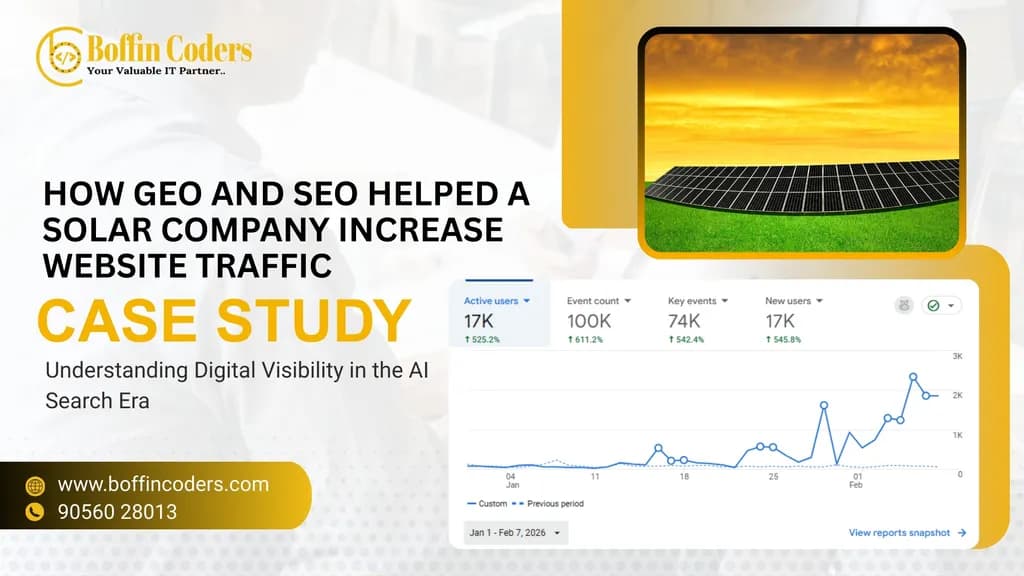
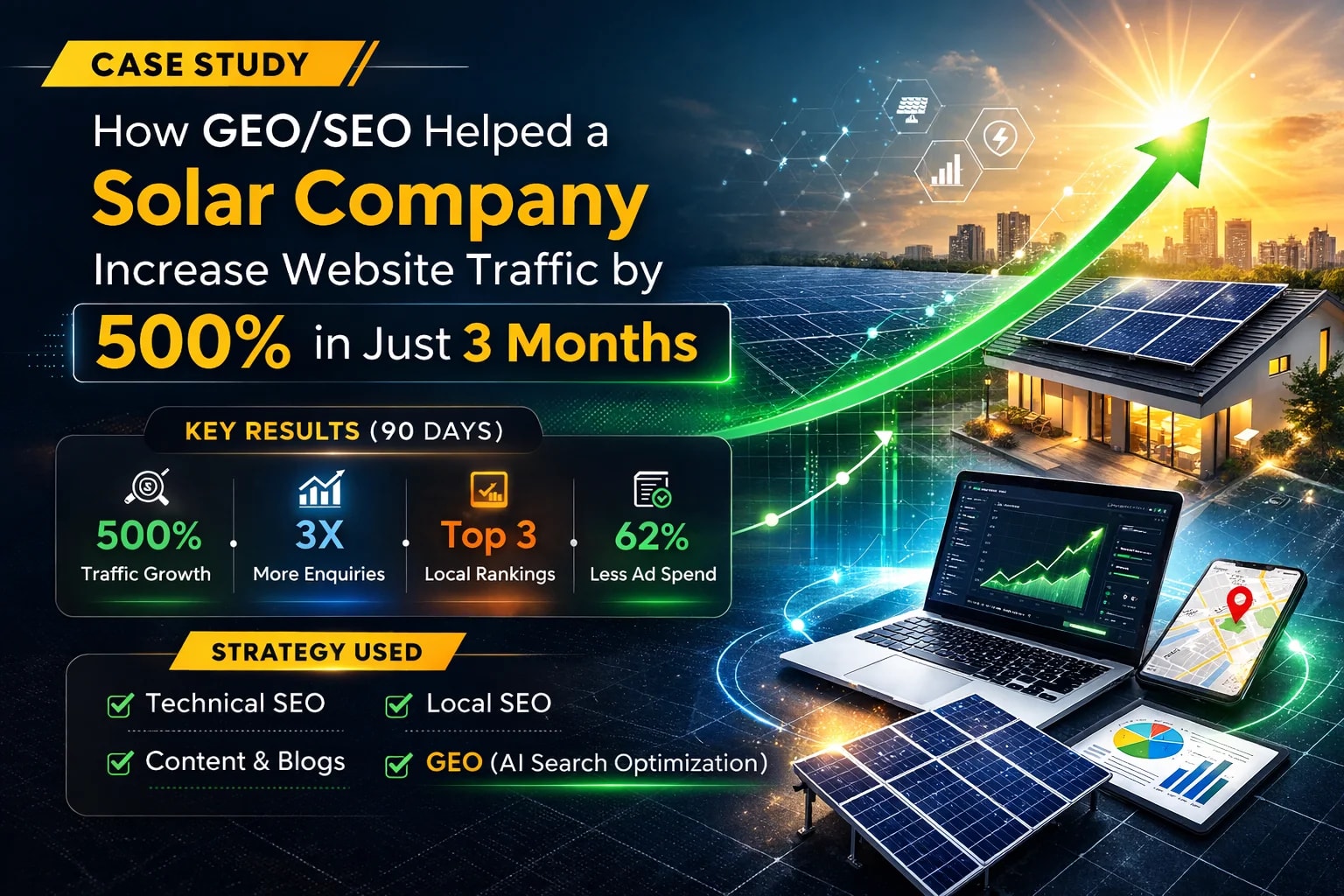
- 500% increase in website traffic
- 3X growth in qualified enquiries, by the client's count
- Top 3 rankings for high-intent local keywords during the engagement
- Reduced dependency on paid ads within 90 days
This wasn’t random growth. It was the result of a structured GEO + SEO framework built for how people search now: on Google, in the Map Pack and in AI answers.
About the Client Requirements
The client was a growing solar installer operating in several cities.
Services Offered:
- Residential rooftop solar installation
- Commercial & industrial solar solutions
- Solar EPC services
- Net metering & subsidy assistance
The challenges
Despite a strong offline reputation and successful projects, their digital presence did not reflect their market position.
Before we started, the company was facing:
1. Low Search Visibility
They were not ranking for high-intent keywords like:
- “solar panel installation near me”
- “commercial solar company”
- “rooftop solar cost”
- “mppt charge controller”
- “solar charge controller”
2. Weak Local Presence
Their Google Business profile was under-optimized and missing important trust signals.
3. Poor Website Structure
- No clear service pages
- Thin content
- No schema markup
- Slow loading speed
4. No GEO Strategy
They were invisible in AI-driven search responses and generative search platforms.
Our Strategy: GEO + SEO Hybrid Growth Framework
We combined traditional SEO with modern GEO (Generative Engine Optimization), the same pairing that runs through our monthly SEO work, to ensure visibility across:
- Google Search
- Local Map Pack
- AI search results
- Voice search queries
Phase 1: Technical SEO Foundation (Week 1–3)
We rebuilt the core structure:
- Website speed optimization
- Mobile-first improvements
- Proper internal linking
- Schema markup (LocalBusiness + Service)
- Crawl error fixes
- XML sitemap & indexing improvements
Phase 2: Keyword strategy by buyer intent (Week 2–6)
We categorized keywords into:
Commercial Intent Keywords
- Solar installation cost
- Best solar company
- Solar panel subsidy guide
Informational Keywords
- How solar panels work
- Is solar worth it?
- Solar ROI calculator
Local Keywords
- Solar company near me
- Rooftop solar installer in each service city
We created high-quality landing pages for each major service.
Phase 3: GEO – Optimizing for AI & Generative Search
Generative search is changing how users discover businesses.
We structured content to:
- Answer question-based queries clearly
- Use conversational formatting
- Add FAQ schema
- Create authoritative topical clusters
This helped the company appear in AI-generated summaries and answer boxes.
Phase 4: Content Authority Building
We developed:
- 12 SEO-optimized blog posts
- 4 in-depth service pages
- Case-based landing pages
- Local city-specific pages
Each article was designed to:
- Educate buyers
- Build trust
- Capture long-tail search traffic
- Guide users toward consultation booking
Phase 5: Local SEO and the Map Pack
We optimised their Google Business Profile, the core of local search for trade businesses, with:
- Keyword-rich descriptions
- Weekly posts
- Review strategy system
- Geo-tagged images
- Local citation building
Within 6 weeks, they started ranking in the top 3 Map Pack results.
How the engagement ran, week by week
Weeks 1 to 3 went on the technical foundation: site speed, mobile layout, internal links, LocalBusiness and Service schema, crawl errors and the XML sitemap. The keyword work began in week 2, before the technical phase had finished, and ran to week 6. It sorted searches into commercial, informational and local intent, and gave each major service its own landing page.
The GEO structuring, the content programme and the Business Profile work then built on that base: question-led pages with FAQ schema, twelve blog posts, four service pages, city pages, weekly profile posts and a review system. By week 6 the company was showing in the top 3 Map Pack results. By day 90 it had reached the traffic and lead figures in the table below.
The results after 90 days
Metric | Before | After 90 Days |
Monthly Organic Traffic | 1,200 | 7,200+ |
Qualified leads (by the client's count) | 18/month | 57/month |
Map Pack Rankings | Not visible | Top 3 |
Keyword Rankings (Top 10) | 6 keywords | 48 keywords |
Overall Traffic Growth: 500%
More importantly, the traffic was high-intent and converted into real installation projects.
ROI Impact
The client reports these business results over the same 90 days:
- 3X increase in consultation bookings
- 2.4X revenue growth in one quarter
- Reduced paid ad budget by 62%
- Strong long-term organic pipeline
Why This Worked
It worked because:
- We combined SEO with GEO
- We focused on buyer intent
- We built topical authority
- We optimised for local search in every city the client serves
- We aligned content with business goals
We looked at how people now search for solar, not only at which keywords they type.
Key Takeaways for Solar Companies
If you are in the solar industry and struggling with traffic:
- SEO alone is no longer enough.
- Local optimization is critical.
- AI search visibility is the new competitive advantage.
- Structured content that answers questions directly gets found in search and in AI answers.
Final Thoughts
This case study proves that when technical SEO, content authority, local optimization, and GEO strategy work together, rapid growth becomes achievable.
Solar is a competitive market, but a local installer can still reach the top three map results in its own cities with the right strategy.
If you're ready to scale your solar business with data-driven SEO and GEO, the opportunity is waiting.
Agencies can have this framework run for their own clients through white-label SEO for agencies.
Questions about this engagement
Q1. How long did it take to see SEO results for the solar company?
Results came within the 90 days of this engagement. The first movement showed after six to eight weeks, and by day 90 traffic had gone from 1,200 to more than 7,200 organic visits a month. For another business the timing varies with the competition and the state of the website.
Q2. What GEO and SEO strategies were used in this project?
Boffin Coders used local keyword optimization, content improvements, technical SEO, location-based pages, and backlink building to improve visibility in targeted regions.
Q3. Can similar results be achieved for other solar businesses?
Results may vary based on competition and market conditions, but Boffin Coders follows proven strategies that help improve visibility and lead generation for solar companies.
Q4. Did this strategy focus on local search rankings?
Yes, the campaign focused strongly on GEO-targeted keywords and local SEO to help the company appear in relevant regional searches.
Q5. How did SEO help reduce dependency on paid ads?
By improving organic rankings and traffic, the company received more qualified leads naturally, reducing the need for continuous paid advertising.
Q6. Is this SEO approach suitable for other industries?
Yes, Boffin Coders adapts its GEO and SEO framework for different industries, including solar, real estate, healthcare, and service-based businesses.
Q7. Can I rank my solar business on Google Maps without a website?
Yes, you can rank with an optimized Google Business Profile. However, without a website, your authority and conversions will be limited. A well-optimized website significantly improves Maps visibility and lead generation.
Q8. What are the top 3 SEO mistakes solar companies make?
Targeting broad keywords instead of local intent, neglecting technical SEO (speed, schema, mobile), and not optimizing for AI-driven search. Many also ignore review management and city-specific landing pages.
Q9. How much does SEO cost for solar contractors?
Our monthly SEO price is published on our SEO services page. The cities you target, the competition in each and the state of your website decide which work comes first.
Show us the site that is not being found
Twenty minutes with the person who would do the work. Send the address when you book and we will have looked at what Google sees before the call.