Jev is not a smaller LLM. It answers a different question.
- September 21, 2026
- 8 min read
Founder, Boffin Coders
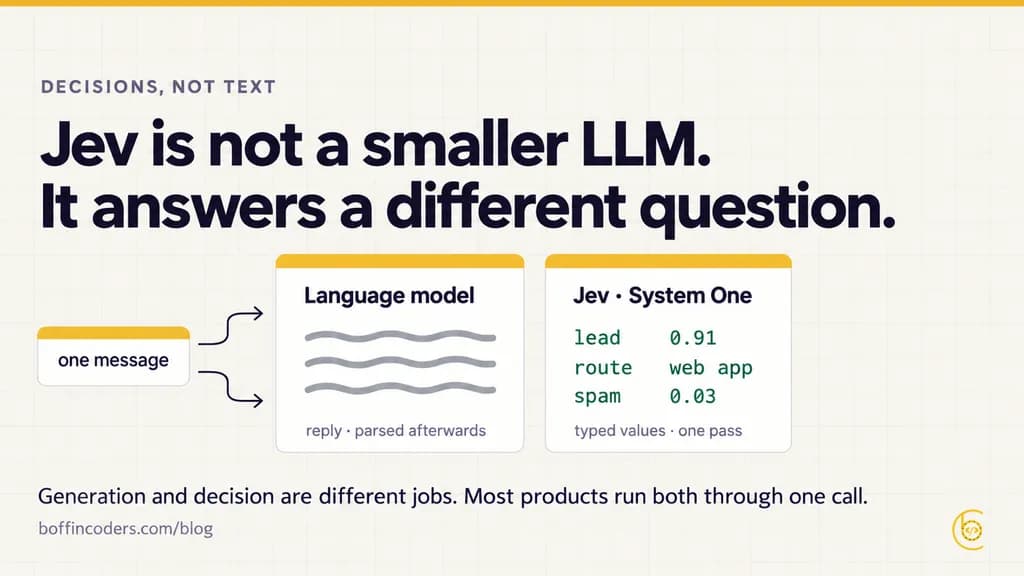
On 15 September a new lab called TypeSafe AI announced a model called Jev and a category name to go with it: a “System One” model. The founder is Diogo Almeida, who worked on the methods that made language models useful at OpenAI. The funding round was reported at $40 million, led by DCVC. Within a day there were a dozen explainers. Most of them treat Jev as a faster, cheaper LLM. It is not, and reading it that way is how you would misuse it.
What was actually announced
You send Jev a piece of program state - a support ticket, a chat message, a JSON object describing a game frame - and a set of typed questions about it. It answers all of them in one pass and returns values, not text. TypeSafe’s figures, as published: 70 to 500 milliseconds end to end, $0.042 per million input tokens, output free, and a type-error rate of zero because the output is constrained to the type you asked for. It is in early access. There is a waitlist, and it is also listed through Vercel’s AI Gateway as typesafe-ai/jev.
The important word in that paragraph is typed. Three kinds of question exist:
- Choice - pick one from a set you define. Returns the pick, a probability for every option, and a confidence.
- Score - place the state on a scale you define. Returns the score, the probabilities behind it, and a confidence.
- Noul - is this statement true? Returns a single number between 0 and 1.
That is the whole surface. There is no “write me a reply”. There is no output to parse. You ask “is this a lead?” and you get 0.91, not a paragraph that contains the word “yes” somewhere in it.
Why that is a different thing, not a smaller thing
A language model produces text one token at a time, and everything else - a decision, a classification, a score - is something you extract from the text afterwards. You write a prompt that asks for JSON, you hope the JSON is well formed, you parse it, you handle the case where the model added a sentence before the brace. Every one of those steps costs latency and every one of them can fail.
Jev, by TypeSafe’s account, does not generate. It evaluates the state against each question in parallel and returns the answer directly. Adding a question barely changes the response time, because the questions are not answered in sequence. The docs make a point of each question being evaluated in isolation, so a long list of questions does not degrade the answers to the early ones.
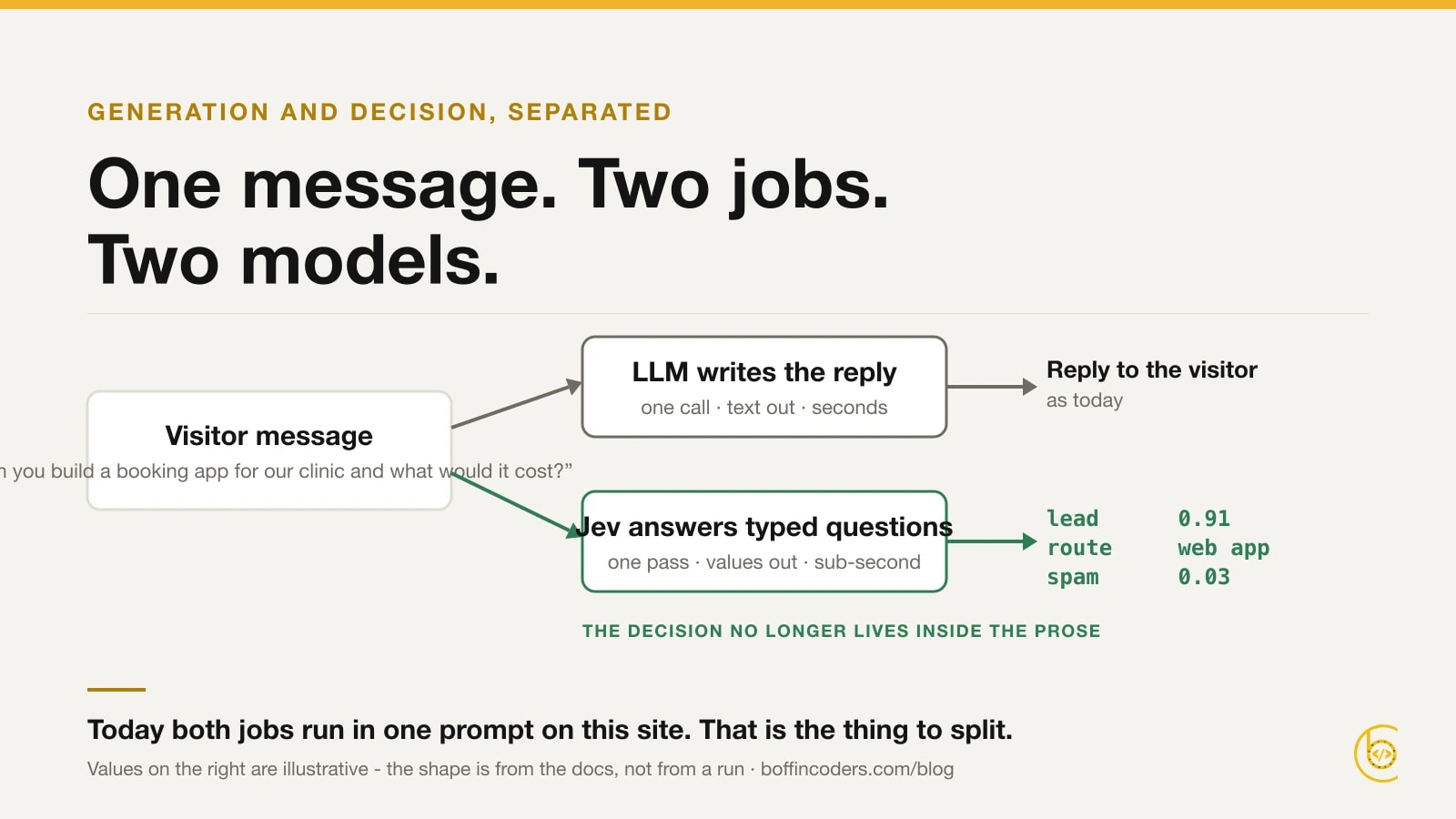
So the honest comparison is not “Jev versus GPT”. It is “a decision extracted from generated text” versus “a decision returned as a value”. On that comparison, a model built for the second thing should win on speed, cost and reliability, and it would be surprising if it did not. Whether Jev’s judgement is as good as a frontier LLM’s on hard cases is the open question, and it is the one nobody outside TypeSafe can answer yet.
Where it fits in a product we run
The assistant on this website is one prompt to one language model. That prompt does two jobs at once. It writes the reply the visitor reads, and - in the same instructions - it is told to notice buying signals and, when it senses genuine intent, to offer a call. The decision “is this person a lead?” lives inside the prose. It is never a value anywhere in the system. It is a behaviour we asked for and hope shows up. What happens when a rule inside that one prompt loses its place is the failure written up in why RAG chatbots ignore your rules.
That works. It is also exactly the shape Jev is built to replace. Split it and the reply stays with the language model, and three typed questions run beside it:
1// Shape from the TypeSafe docs. Illustrative - not a run.
2const { answers } = await client.systemOne({
3  state: lastVisitorMessage,
4  questions: {
5    lead: noul('The visitor is asking to have something built or priced.'),
6    route: choice('What are they asking about?', {
7      web_app: 'A web application, portal or dashboard',
8      mobile_app: 'An iOS or Android app',
9      seo: 'Search, rankings or being found',
10      other: 'None of the above',
11    }),
12    spam: noul('This message is spam or a bot.'),
13  },
14})
Three things change. The lead decision becomes a number you can log, threshold and chart. The route becomes a value you can hand to a form, a CRM field or a person - without asking the language model to “also mention which service they meant”. And the spam check runs before you spend a language-model call on the reply at all.
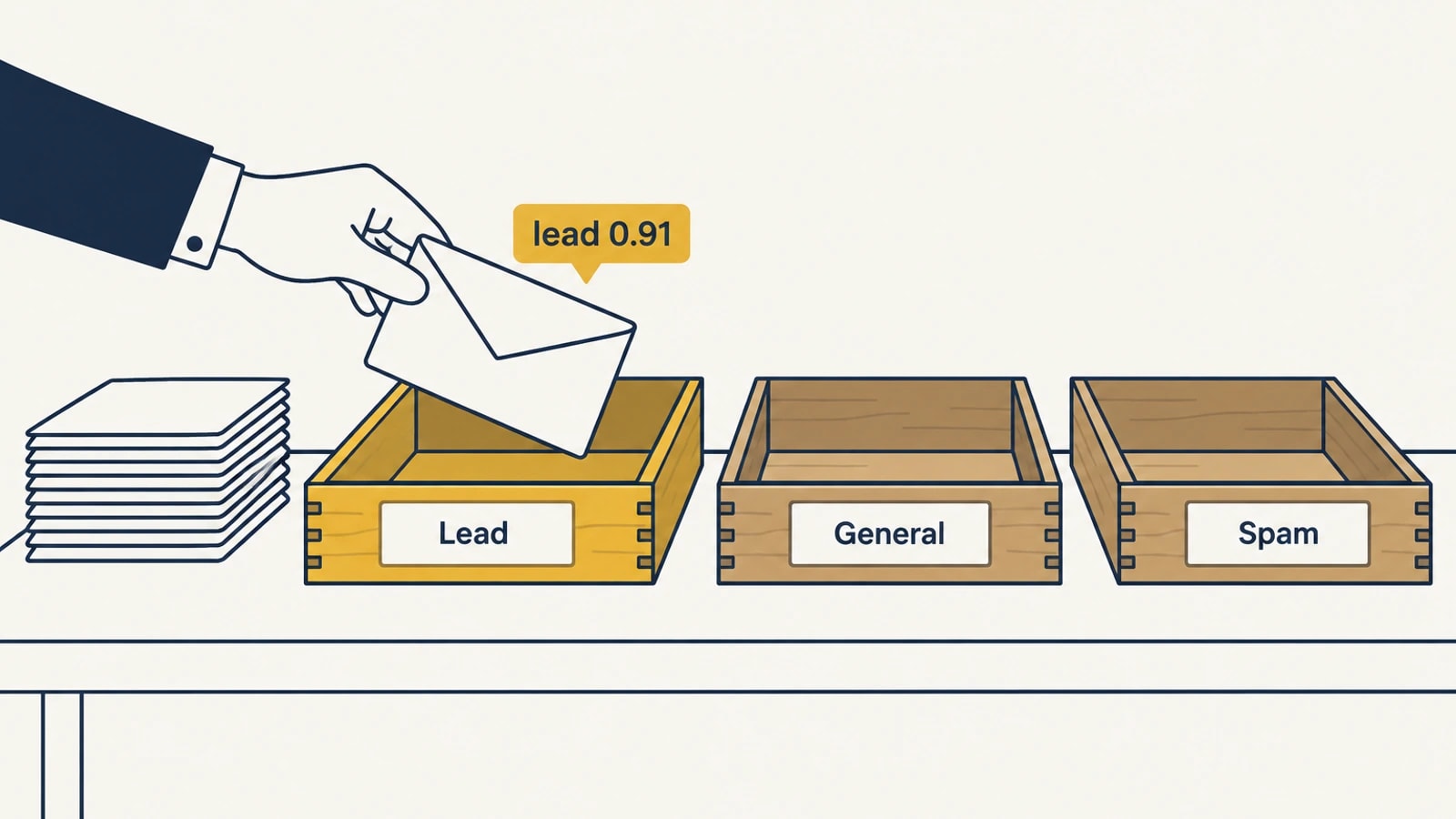
The same shape appears on almost every site we build. An estate agency site that must send a valuation request to the right branch. A clinic site that must tell a booking from a complaint. A contact form that must decide whether a submission is worth a person’s time. None of those needs a sentence. All of them are currently getting one, because a language model was the only tool on the desk. If you run an agency and your clients' sites need this decision layer, we build it under your agency's name as white-label AI.
Where it does not fit
Read the limitations page before the pricing page. As documented today:
- It cannot write. No summaries, no replies, no drafts. If the job ends in a sentence, it is not a Jev job.
- It cannot count or compare numbers reliably. “Is the total over $500?” is a question for your code, not for the model.
- It is poor with dates and indirection. Anything that requires reasoning from one fact to another is outside the design.
- It reads instructions literally. Criteria have to be explicit. “How urgent is this?” underperforms. “Urgent means the customer says something is broken now” works.
- Text only. No images, audio or video.
- State is capped. Roughly 64,000 tokens shared between state and questions, about 32,000 for one question plus its state. Fine for a message, not for a document set.
- Nothing about regions. As of 21 September the documentation says nothing about where inference runs or whether data stays in a region. For a client in Germany or the Netherlands that is a question to ask before a single ticket is sent.
None of these is a flaw. They are the shape of the tool. The failure mode to expect is not “Jev is bad”. It is someone asking it to do a language model’s job and then writing a post about how it hallucinated.
What to measure before you trust it
If you have a decision currently extracted from generated text, the test is short and you already have the data:
- Agreement. Run the last few hundred real inputs through both. How often does the typed answer match what your current system decided - and, more usefully, when they disagree, which one was right?
- Latency at the 95th percentile, not the median. The claim is sub-second. The number that matters is the slow tail on your traffic.
- Cost per thousand decisions, all in - including the language-model calls you no longer make because spam was filtered first.
- Behaviour on the ambiguous ones. The confidence field is the interesting part. A system that says
0.55on a message a human also cannot classify is worth more than one that says0.97on everything.
That is an afternoon of work with the SDK and a spreadsheet. It is also the only way to know, because nobody has published independent numbers yet and the ones in the launch post are TypeSafe’s.
The part that outlives the vendor
Whether Jev becomes the standard for this or gets absorbed by a larger lab in a year, one idea in the announcement is right and was right before it: generation and decision are different jobs, and most products run them through the same call. Half the language-model spend in a typical system is text that exists only so a decision can be parsed out of it. Look at your own prompts. Anywhere you asked for JSON, anywhere you asked the model to “also say whether”, anywhere a regex runs on the output - that is a decision wearing a sentence as a costume.
Separate them, and the choice of decision model becomes a one-line change. Leave them tangled, and no model - Jev or otherwise - will make the system faster, because the slow part is the shape.
Sources: TypeSafe’s announcement · the documentation · Flavio Copes’ walkthrough of the API, from which the request shapes above are taken. Every figure about Jev is TypeSafe’s own. Run the four checks above on your own data before production use.
Keep reading
Manoj Sethi
Founder, Boffin Coders
Manoj founded Boffin Coders in 2017 and leads its work with agencies: white-label builds, delivery and partnerships. Manoj writes about how agencies can add development capacity without losing control of their clients.
Frequently asked questions
Jev is a System One model from TypeSafe AI, announced on 15 September. You send it a piece of program state and a set of typed questions, and it answers all of them in one pass with values, not text: a choice with probabilities, a score, or a number between 0 and 1. By TypeSafe's own account it is in early access, with a waitlist.
Not answered here?
Need this built?
Hire dedicated AI engineers in India
US$25-40 an hour, or from US$4,000 a month for a dedicated developer. Shortlisted profiles within two working days; an engineer you choose starts within one to two weeks. They work in your tools, under your management.
How hiring AI engineers in India worksNeed this built?
We build websites and apps for businesses, and work behind digital agencies as their development team. Tell us where things stand on a 20-minute call.