School and exam software

Software for schools
and coaching centres

School management systems, parent apps, online exams and learning platforms, built in your own accounts. Your staff run it day to day without us, and you keep the code.

Admissions to report cardsExams marked on submissionRuns in your own accounts
Marked on submit
Runs on your server

2017

Shipping software since

Same owners, same team

Web + app

Staff workspace and parent app

Android and iOS, built by the same team

100%

IP ownership

Your repository and accounts from the first commit

1 day

Reply time

One working day, every enquiry

What slows schools down

Where education software usually fails

A school, a coaching centre and an EdTech team have different budgets and the same four problems. None of them is about the software being old. They are about the records not agreeing, the families not hearing, and someone else holding the data.

The office runs on registers and spreadsheets

Attendance in one book, fees in a ledger, timetables in a spreadsheet and notices in a chat group. None of them agree, and someone spends the end of every month making them.

Parents hear last

Homework, leave, fee reminders and holiday notices reach families through five channels, or not at all. Often the first a parent hears of a problem is the report card.

Practice is rationed by marking

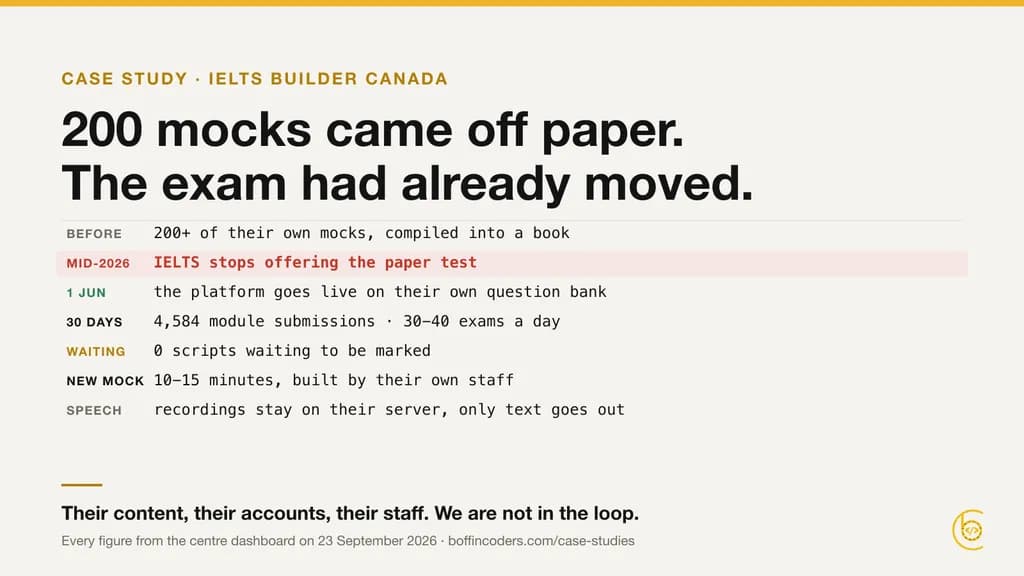
Every mock marked by hand means realistic practice happens when a teacher has time, not when a student needs it. And many exams now run on a computer, so paper practice no longer matches the real thing. One coaching institute moved 200 mocks off paper when theirs did.

Off-the-shelf software owns your data

A per-student licence, the vendor’s hosting and the vendor’s roadmap. A report in your own format waits for their next release, and student records and recordings sit on servers you cannot inspect.

What we build

Education software, built in your accounts

Four kinds of build for schools, coaching centres and EdTech teams. Where we have done it before, the paragraph links to the proof.

01

School management systems

Students, guardians and staff, classes and timetables, attendance and leave, fees and notices, kept in one record instead of five. Built as a web application in your own accounts, for a single school or for several branches under one head office. Moving off an older system first? That is a modernisation job and we plan the data move before anything else.

Tech Stack:
Node.jsTypeScriptReactMongoDBAWS
Key Features:
One record per student, from admission to exit
Timetables that catch teacher and room clashes
Attendance and leave in the same place
Fee structures, instalments and balances
Notices by school, class or student
Access scoped by branch, class and role
02

Parent and student apps

The part families actually use: one login per family, switch between children, and see the timetable, homework, notices and fee position from a phone. Built as mobile apps for Android and iOS, usually by Flutter developers or React Native developers working alongside the web team, so the app and the office system share one set of data.

Tech Stack:
FlutterReact NativeFirebaseNode.js
Key Features:
One family login, several children
Homework and notices per child
Leave applied for from the phone
Light and dark appearance
Push notices where the device allows
Published to both app stores in your name
03

Online exams and mock tests

Exams sat on screen in the format students will face, built on your own question bank. Objective sections are marked the moment a student submits, and written or spoken answers get feedback a teacher approves first. We run one for a coaching institute: 4,584 submissions in thirty days with nothing waiting to be marked.

Tech Stack:
Node.jsReactMongoDBRedis
Key Features:
Your own questions, not a vendor’s bank
Timed sections in the real exam format
Objective answers marked on submit
Teacher review before any grade is shown
A whole class sits by exam code
Every attempt kept for comparison
04

Learning platforms and apps

Courses, lessons, video and reading material organised by subject, with progress per student. For younger learners it is often an app first: we built Kokozi, an IoT learning platform, and BrightNest, a painting app for children. Student dashboards are their own design problem and we treat them as one.

Tech Stack:
Next.jsNode.jsFlutterAWS
Key Features:
Courses organised by subject and topic
Video and reading material together
Progress per student and per class
Designed for the age using it
Works on the devices a school has
Content your staff can update
Where AI sits

The model drafts. A teacher decides.

AI where it saves a teacher time, with a person between the model and the student every time.

A grade is not a thing to be confidently wrong about.

So the model never publishes one. It drafts feedback on written and spoken work, a teacher reads it, and where they disagree they correct it or replace it. The teacher reads a draft instead of starting from a blank page, which is where the time is saved, and the judgement stays with the person qualified to make it. It is the same rule we use anywhere a model does something that cannot be taken back: let it draft, never let it send.

Where students are recorded, the speech models can run on your own server, so a recording is never handed to an AI vendor. How that pipeline is built, and what it costs, is written up in full, and it is running today on a coaching institute’s exam platform.

Drafted feedback, published by a teacher

The model drafts feedback on written and spoken work. A teacher reads it, corrects it, and only then does a student see it.

Speech on your own server

Transcription and a practice voice can run on your own machine, so a student’s recording is never handed to an AI vendor.

Practice without booking a person

Spoken practice a student can do on a Tuesday evening, with a teacher reviewing the result the next morning.

A provider you can change

Which model does the work is a setting, not a rebuild. One that gets worse or dearer is swapped the same afternoon.

Course PilotBeta
Connected to: Physics_101.pdf
Can you explain the Doppler Effect formula? I'm confused about the variable signs.
Student • 10:42 AM
Analyzing Textbook Chapter 4...

Sure. According to the provided material, the observed frequency f' is calculated as:

f' = ((v ± vo) / (v ∓ vs)) f

Use + in the numerator if the observer moves towards the source.

Source: Physics_Vol2.pdf • Pg 142
Curriculum Ingested
Ready for Q&A
Proof

Education work you can read about

What we have built in this sector, where each piece stands today, and the full account of it.

Live with a client

A computer-delivered exam platform

Running for IELTS Builder Canada since June 2026. 4,584 submissions in the thirty days to 23 September, with nothing waiting to be marked.

Read the case study
Live with a client

How its speech pipeline keeps recordings

The same platform, written up for engineers: why the transcription runs on the institute’s own server and what that costs.

Read the write-up
Built, no school live yet

Our own school management product

Built in-house with a parent app for Android and iOS. Finished, and waiting for its first school.

How we work

Yours to run, and ours to be honest about

Four things that are true of every engagement here, each of which you can check by asking.

It runs in your accounts

The system runs on your hosting, with your content and your students, and your staff run it day to day without us. A school whose records live inside a vendor’s product has swapped one dependency for another. You keep the source code.

Student data stays where you put it

"Where do the recordings go?" should be answerable in one sentence by anyone holding them, and often it is not. Records sit in your own storage under your own access rules, and we follow the data protection law that applies where you operate.

Usable on the hardware students have

Built against WCAG 2.1 AA for keyboard and screen-reader use, and tested on the low-end machines and older phones a school and its families actually use.

We say what we have not built

We have not shipped an LTI integration, a SCORM wrapper, an xAPI Learning Record Store or AI proctoring. If one of those is a hard requirement, ask on the first call and we will tell you whether it is ours to build.

The stack

What it is built with

The technologies behind the exam platform. Not a list of integrations we have delivered.

Node.js
TypeScript
React
Next.js
MongoDB
Flutter
React Native
AWS
Whisper (self-hosted)
Before you call

Questions schools ask us

What schools, coaching centres and EdTech teams ask before they commission education software from us.

Yes. Students and guardians, staff, classes and timetables, attendance and leave, fees and notices, with a parent app for Android and iOS. We have built our own school management product in-house, so the hard parts, such as timetable clashes, leave that updates attendance, and parents with children at different branches, are already worked out rather than discovered on your project.

What it costs

Published, not quoted on the call

These are floors rather than averages, in USD. Nothing is quoted outside them, and if the number does not work for you, you have saved yourself a meeting.

An education build starts at
$5,000
Scoped once, with the lines shown.
Short pieces of work
$25-49 an hour
By seniority and the work.
A developer by the month
$4,000 a month
Month to month after the first three.
Agency sprint
$2,400 per two-week sprint
Under your brand, fixed before we start.

Every price on one page →

Bring in the team

Hire developers for your education project

Whether it is a school management build, a parent app or an exam platform, you can take the whole project or hire the people and run it yourself. They work in your tools, under your management, at the rate published on this site.

$25-49 an hour, or $4,000 a month for a dedicated developer. Shortlisted profiles within two working days, and whoever you pick starts within one to two weeks.

Running a school or a coaching centre?

Twenty minutes with the person who would build it. You will get a straight answer on what is running today, what is built and waiting, and what would be a build.