Link Building for Agencies: Which Links Are Safe to Resell?
- November 23, 2026
- 8 min read

SEO and AI Search Specialist
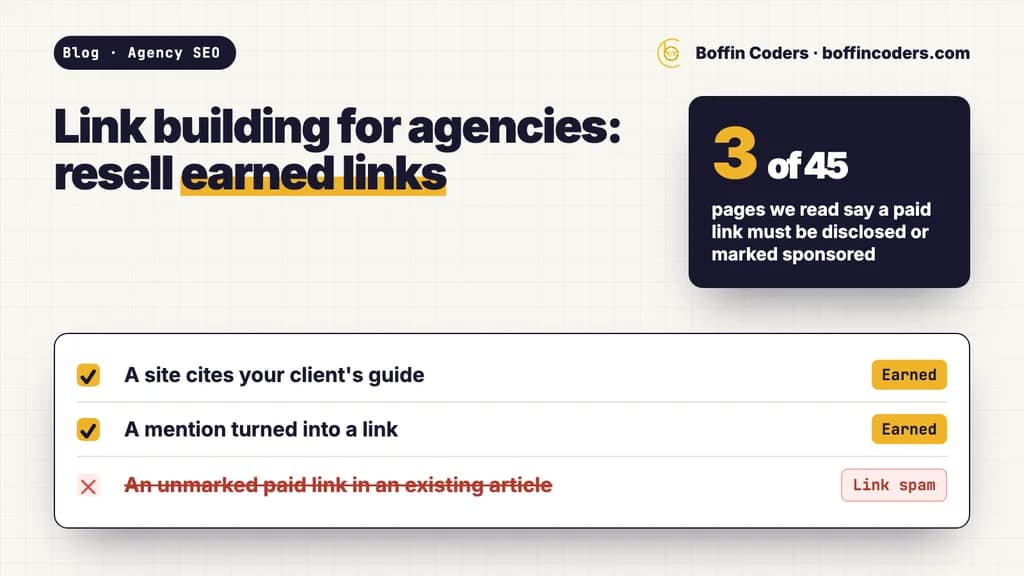
Link building for agencies is safe to resell when each link is earned: another site linked to your client's page because it is worth citing, and nobody paid for it. Google's spam policies treat links bought for ranking as link spam, and that covers paid guest posts and paid links added to existing articles. A paid link is allowed only when it carries rel="sponsored" or rel="nofollow". Before a partner's links go out under your brand, ask how each was won and check them yourself.
On 20 Nov 2026 we opened the 45 pages that loaded from Google's top 20 for "link building for agencies" in the US and the UK and for "white label link building" in the US. 39 of them mention guest posts, 35 mention a domain score such as DR or DA, 25 mention links placed in articles that already exist, and 12 put a price on links. Only 3 say that a paid link has to be disclosed or marked as sponsored. Ten mention unlinked mentions, where a site already names a business and only the link is missing.
What does link building for agencies include?
Link building for agencies is the work of getting other sites to link to a client's pages, done by the agency or by a partner working under the agency's name. It means finding sites that already write about the client's subject, giving them a page worth citing, asking for a link where the business is mentioned without one, and checking every link once it is live. The agency keeps the client, the plan and the report.
Your agency keeps | A link building partner does |
|---|---|
The client, and every message the client receives | Lists of sites that write about the client's subject |
The plan: which pages need links and why | Pages on the client's site worth citing, such as a guide or a data page |
The price and the report the client sees | Outreach to editors and site owners, and follow-up on unlinked mentions |
The client's Search Console and analytics access | A monthly list of every live link, with its page, anchor and date |
Link work is one part of a wider choice about which search work to hand to a partner, covered in the guide on SEO outsourcing.
Which links break Google's rules, and which are allowed?
Google's spam policies call it link spam when links are made mainly to change search rankings. The first example is buying or selling links for ranking: paying for a link or for a post that contains one, swapping goods or services for links, sending a product in return for a review with a link, excessive link exchanges and links made by automated programs. The same policy says paid links are allowed when they are marked with rel="sponsored" or rel="nofollow".
The link | How it was won | What Google's spam policy says |
|---|---|---|
A site cites your client's guide or data without being asked | Earned | Allowed |
A site that already names the business adds a link when asked | Earned | Allowed |
A paid guest post whose link passes ranking credit | Bought | Link spam |
A link added to an existing article for a fee | Bought | Link spam, unless the link is marked as paid |
A paid placement marked | Bought and disclosed | Allowed |
Guest posts or press releases with keyword-rich links, spread across other sites | Placed in volume | Link spam |
Excessive "link to me and I'll link to you" swaps | Swapped | Link spam |
Low-quality directory or bookmark site links | Submitted | Link spam |
A guest post is not banned in itself. The policy names guest posts where payment is received for links that pass ranking credit, and keyword-rich links in guest posts or press releases distributed on other sites. Read the full link spam section of Google's spam policies before you sign with any partner, and keep Google's page on how to mark paid links to hand for your clients' own sites.
What do white label link building services sell?
White label link building services build links for an agency's clients and let the agency resell the work under its own brand. The pages we read describe the product mostly as placements: guest posts on 39 of the 45 pages and links in existing articles on 25, often graded by a domain score. Unlinked mentions, the plainest earned link, come up on 10.
A price per link pays for placements, so it rewards a supplier for links that can be delivered on demand. A link added on demand for a fee is what Google's policy describes, unless it is marked as paid. So ask any provider how a link gets onto the page. A domain score is a third-party estimate and says nothing about whether the link was paid for.
If you are working out what to charge for search work you resell, the guide on white label SEO pricing covers what agencies pay and charge.
How do you check a white label link building partner before you resell it?
Check a white label link building partner on its recent live links. Ask for a sample, open every linking page, read the link's code, and get in writing whether any link was paid for. Then confirm the links in the client's own Search Console.
- Ask for recent live links and how each was won. For every link you want the page it sits on, the page it points to, the anchor text and the reason the site linked: it mentioned the business, it keeps a list of resources, or it cited the client's data. "It was placed" is not a reason.
- Open every linking page. Check that it is a real site with its own readers and subject, and that the link sits inside text that makes sense. To see whether Google has the page indexed, search for its address with
site:, for examplesite:example.com/page. - Read the link's code. Open the page source and find the link. A paid placement should show
rel="sponsored"orrel="nofollow". A link with neither, on a site that sells placements, is the kind the policy names. - Get the payment answer in writing. Put a clause in your contract with the partner that says whether money, a product or a service changed hands for any link.
- Agree who approves new sites. Decide whether new link sources come to you before outreach starts, so nothing appears on a site your client would object to.
- Confirm the links in Search Console. The Links report shows the top linking sites, top linked pages and top linking text. It is a sample, and each table stops at 1,000 rows, so use it to confirm that the partner's links appear. It will not give you a full count.
What should a monthly link report show your client?
A monthly link report should list every live link with the page it sits on, the client page it points to, its anchor text, the date it was found live, how it was earned and its rel value, plus any link lost since the last report. Your client can then open each one and see the work for themselves.
Column | What it shows your client |
|---|---|
Linking page | The address they can open to see the link |
Target page | Which of their pages gained the link |
Anchor text | Whether the link reads naturally in its sentence |
Date found live | That the link belongs to the month being reported |
How it was earned | A mention, a resource list or cited data |
| That nothing paid is passing as earned |
Add the work behind the links as well: pages created to be cited, sites contacted and mentions followed up. In a slow month, that part of the report shows the client what was done.
For our white label SEO work, we send the agency each month's results as a spreadsheet, and the agency writes the report for its client under its own brand. We never contact the agency's client unless the agency asks.
What can an agency promise a client from earned links?
Promise the work behind the links. Earned links depend on what other sites decide to publish, so a fixed number of links a month or a target domain score pushes a supplier towards placements that can be bought. You can promise the pages built to be cited, the sites contacted, the mentions followed up, and a report of every link that appears.
Our own SEO work earns links that way: we make pages worth citing and ask the sites that already mention a business to link to it, and we do not buy links, rent them from private blog networks or trade them. It takes longer than buying placements. In return, every link in the report is one the client can show to anyone, including Google.
What if a client already has paid or spammy links?
If the client's Search Console shows the manual action "Unnatural links to your site", Google's manual actions help sets out the clean-up. Download the client's links from Search Console, check them against the link spam policy starting with the sites that link most and the links from recent months, and ask each site owner to remove the link or mark it with rel="nofollow" or a more specific value.
Only links you could not get removed go into the disavow file. Google warns that disavowing every backlink without trying to remove them first is not a good-faith effort and can lead to the request being rejected, and that organic links should never be disavowed. Then select Request Review in the Manual Actions report, with notes on what was removed and what could not be.
If you would rather hand the outreach, the checks and the monthly spreadsheet to a partner who earns links and never buys them, our white label SEO runs under your brand, and you see each month's work before you pay.
Keep reading
Santosh Kumari
SEO and AI Search Specialist
Santosh Kumari works on technical SEO and AI search visibility, from site fixes to the structured data and page formats that AI answers quote. Santosh Kumari writes about practical changes that help search engines and AI understand a page.
Frequently asked questions
White label link building is safe for your clients when every link is earned, or when a paid link carries the sponsored or nofollow attribute. Ask the partner how each link was won, open every linking page, read the link's code and confirm the links in the client's Search Console before the first report goes out under your brand.
Not answered here?
Need this built?
We build websites and apps for businesses, and work behind digital agencies as their development team. Tell us where things stand on a 20-minute call.