Five questions to ask before you hire a dedicated developer
- September 21, 2026
- 6 min read
Founder, Boffin Coders
Picture Tom, who runs a small agency in Manchester. He has more client work than his two developers can take, so he asks three Indian agencies for a dedicated developer. Three proposals arrive. All three say dedicated developers, flexible engagement models, seamless integration with your team. All three quote a rate. He cannot tell them apart, and he is about to choose the cheapest.
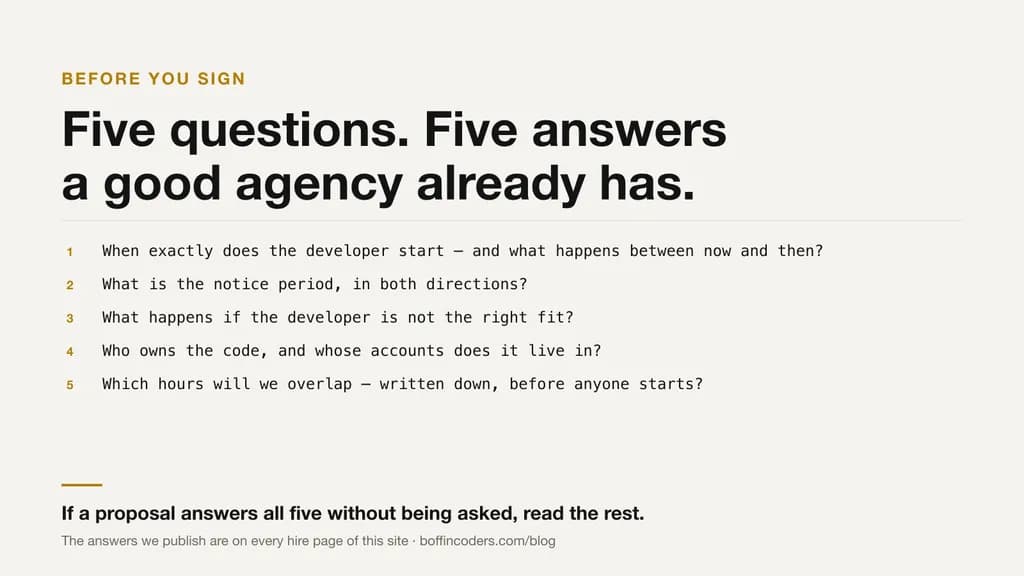
Before you hire a dedicated developer, ask for five answers in writing. When do profiles, interviews and the first commit happen? What is the notice period, in both directions? What happens if the developer is not the right fit? Who owns the code and the accounts it lives in? Which hours will you overlap? Then ask for the hourly band and the monthly figure. A good agency has already published all six. A proposal that cannot answer them is not cheaper. It is quieter about the cost.
Tom should ask those five questions before he chooses. A good agency answers all five without being asked, usually on its own website. (If what Tom wants is finished work delivered under his own agency’s name, that is a different contract: white-label development.)
1. When exactly does the developer start - and what happens between now and then?
“Start in 48 hours” sounds good and means almost nothing, because three different things are being timed and the proposal does not say which.
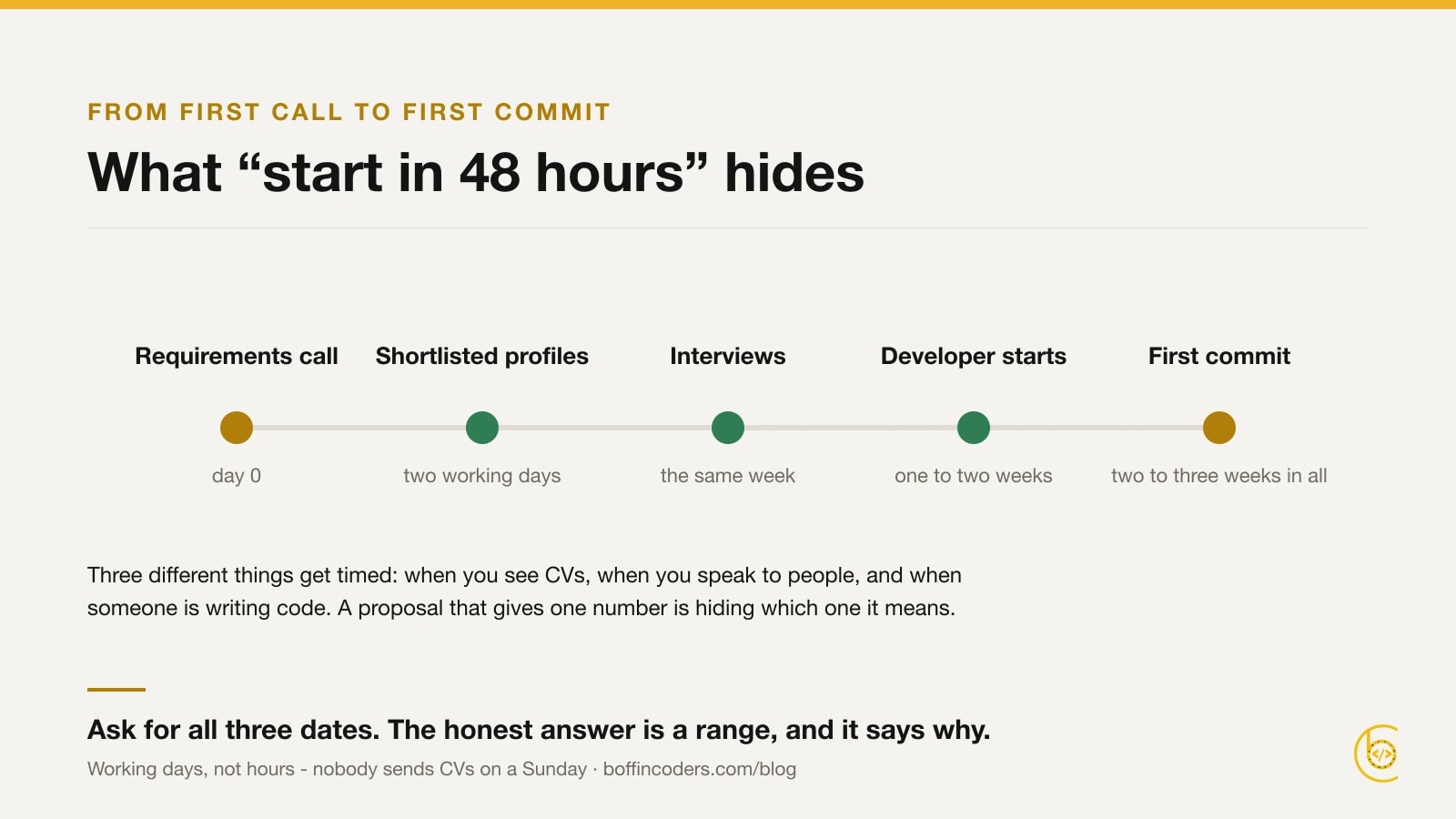
The honest answer is three dates. Profiles - when you see CVs - is typically two working days after the requirements call. Interviews - when you speak to real people - the same week, assuming you can make the time. Start - when someone is writing code in your repository - one to two weeks after you choose, depending on whether the person is free now or finishing another project. End to end, two to three weeks from the first call to the first commit.
Notice the range on the last one, and the reason next to it. An agency that promises a same-week start for every role either has developers sitting idle - which you are paying for - or is guessing. The range is what makes the number believable.
2. What is the notice period, in both directions?
Tom’s worry is the developer leaving mid-project. The agency’s worry is Tom leaving mid-month. The fair answer covers both: monthly, with a month’s notice either way, and no minimum term beyond that.
Read the proposal for the words minimum commitment. Three months, six months, twelve. There is nothing wrong with a long engagement - most good ones run for years - but a long minimum means the agency is not confident you will stay by choice. If it is not working, one month should be all it costs you to stop.
3. What happens if the developer is not the right fit?
It happens. A good developer on paper is the wrong developer for your team, or the person leaves the agency, or the chemistry is off. The answer you want is short: tell us early and we will replace them, from our own team, at our cost.
Two words matter there. Our own team - not a freelancer found the same afternoon, because then you are onboarding a stranger again. And early - a replacement in week two costs you a week. A replacement in month four costs you a quarter. A short notice period in both directions is what makes this promise real: the agency has no reason to keep a bad fit in place.
4. Who owns the code, and whose accounts does it live in?
This is the question most people forget and most regret. The answer should be: yours, from the first commit. Your repository, your hosting account, your domain, your app store account, with the developer added as a collaborator. Not the agency’s repository “handed over at the end”.
Why it matters: an agency that holds your code holds the relationship. Leaving becomes a migration. Everything you built lives in someone else’s account and you find out how much that matters on the day you disagree about an invoice. If the proposal is vague here, ask directly, and ask for it in writing. There is a full list of who should own each account if you want to check yours one by one.
5. Which hours will we overlap - written down, before anyone starts?
India is four and a half hours ahead of London, about nine and a half ahead of New York, and about four and a half behind Sydney - the exact gap moves with daylight saving. Overlap is possible with all of them. What is not acceptable is finding out in week three that “flexible timezone” meant the developer answers at 2 p.m. your time and logs off at 3.
The good answer is specific: we agree the overlap hours before anyone starts and put them in the agreement. A few hours of shared working day is normal for UK and European clients. A morning for Australia. Ask for the number, not the adjective.
The bonus question: what does it cost, in writing?
An hourly rate with no monthly figure lets the invoice float. A monthly figure with no hours does the same in reverse. The clear answer has both: a band per hour and a fixed monthly figure for a full-time developer, published, not quoted. On this site both are published for every stack, set by seniority: from US$12-25 an hour for WordPress work to US$25-40 an hour for AI engineers, and a React developer, for example, from US$3,000 a month dedicated. The reason it is on a public page rather than in a PDF is so that Tom can compare before a sales call, not after.
What a weak proposal looks like
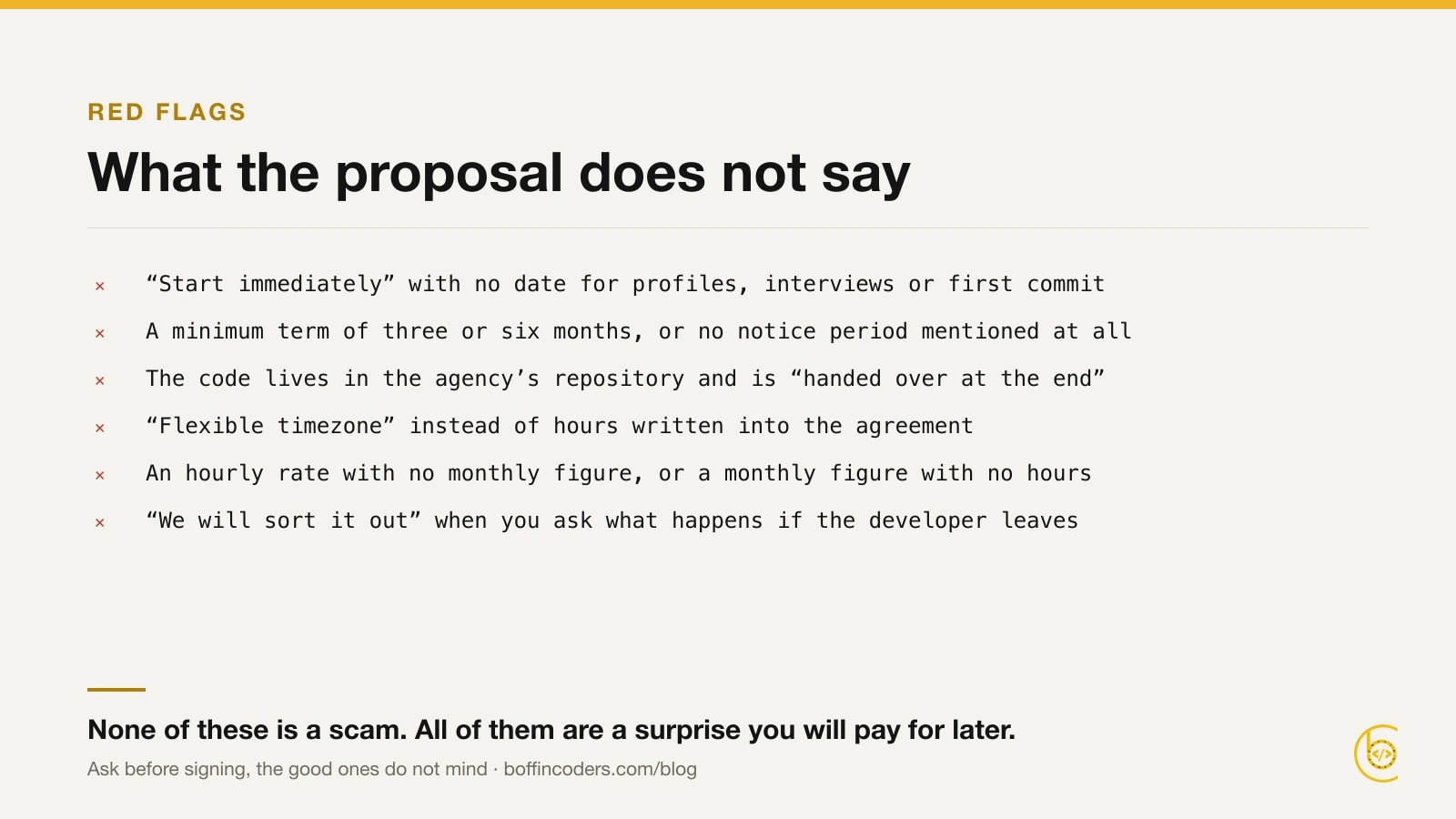
- No start date.
- No notice period.
- Code in the agency’s repository.
- Overlap hours not in writing.
- A rate with no monthly figure.
- A replacement policy that is not written down.
None of these is dishonest. All of them are a surprise you will pay for later - a term you did not expect, a repository you do not control, an overlap that never existed. Ask before signing. The good agencies do not mind, because they have already written the answers down.
Tom asked all five. One agency answered from its website before he finished typing. One needed a call to “clarify the engagement model”. One quoted a three-month minimum and a repository it owned. He did not choose the cheapest. He chose the one whose answers were the same as its web page, which is the only test that works from four thousand miles away. If you want to run the same test on us, every answer above is on our dedicated development team page, in writing.
Keep reading
Manoj Sethi
Founder, Boffin Coders
Manoj founded Boffin Coders in 2017 and leads its work with agencies: white-label builds, delivery and partnerships. Manoj writes about how agencies can add development capacity without losing control of their clients.
Frequently asked questions
The questions to ask before hiring a dedicated developer are five: when profiles, interviews and the first commit happen, what the notice period is in both directions, what happens if the developer is not the right fit, who owns the code and the accounts, and which hours you will overlap. Then ask for the hourly band and the monthly figure, both in writing.
Not answered here?
Need this built?
Hire dedicated React developers in India
US$18-35 an hour, or from US$3,000 a month for a dedicated developer. Shortlisted profiles within two working days; a developer you choose starts within one to two weeks. They work in your tools, under your management.
How hiring React developers in India worksNeed this built?
We build websites and apps for businesses, and work behind digital agencies as their development team. Tell us where things stand on a 20-minute call.