Time and Material Contract or Fixed Price: Which Fits Your Project?
- November 22, 2026
- 9 min read

Co-Founder, Boffin Coders
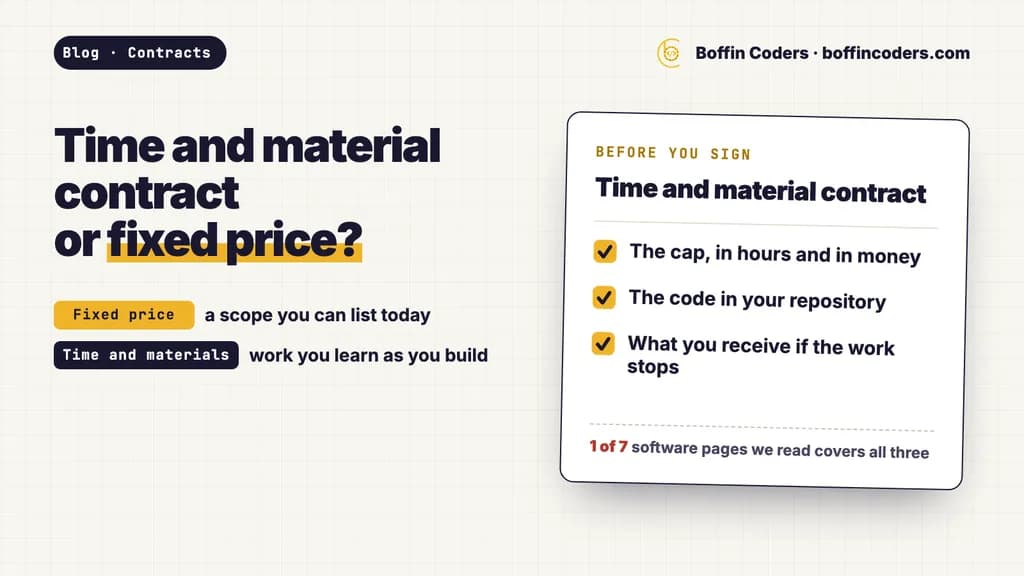
A time and material contract pays your developers for the hours they work, at rates agreed in advance, up to a cap you set. A fixed price contract sets one figure for a written scope before work starts. Fixed price fits a website or app whose pages, features and integrations you can list today. Time and materials fits work you will understand better as it is built: a first version, an integration nobody has tried, or a product that keeps changing after launch. Many projects use both in turn.
On 20 Nov 2026 we read the 27 pages that would open from Google's US top 20 for "time and material contract" and "time and materials vs fixed price". Seven were written by software or IT firms for people buying a build. The other 20 were about construction, contract templates, government contracting and project or time-tracking tools. Of the seven, four mention a cap on billed hours, two say who owns the code, and two say what happens if the work stops halfway. One page covers all three. Those three clauses are where a contract for a website or app differs most from a building contract, so this guide gives them their own section.
What is a time and material contract?
A time and material contract (also written time and materials, or T&M) has three parts. You agree a rate for each role, such as a developer, a designer or a project manager, by the hour, the day or the month. The supplier keeps a record of the time each person spends, and you are billed against that record. And anything bought for the project, the materials, is passed on at cost.
In a website or app project the materials are rarely physical. They are the domain and hosting, paid plugins and theme licences, stock images, map or email services, and the app store developer accounts. Ask for each of these to be bought in your name and on your card, so nothing has to be transferred later. The guide on who should own your software accounts covers the ones that cause the most trouble.
You pay for the work that was done. If it takes fewer hours than the estimate, you pay less. If it takes more, you pay more, up to the cap. You carry the risk of the estimate, and in return you can change direction during the build without renegotiating the contract.
Time and materials vs fixed price: what changes for you?
Time and materials vs fixed price comes down to who carries the risk of a wrong estimate. Under fixed price the supplier carries it and prices it into the quote. Under time and materials you carry it, and you get the freedom to change the plan as you learn. Most of the differences you will notice day to day follow from that.
Fixed price | Time and materials | |
|---|---|---|
What you agree before work starts | A written scope, a price and milestones | Rates by role, a cap and how hours are reported |
Who carries the risk of a wrong estimate | The supplier, who adds a margin for it to the price | You, up to the cap |
A change of plan | A change request, priced and approved before work on it starts | A new priority on the list, billed as hours like the rest |
What you check each month | Milestones delivered against the scope | Hours by person and task, against the cap |
What it needs from you | Time before the start to write the scope | Someone who sets priorities every week or two |
Fits best | A site or app you can describe page by page today | A first version, a new integration, or a product that keeps changing |
Pick by how well you can describe the work today. If you can write down every page, every feature and every system it connects to, fixed price gives you one number to plan around. If you cannot, a fixed quote will either carry a large margin for the unknowns or turn into a long list of change requests once the build starts.
When does a fixed price contract for software development fit?
A fixed price contract for software development fits when the scope is written, stable and testable: every page or screen listed, every integration named, and a plain test for when each part is done. A brochure website, the rebuild of an app that already exists, or a second phase whose designs you have signed off all qualify. Without that, the supplier is pricing guesses.
A scope that can carry a fixed price names:
- the pages or screens, with what each one does
- every system it connects to, such as payments, booking, a CRM or email, and who provides the access
- the content, who writes it and who loads it
- what "done" means for each milestone, in terms you can test yourself
- what is out of scope, in writing
Changes after signing go through a change request. The supplier prices the change, you approve it, and only then does work on it start. Ask to see a real change request from a past project before you sign, because it shows how the supplier behaves once the price is fixed.
Suppliers add a margin for the unknowns to a fixed price. The clearer your scope, the smaller the part of that margin you pay for.
How do you work out a time and materials budget?
Work out a time and materials budget in hours first, then turn it into money. List the work, ask the supplier for the hours each item needs by role, multiply by each role's rate and add the materials. Then set the cap: the estimate plus a margin you choose for what the list missed. Ask for hours to be reported against the same list, so you can see early which items run over.
An example for a small website with a booking system, with invented hours:
Item on the list | Estimated hours |
|---|---|
Design of six page templates | 40 |
Build of the templates and the content editor | 90 |
Booking system integration | 30 |
Testing and launch | 20 |
Estimate | 180 |
Margin for what the list missed, 20% | 36 |
Cap | 216 |
Multiply 180 and 216 by the rate in your quote and you have the expected cost and the most you can be billed without signing again. The 20% is only an example. A build the supplier has done many times needs less, and a first integration with a system nobody on the team knows needs more.
Two figures in each report tell you where you stand: hours used against the cap, and items finished against the list. If half the hours are gone and a third of the items are done, you find out in the middle of the project, while there is still time to cut or reorder the list.
What should a time and material contract say about the cap, the code and stopping?
A time and material contract for a website or app should say, in plain words, what the cap is and who can approve going past it, who owns the code from the first commit, what you receive if either side stops the work, and how hours are reported. Five of the seven software pages we read mention one of the first three at most, and those are the clauses that decide what happens when the work runs over or stops.
- Write the cap in hours and in money. State the cap as a number of hours and the amount it comes to. Going past it should need your written approval before the extra hours are worked.
- Keep the code in your repository. The code should sit in a repository you own from the first commit, with the supplier added as a collaborator. If it lives in the supplier's account, ownership becomes a negotiation at the end.
- Say how it ends. Set the notice period for either side and list what you receive on the last day: the code, the credentials, the documentation and a handover call. Our own monthly work runs on a month's notice either way.
- Ask for hours by task. A weekly or fortnightly report should show hours by person and by item on the list, so you can match it to work you can see.
- Pass materials through at cost, in your name. Licences, hosting and paid services should be bought in your accounts. If the supplier buys one for you, the invoice should carry the receipt.
The same clauses matter under fixed price, with one change: the cap becomes the price, and the hours report becomes the milestone review.
Fixed price vs time and materials: which costs less in the end?
Fixed price vs time and materials has no permanent winner on cost. Fixed price costs more when the scope was clear all along, because you pay the supplier's margin for risks that never happened. Time and materials costs more when nobody manages the list, because hours keep going to work that was never needed. With a clear scope, fixed price is easier to manage. With a moving scope, capped time and materials avoids paying both a margin and a stack of change requests.
Count your own time as well. Fixed price asks for days at the start to write the scope and an hour or two for each change request. Time and materials asks for a regular slot every week or two to set priorities and read the report. Neither model runs well without someone on your side who owns the decisions.
If you are also deciding who directs the day-to-day work, the guide on staff augmentation vs outsourcing covers that choice.
Can you combine fixed price and time and materials on one project?
You can, and many website and app projects do. One common pattern is a fixed price for the first version you can describe, followed by time and materials for everything that comes after launch, when real users start asking for changes. Another is a short, fixed-price discovery phase that produces the written scope, followed by a fixed-price build against it. Either way, each stage gets the contract that matches how much you know at that point.
We sell both and say on the first call which one fits the work. A fixed-price project with us starts at US$4,000 for a written scope, is delivered in milestones, and each milestone is invoiced after you have seen the work. Work that keeps changing runs by the hour at the published US$18-38 an hour for web applications, or with a developer by the month from US$3,000, on a month's notice either way with no minimum term. If the work after launch keeps changing from week to week, a dedicated software development team billed by the month is the version of time and materials built for it.
Keep reading
Jyoti
Co-Founder, Boffin Coders
Jyoti co-founded Boffin Coders and looks after client relationships and how projects run from first call to handover. Jyoti writes about hiring, process and what makes a development partnership work.
Frequently asked questions
T&M in a contract means time and materials. You pay for the hours people work, at rates agreed before the work starts, plus the cost of anything bought for the project, such as licences or hosting. Most time and materials contracts also set a cap, so the total cannot pass an agreed figure without your written approval.
Not answered here?
Need this built?
We build websites and apps for businesses, and work behind digital agencies as their development team. Tell us where things stand on a 20-minute call.