Staff Augmentation vs Outsourcing: Which Should Your Agency Use?
- October 27, 2026
- 8 min read

Co-Founder, Boffin Coders
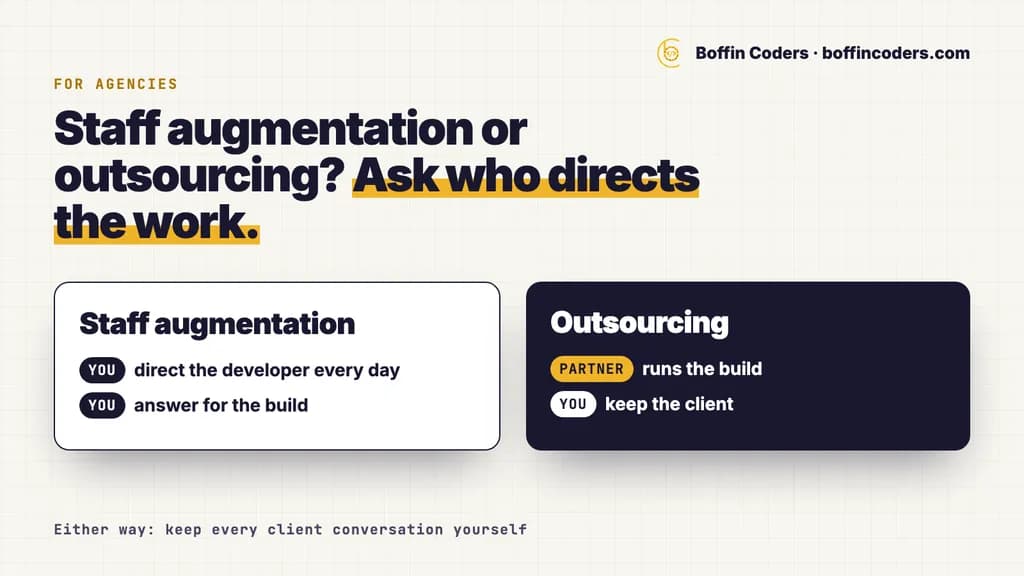
Staff augmentation adds a developer to your agency's own team: you direct their work every day, and the delivery risk stays with you. Outsourcing hands a whole piece of work to a partner who runs the build and answers for the result, while you keep the client. Choose staff augmentation when you have a technical lead with spare hours and a steady flow of work. Choose outsourcing when the gap is a whole project, a stack nobody on your team runs, or a lead who is already full.
Search the question and you get answers written for a company buying help for itself. We read the US first page for it on 25 October 2026. Of the nine ordinary results we could open seven, and none of the seven mentions white-label work or reselling. For an agency, the client it keeps is the part that decides the answer.
What is staff augmentation, and is it a kind of outsourcing?
Staff augmentation is a way to add developers to your team without hiring them. A provider employs the developer, and the developer works only on your projects, in your tools, under your direction. You pay by the month and stop when the work stops.
It is a kind of outsourcing in the narrow sense: someone outside your payroll does the work. The difference is what you hand over. With augmentation you buy a person's time and keep the management. With project outsourcing you buy a result and hand over the management of the build. Most comparisons call the second one simply "outsourcing", and agencies usually call it white-label development, because the work goes out under the agency's name.
Staff augmentation vs outsourcing: how do they compare for an agency?
The two models differ less on price than on who does the managing. This table sets them side by side for an agency that sells the work to its own client.
Question | Staff augmentation | Outsourcing (white-label) |
|---|---|---|
Who directs the work day to day? | Your project manager or tech lead | The partner's lead, against your brief |
Who reviews the code? | Your team | The partner first, then you before your client sees it |
Who answers for a late or broken build? | You | The partner, to you |
Who talks to your client? | You, with the developer in your calls if you choose | Only you |
How do you pay? | Per developer, per month | Per project, per sprint or per month |
When does the cost stop? | At the end of the notice period | When the scope or sprint ends |
What must you have in-house? | Someone who can lead developers and read their code | Someone who can write a brief and judge the result |
What suits it best? | A steady pipeline in a stack you already run | A whole project, a new stack, or a peak that will pass |
Neither model removes your own review. In both, your name is on the work, so somebody at your agency has to look at it before your client does.
When does staff augmentation suit an agency?
Staff augmentation suits an agency with a steady pipeline and a technical lead who has hours to spare. The developer joins your standups, your board and your repository. Your lead sets the tasks, answers questions and reviews every pull request, and the developer works the way your team already works.
It works best when:
- the work is in a stack your team already runs, so your lead can review it properly
- there is enough work to keep a developer busy for months, not weeks
- your client work changes daily and needs someone who can be redirected at short notice
- you want the developer to learn your clients' sites and stay on them
What does an augmented developer need from you?
An augmented developer needs a lead, a backlog and access. Plan for daily time from your lead in the first weeks, written tickets the developer can pick up without a call, and logins to your repository, staging and project board on day one. If your lead is already the bottleneck, an extra developer adds to their load before it takes anything off it.
When does outsourcing suit an agency better?
Outsourcing suits an agency when the gap is bigger than one pair of hands. A full website build, a web application, an app, or a stack your team has not used are all easier to hand over whole than to manage piece by piece. The partner plans the work, runs the developers and tests the build, and you check it against the brief.
It is also the better fit when the work comes in waves. A launch season or a large pitch needs capacity for a few months, and a project or a run of sprints stops costing anything the day it ends.
Is staff augmentation vs project outsourcing riskier for the client relationship?
The risk to the client relationship depends on the contract more than the model. With staff augmentation vs project outsourcing, the developer or the partner can in theory reach your client either way. Keep every client conversation yourself, sign a mutual confidentiality agreement and a non-circumvention clause before you name the client, and keep the code in your repository or your client's from the first commit. A partner that works this way never needs to speak to your client. Our questions to ask a white-label partner cover the rest of that check.
What about staff augmentation vs managed services?
Staff augmentation vs managed services is a choice about outcomes. With managed services a provider takes ongoing responsibility for an area, such as keeping all your clients' WordPress sites updated, backed up and patched, and you pay for that service level each month. You do not direct the people who do it.
For agencies, managed services suit routine work that repeats across many client sites. Augmentation suits work that changes every week and needs your judgement. Project outsourcing sits between them: a defined result, delivered once.
Which model fits which kind of agency work?
The same agency often needs a different model for each line of work. Sort your next quarter's jobs by how defined they are and how long they run, then match each one:
Agency work | Usual fit | Why |
|---|---|---|
A new website from an approved design | Outsourcing, by project or sprint | The scope is written down and the work ends at launch |
A web application whose scope keeps moving | Outsourcing, by sprint | Each sprint has its own written scope, so changes go into the next one |
Daily changes across one large client's site | Staff augmentation | Someone has to learn the site and be redirected every morning |
Updates, backups and patches across many client sites | Managed services | The same routine repeats, and you want a service level, not a person |
A stack your team has never used | Outsourcing | Your lead cannot review work in a stack they do not know |
A steady flow of builds in your own stack | Staff augmentation | Your lead already reviews this work, so one more developer fits in |
If most of your list lands in one column, start there. If it splits, price each column with the table below.
How do you work out which one costs less?
Compare the full cost of a month of output, not two day rates. An augmented developer's monthly price leaves out your lead's time, and an outsourced sprint price already includes the partner's management. Put your own figures into this table for the same piece of work:
Cost line | Staff augmentation | Outsourcing |
|---|---|---|
Price paid to the provider | Monthly price x months | Sprint or project price |
Your lead's time | Hours a week directing and reviewing x your hourly cost | Hours a week reviewing x your hourly cost |
Quiet weeks | Weeks with no work x the weekly price | None, if you buy by the sprint |
Rework you catch late | Your team fixes it | The partner fixes it within the sprint |
Two figures decide most comparisons: how many hours a week your lead spends on an augmented developer, and how many weeks in a quarter that developer would sit idle. If your lead spends a day a week directing them, add a fifth of your lead's cost to the augmentation column before you compare.
Outsourcing vs staff augmentation: which is cheaper per hour?
On price per hour, outsourcing vs staff augmentation often looks like a win for augmentation, because a monthly developer costs less per hour than a managed sprint. The hour price hides the management. Once your lead's hours and the quiet weeks are counted, outsourcing is often cheaper for one-off projects, and augmentation is often cheaper for steady work that your lead would review anyway.
Can an agency use both?
You do not have to pick one model for good. A common path is to outsource one small, well-defined piece first, review it, and move to a dedicated developer once the partner's code and habits are known. The first piece tests the partner. The monthly developer then adds capacity your lead already trusts.
At Boffin Coders both models run the same way. The developers are our own employees in Mohali, and we do not subcontract. For IT staff augmentation services, you interview the developer first, they work only on your projects in your repository under your direction, and you pay monthly with a month's notice either way and no minimum term. A dedicated software development team is the same arrangement with more than one person. For white-label work, agency sprints are US$2,000 per two-week sprint, built in your repository and invoiced after you have seen the work. Two of our clients have paid every month since 2017.
If you would rather hand your next project to a team that works under your brand, start with our page for agencies looking for a white label development partner.
Keep reading
Jyoti
Co-Founder, Boffin Coders
Jyoti co-founded Boffin Coders and looks after client relationships and how projects run from first call to handover. Jyoti writes about hiring, process and what makes a development partnership work.
Frequently asked questions
The difference between staff augmentation and outsourcing is who manages the work. With staff augmentation a provider's developer joins your team and you direct them every day, so the delivery risk stays with you. With outsourcing a partner runs a whole project or sprint, manages the build and answers to you for the result, while you keep the client.
Not answered here?
Need this built?
We build websites and apps for businesses, and work behind digital agencies as their development team. Tell us where things stand on a 20-minute call.